

Frequency, Not Dose: Long Term Kratom Risk and Lab Tested Transparency
6 September 2026

Long-term kratom use commonly produces physical dependence and withdrawal, and that outcome shows up far more often than serious organ damage in the available research. Rare but documented harms, including liver injury, cardiac rhythm changes, and seizures, cluster around high-frequency dosing, concentrated extracts, or products mixed with other substances. Most of what follows applies to daily or near-daily users. If you notice red-flag symptoms discussed below, treat them as a reason to seek medical care, not a reason to panic.
TL;DR:
- Long-term kratom use primarily causes dependence and withdrawal symptoms, with dependence markers forming faster with increased dosing frequency rather than dose size.
- Serious organ damage from long-term use is rare, but high doses and contaminated products increase risks of liver injury, cardiac issues, seizures, and kidney disturbances.
- Using concentrated extracts and multiple daily doses significantly raises the likelihood of tolerance, dependence, and adverse events compared to whole-leaf powder and lower frequency use.
- Dependence and withdrawal symptoms typically start within 1 to 12 hours after stopping, resolving in about three days, but severe symptoms like seizures require immediate medical attention.
- Individuals with pre-existing health conditions, genetic differences, or mental health issues face higher risks, making baseline testing and careful management essential for long-term users.
Table of Contents
- Long-Term Kratom Effects Users and Studies Actually Report
- Dependence and Kratom Use Disorder: How Common Is It?
- Organ-Specific Risks From Long-Term Kratom Use
- Does Dose Size or Product Type Change the Risk Picture?
- Kratom Withdrawal Symptoms and Timeline
- Practical Ways to Reduce Risk During Long-Term Use
- What We Still Don’t Know About Chronic Kratom Use
- Mental Health Beyond Mood: Anxiety, Depression, and Psychosis
- Who Faces Higher Risk: Genetics and Pre-Existing Conditions
- Long-Term Kratom Use and Social, Occupational, and Reproductive Effects
- Our Take on Long-Term Kratom Safety
- Explore Kratomvia’s Lab-Tested Products and Resources
- Sources
Long-Term Kratom Effects Users and Studies Actually Report
Ask someone who has used kratom daily for a year or more what changed, and you’ll hear a fairly consistent list. Chronic kratom usage tends to bring:
- Disrupted sleep, ranging from difficulty falling asleep to early waking
- Appetite suppression and gradual weight loss
- Constipation and other GI complaints, often the most persistent side effect
- Skin darkening or dryness, particularly on the face
- Increased urinary frequency
- Mood swings, irritability between doses, and reports of “brain fog”
A community study in Southern Thailand followed fresh-leaf users with five or more years of regular consumption and found no clinically significant liver or blood toxicity after adjusting for confounding factors. Some long-term users actually showed lower glucose and certain lipid markers than shorter-term users. That’s a sharp contrast with Western case-report literature, which skews toward concentrated extracts, higher doses, and polysubstance combinations.
Statistic to know: Survey data show that dosing frequency, not the size of any single dose, is the strongest predictor of who develops withdrawal and dependence symptoms. Someone taking small amounts four times a day faces more risk than someone taking a larger amount once.
Dependence and Kratom Use Disorder: How Common Is It?
Kratom use disorder (KUD) is assessed using the same framework clinicians apply to other substance use disorders: DSM-5 criteria. Applied to kratom, the relevant signs include tolerance (needing more for the same effect), withdrawal on stopping, strong craving, and repeated unsuccessful attempts to cut back or quit.
Recent survey work suggests KUD symptoms exist on a spectrum, with many long-term users reporting mild-to-moderate dependence mostly characterized by tolerance and physical withdrawal. A smaller subset experiences more severe symptoms that interfere with daily functioning. Reported lengths of regular use vary among populations.
Dosing frequency has a more robust association with withdrawal and KUD symptoms than the amount taken per dose. A person dosing multiple times daily develops dependence markers faster than someone using a larger amount less often.
That single finding reframes how you should think about risk. It isn’t “how much” that matters most here. It’s “how often.” The same dosing frequency research found men reported more acute effects and higher symptom counts in some cohorts, though sample sizes limit how far that finding generalizes.
Organ-Specific Risks From Long-Term Kratom Use
Chronic use doesn’t just risk dependence. It has been tied, in a smaller number of cases, to measurable organ effects worth understanding individually.
- Liver: Case reports describe elevated liver enzymes in some long-term users, occasionally progressing to clinically apparent injury. If you use kratom regularly and have any risk factors (alcohol use, other hepatotoxic medications), baseline and periodic liver function testing is a reasonable precaution.
- Heart: Mitragynine, kratom’s primary active alkaloid, inhibits certain potassium currents in cardiac cells, which can prolong the QTc interval. Case reports link high-dose or chronic use to QTc prolongation and, in rare instances, an unmasked Brugada-pattern ECG, a finding documented in long-term use cases that typically resolved after stopping use.
- Kidneys and electrolytes: Hyponatremia (low sodium) and dehydration have appeared in case reports, often connected to withdrawal-related GI losses or heavy fluid intake patterns around dosing.
- Neurologic: Seizures and cognitive complaints show up in the case literature, though many of these cases involve adulterated products or coingested substances rather than kratom alone.
These events are uncommon relative to the number of regular users. They cluster heavily around high doses, concentrated extracts, or products contaminated with other compounds, a pattern echoed across the narrative review literature on kratom and polysubstance use.
Does Dose Size or Product Type Change the Risk Picture?
Two variables move the needle more than anything else: how often you dose and what form the kratom takes.
- Frequency over amount: Multiple daily doses build tolerance faster and correlate more strongly with KUD than a single larger dose taken less often.
- Extracts versus whole leaf: Concentrated extracts deliver a denser alkaloid load per serving, and clinical pharmacology reviews associate frequent extract use with faster tolerance buildup and a higher rate of adverse events than traditional whole-leaf preparations.
- Labeling inconsistency: Alkaloid content varies meaningfully across products, and inconsistent labeling makes it difficult for anyone to know their actual dose. This is exactly why independent lab testing matters. Understanding what’s actually in the alkaloid profile you’re consuming is a meaningful first step toward managing risk.
If you’re using kratom regularly, favor whole-leaf powder over extracts, and treat frequency as the lever you control most directly.
Kratom Withdrawal Symptoms and Timeline
Withdrawal is the most predictable consequence of stopping after chronic kratom usage. Here’s what the evidence and clinical reports describe:
- Onset: Symptoms typically begin 1 to 12 hours after the last dose.
- Common symptoms: Muscle aches, irritability, anxiety, insomnia, runny nose, sweating, and GI upset.
- Duration: Most cases resolve within roughly 3 days, though psychological cravings can linger longer.
- Red flags requiring urgent care: Seizures, severe dehydration, chest pain, or fainting are not typical withdrawal and need immediate medical attention.
- Treatment approaches in clinical practice: Supportive care (fluids, rest, symptom management) is standard. Clonidine has been used off-label for autonomic symptoms, and buprenorphine has appeared in some clinical case management for more severe dependence. No randomized controlled trials currently support a specific withdrawal protocol, so treatment remains individualized.
Anyone tapering off long-term use should read up on safe tapering strategies before stopping abruptly, particularly if daily intake has been high.
Practical Ways to Reduce Risk During Long-Term Use
If you’re going to continue using kratom long-term, a few practices consistently show up in harm-reduction literature as meaningful risk reducers.
- Cap dosing to once or twice daily rather than multiple times, since frequency drives dependence more than amount.
- Schedule regular tolerance breaks, a strategy long-term users report using successfully to slow escalation.
- Avoid concentrated extracts when whole-leaf powder will do.
- Skip alcohol and other CNS depressants entirely while using kratom regularly.
- Ask your vendor whether products are independently lab-tested, and review the results yourself, since product variability and contamination are common confounders in the case-report literature.
- If you have cardiac risk factors, ask a clinician about a baseline ECG and periodic liver panels.
Pro Tip: Keep a simple log of your dose, timing, and any symptoms for two to three weeks. Bringing that record to a clinician turns a vague “I feel off sometimes” into data they can actually act on.
What We Still Don’t Know About Chronic Kratom Use
Most kratom research to date relies on cross-sectional surveys and self-reported data, which means it captures a snapshot, not a trajectory, and depends heavily on how honestly people recall their own use. Polysubstance use frequently confounds toxicity findings, since many Western case reports involve other drugs or contaminated products alongside kratom.
Researchers still need longitudinal studies that track the same users over years, dose-controlled trials with standardized alkaloid measurement, and head-to-head comparisons between traditional fresh-leaf consumption and Western extract-based use. Until that data exists, conclusions about long-term safety will remain probabilistic rather than definitive.
Mental Health Beyond Mood: Anxiety, Depression, and Psychosis
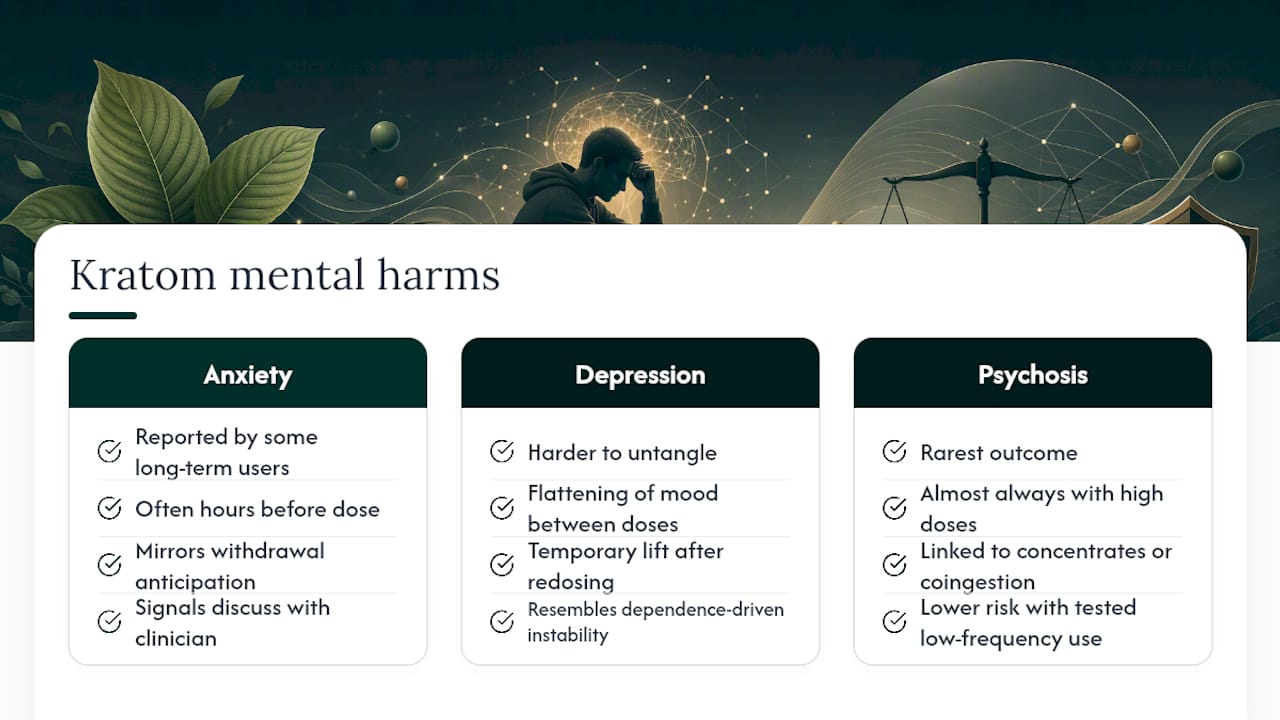
Mood swings get most of the attention in discussions of chronic kratom use, but the mental health picture extends further. Some long-term users report new or worsening anxiety, particularly in the hours before a scheduled dose, a pattern that mirrors classic withdrawal anticipation rather than a standalone anxiety disorder.
Depression is harder to untangle. Kratom interacts with opioid receptors, and chronic opioid-receptor activity has a documented relationship with mood dysregulation in other substances. Some users describe a flattening of mood between doses that lifts temporarily after redosing, a cycle that resembles dependence-driven mood instability more than primary depression.
Psychosis is the rarest of the three, and case reports describing it almost always involve high doses, concentrated extracts, or coingestion with other psychoactive substances rather than moderate whole-leaf use alone. That distinction matters when you’re trying to assess your own risk: someone using a measured, tested product at low frequency faces a very different mental health profile than someone consuming unregulated extracts at high doses.
If you notice anxiety or low mood tracking closely with your dosing schedule rather than existing independently of it, that’s a signal worth discussing with a clinician, especially before assuming it reflects an unrelated psychiatric condition.
Who Faces Higher Risk: Genetics and Pre-Existing Conditions
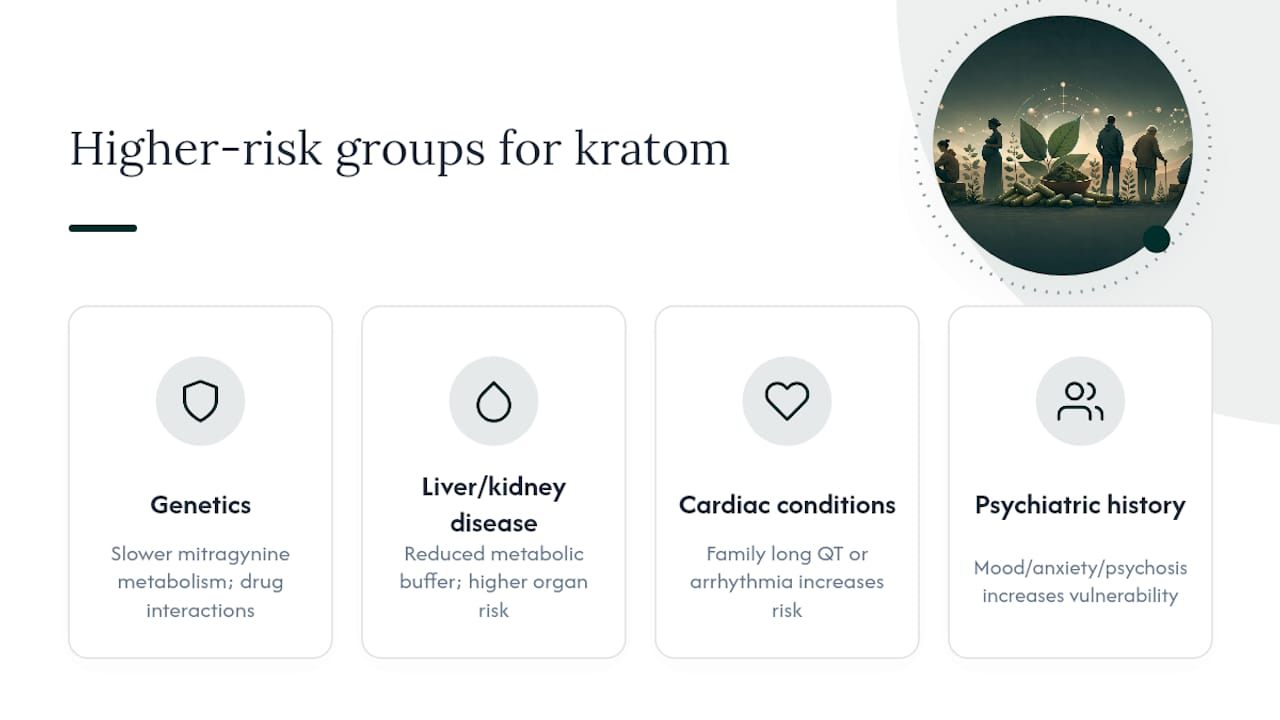
Not everyone who uses kratom long-term faces the same odds. Genetic variation in liver enzymes, particularly the CYP450 family responsible for metabolizing mitragynine, likely explains why some people develop tolerance and side effects faster than others on comparable doses. This is the same enzyme system implicated in drug interactions, which is why combining kratom with certain medications carries added risk for slow metabolizers.
Pre-existing liver or kidney conditions raise the stakes on organ-specific risks discussed earlier. Someone with fatty liver disease or reduced kidney function has less physiological buffer if kratom or a contaminated product adds metabolic strain. The same logic applies to underlying heart conditions: a person with a family history of long QT syndrome or an existing arrhythmia faces meaningfully higher stakes from mitragynine’s cardiac effects than someone with a clean cardiac history.
Mental health history matters too. People with a personal or family history of anxiety disorders, mood disorders, or psychosis may be more vulnerable to the psychiatric effects described above. None of this means these groups can’t make informed choices about kratom. It means the calculus is different, and it’s worth naming that difference honestly rather than treating every long-term user as facing identical odds.
Long-Term Kratom Use and Social, Occupational, and Reproductive Effects
Dependence doesn’t stay contained to biology. Long-term users sometimes describe organizing their day around dosing schedules, missing sleep due to timing doses late, or feeling distracted at work during withdrawal windows between uses. These functional impacts are part of what clinicians assess when applying DSM-5 criteria to kratom use disorder, since impairment in daily functioning is one of the diagnostic markers, not just physical tolerance.
Hormonal and reproductive effects remain thinly studied in humans, but kratom’s action on opioid receptors raises plausible concern given that chronic opioid use is well documented to suppress reproductive hormones in some people, affecting libido and menstrual regularity. Evidence specific to kratom is limited, so this remains an area to discuss with a clinician rather than a settled finding, particularly for anyone trying to conceive or managing an existing hormonal condition.
Our Take on Long-Term Kratom Safety
The evidence doesn’t support treating kratom as either a harmless botanical or a guaranteed path to serious harm. It supports something less satisfying but more accurate: risk that scales directly with how you use it, not just whether you use it. The traditional-use data from Thailand and the Western case-report literature aren’t contradicting each other. They’re describing two different use patterns.
This approach starts from that same evidence-first position. Independent lab testing for purity and potency is important because product variability is one of the confounders showing up again and again in the case-report literature. If you’re managing chronic use, talk to a clinician about baseline testing, and treat product transparency as a non-negotiable part of your own risk calculation.
— Kratome
Explore Kratomvia’s Lab-Tested Products and Resources
If organ-specific risks and product contamination concerns from this guide have you rethinking where your kratom comes from, that’s exactly the gap Kratomvia was built to close. Every batch we sell carries independent lab testing for purity and potency, giving you the transparency that’s missing from a large share of the products behind the case reports discussed above.

Beyond kratom powder itself, we also stock supplies for hobbyists interested in topical, non-ingestive projects. If you’re curious about DIY applications, our transparent glycerin soap base and SLS-free glycerin soap base work well for kratom-themed soap making, paired with our red soap colorant for finishing touches. None of these are intended for ingestion. They’re craft supplies for topical projects only.
If you’re weighing chronic use and want to see what independent testing actually looks like, browse our batch lab reports before your next order and see the purity data for yourself.
This article is general information, not a substitute for advice from a qualified doctor. Consult a qualified healthcare professional about your own circumstances before acting on anything here.
Sources
- Kratom addiction per DSM-5 SUD criteria, and kratom physical dependence: Insights from dosing amount versus frequency
- An update on the clinical pharmacology of kratom: uses, abuse potential and future considerations
- The Health Impact of Long-Term Kratom (Mitragyna speciosa) Use in Southern Thailand
Recommended
Related reading

6 September 2026 · en
Kratom nausea: spot early signs and choose lab tested, lower doses
Read article
5 September 2026 · en
Sicher starten: 0,5–1 g Kratom-Dosis für Anfänger, Laborberichte prüfen
Read article
4 September 2026 · en