

Adults: 15 Minute Peppermint Relief for Headaches, Evidence and Safety
7 September 2026

Diluted topical peppermint oil can ease mild tension-type headache pain for many adults, with clinical trials showing effects starting within 15 to 20 minutes of application to the forehead and temples. It works best on mild to moderate tension headaches, not severe or new-onset pain. Always dilute it, patch-test first, keep it away from children, and see a clinician for anything unusual or severe.
TL;DR:
- Peppermint oil used topically at 10% concentration can reduce tension headache pain within 15 minutes in most cases.
- Application requires proper dilution, patch testing, and careful avoidance of eyes and irritated skin to prevent adverse reactions.
- The strongest evidence supports its use for mild to moderate tension headaches, with limited data on migraines and no research on cluster headaches.
- Reactions like contact dermatitis, respiratory sensitivity, or increased headache from strong scent can occur if not used properly or on sensitive skin.
- For consistent, safe use, buy pure, lab-tested peppermint essential oil and prepare your own dilutions rather than relying on pre-diluted products.
Table of Contents
- How to Use Peppermint Oil for Headache Relief
- What Does the Clinical Evidence Actually Show?
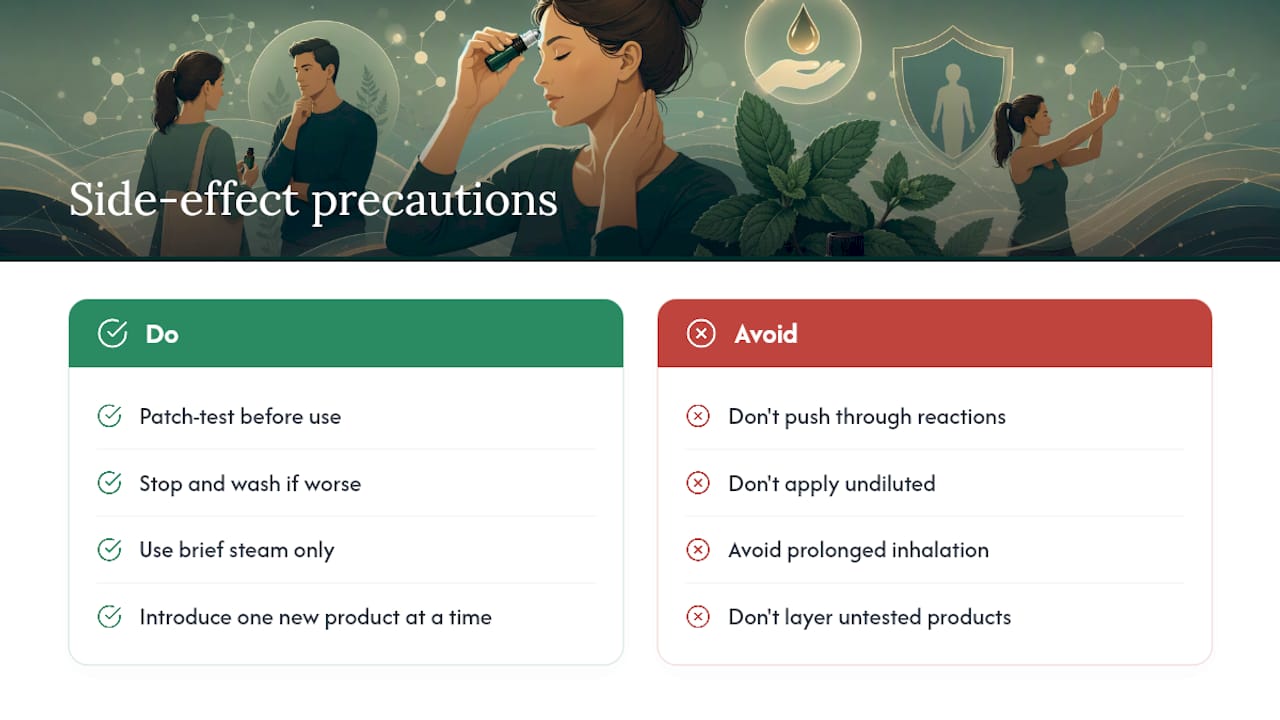
- Safety Rules That Actually Matter
- When Is a Headache More Than Peppermint Oil Can Handle?
- Buying Peppermint Oil for Headache Relief: What to Look For
- Side Effects Beyond the Basic Safety Warnings
- Does It Work for Migraines and Cluster Headaches Too?
- A Practical Routine Worth Trying
- Where to Buy Peppermint Oil You Can Actually Trust
- Sources
How to Use Peppermint Oil for Headache Relief
Peppermint oil for headaches works through direct skin contact, not through the air alone, though inhalation has a supporting role.
Topical application is the method with the strongest evidence behind it.
- Mix a small amount of peppermint essential oil with carrier oil such as jojoba, sweet almond, or fractionated coconut oil, to achieve a suitable dilution.
- Dab a small amount on the forehead and temples using clean fingertips, avoiding the hairline near the eyes.
- Massage gently in small circles for 30 to 60 seconds. Many people report a cooling sensation within a few minutes.
- Wash your hands immediately after application to avoid transferring oil to your eyes later.
For inhalation, add 2 to 3 drops to a bowl of steaming water or a personal diffuser and breathe in for a few minutes. This method suits people who find topical menthol too intense on the skin, though anyone with migraine and heightened scent sensitivity should test it cautiously since strong smells can sometimes trigger rather than relieve migraine pain.
A diluted massage oil rubbed into the back of the neck and shoulders can help with tension headaches tied to muscle tightness. Warm baths with 4 to 6 drops of peppermint oil mixed into a tablespoon of carrier oil (never dropped directly into bathwater) offer a gentler, full-body version of the same effect.
Never swallow concentrated peppermint essential oil. It is not formulated for ingestion and can irritate the digestive tract or interact with medications. Peppermint tea, made from the leaf rather than the concentrated oil, is a mild and safe alternative if you want an oral option alongside topical use.
- Patch-test before your first full application.
- Apply a small amount only a few times daily.
- Keep the oil away from eyes, broken skin, and mucous membranes.
Pro Tip: Keep a small rollerball bottle pre-mixed with your peppermint and carrier oil blend in your bag. Reaching for a ready-made dilution at the first sign of tension beats fumbling with drops and measuring later.
What Does the Clinical Evidence Actually Show?
The research on peppermint oil for headaches is more specific than most natural remedy claims. A randomized, double-blind crossover study tracked 164 headache attacks across 41 patients and found that a 10% peppermint oil solution applied to the forehead and temples significantly reduced tension-type headache intensity within 15 minutes compared with placebo.
A larger follow-up, the phase IV EUMINZ trial, tested the same 10% ethanolic solution on 211 participants and found significant improvements in pain scores favoring peppermint oil for episodic tension-type headache, though the primary endpoint for a single first episode fell short of statistical significance. That nuance matters: the effect shows up more reliably across repeated use than in a single isolated headache.
- Onset: measurable relief within 15 minutes in the original crossover trial.
- Concentration used in both major trials: 10% peppermint oil.
- Population studied: primarily tension-type headache, not migraine or cluster headache.
The mechanism traces back to L-menthol, the primary active compound in peppermint oil. Menthol activates cold-sensing receptors on the skin, producing that recognizable cooling sensation, and pharmacological research suggests it may also act as a calcium channel antagonist that reduces pain signal transmission. That dual action, cooling sensation plus dampened pain signaling, likely explains why relief arrives quickly rather than building gradually.
The European Medicines Agency’s Committee on Herbal Medicinal Products (HMPC) has reviewed this evidence and recognizes topical peppermint oil as having well-established use for relief of mild headaches in adults, while explicitly advising against this use in children and adolescents under 18. That regulatory line is a useful anchor: it confirms real evidence exists, but only for a specific population and a specific headache type.
Safety Rules That Actually Matter
Peppermint oil is potent, and the concentration that makes it effective is the same concentration that can cause irritation if handled carelessly.
Dilution is not optional. Never apply undiluted peppermint essential oil directly to facial skin. A 3 to 5 percent dilution in a carrier oil matches what clinical trials used and gives you the cooling effect without the sting.
Patch-test before your first use. Apply a small diluted drop to your inner forearm and wait 24 to 48 hours. Redness, burning, or itching means you should skip facial application entirely and consider a different remedy.
Eye contact is the most common accident. Volatile menthol vapors can drift toward the eyes even without direct contact, and accidental exposure causes intense stinging. Wash your hands thoroughly after every application, and never touch your eyes for several minutes afterward.
- Avoid use on broken, sunburned, or already irritated skin.
- Do not use on children or adolescents under 18 for headache relief, per HMPC guidance.
- Pregnant or breastfeeding individuals should check with a clinician before regular use.
- If you take medications for blood pressure or have a chronic condition, ask your doctor before adding peppermint oil to your routine.
Stop using it immediately if you notice burning that does not fade, a rash, dizziness, or a headache that worsens rather than improves.
Pro Tip: If your skin runs sensitive, cut the standard dilution in half for your first few uses. You can always increase the concentration gradually once you know how your skin responds.
When Is a Headache More Than Peppermint Oil Can Handle?
Peppermint oil treats symptoms. It does nothing for whatever is causing a headache in the first place, and some causes need medical attention right away.
Seek immediate care for a sudden, severe headache unlike any you’ve had before, one accompanied by fever, neck stiffness, confusion, seizure, or any focal neurological sign like slurred speech or weakness on one side. The same urgency applies to a first headache after age 50 or any headache following a head injury.
- Sudden “thunderclap” headache reaching peak intensity within seconds
- Fever, stiff neck, or rash alongside head pain
- Vision changes, confusion, slurred speech, or one-sided weakness
- New headache pattern after age 50 or following trauma
If headaches recur daily or weekly, talk to a clinician about the underlying cause instead of relying on repeated home treatment. Peppermint oil can dull a mild headache, but it cannot diagnose or resolve whatever keeps bringing them back.
Buying Peppermint Oil for Headache Relief: What to Look For
Not every bottle labeled “peppermint oil” is suited for the dilution work described above. Purity and sourcing transparency determine whether you’re applying a consistent, predictable concentration or guessing.
Kratomvia’s Peppermint Essential Oil for Kratom Soap Making is offered as a 100% pure essential oil, the same starting standard clinical dilution work assumes. Every batch Kratomvia sells, across its kratom and essential oil lines, goes through independent lab testing for purity, and the company is upfront about sourcing rather than leaving buyers to guess where an oil actually came from. Shipping arrives discreetly in unmarked packaging, which matters if you’d rather your mail not announce what’s inside.
For anyone building out a broader topical or aromatherapy routine, Kratomvia’s Rosemary Essential Oil for Kratom Soap Making offers a complementary scent profile for blends beyond headache relief, and the full essential oils collection covers additional carrier and scent options.
| What to check | Why it matters |
|---|---|
| Purity label (“100% pure”) | Confirms no synthetic fillers diluting the menthol content |
| Independent lab testing | Verifies potency matches what’s on the label |
| Clear carrier oil guidance | Prevents skin irritation from over-concentrated blends |
| Discreet packaging | Matters for buyers who value shipping privacy |
- Buy a pure, undiluted essential oil and mix your own carrier blend rather than trusting pre-diluted “headache roller” products with unclear ratios.
- Patch-test any new bottle, even from a trusted seller, since skin sensitivity varies by individual, not just by product.
- Skip products with no visible testing information. If a seller can’t confirm what’s actually in the bottle, you can’t confirm a safe dilution either.
Side Effects Beyond the Basic Safety Warnings
Most people tolerate diluted topical peppermint oil well, but reactions do happen, and they’re worth recognizing early rather than pushing through.
Contact dermatitis is the most common adverse reaction. It shows up as redness, small bumps, or persistent itching at the application site, usually from either too little dilution or repeated daily use without breaks. Unlike a brief cooling tingle, dermatitis lingers and often worsens with continued exposure.
Headache paradox is a lesser-known reaction some people report: instead of relief, the strong menthol scent itself triggers or intensifies head pain, particularly in people prone to migraine or sensitive to strong odors generally. If your headache gets worse within the first 30 minutes rather than better, stop and wash the area.
Respiratory sensitivity can occur with inhalation methods. Menthol vapor in high concentrations can trigger coughing or a tight feeling in the chest for people with asthma or reactive airways. Steam inhalation should be brief, a few minutes at most, rather than prolonged.
Photosensitivity is rare with peppermint compared to citrus oils, but combining it with other topical products containing photosensitizing ingredients can occasionally increase sun sensitivity at the application site. If you’re layering products, introduce one new item at a time so you can trace any reaction back to its source.
None of these reactions are common at proper dilution, but they’re the reason a patch test isn’t a formality. It’s the step that catches a problem before it’s on your forehead.
Does It Work for Migraines and Cluster Headaches Too?
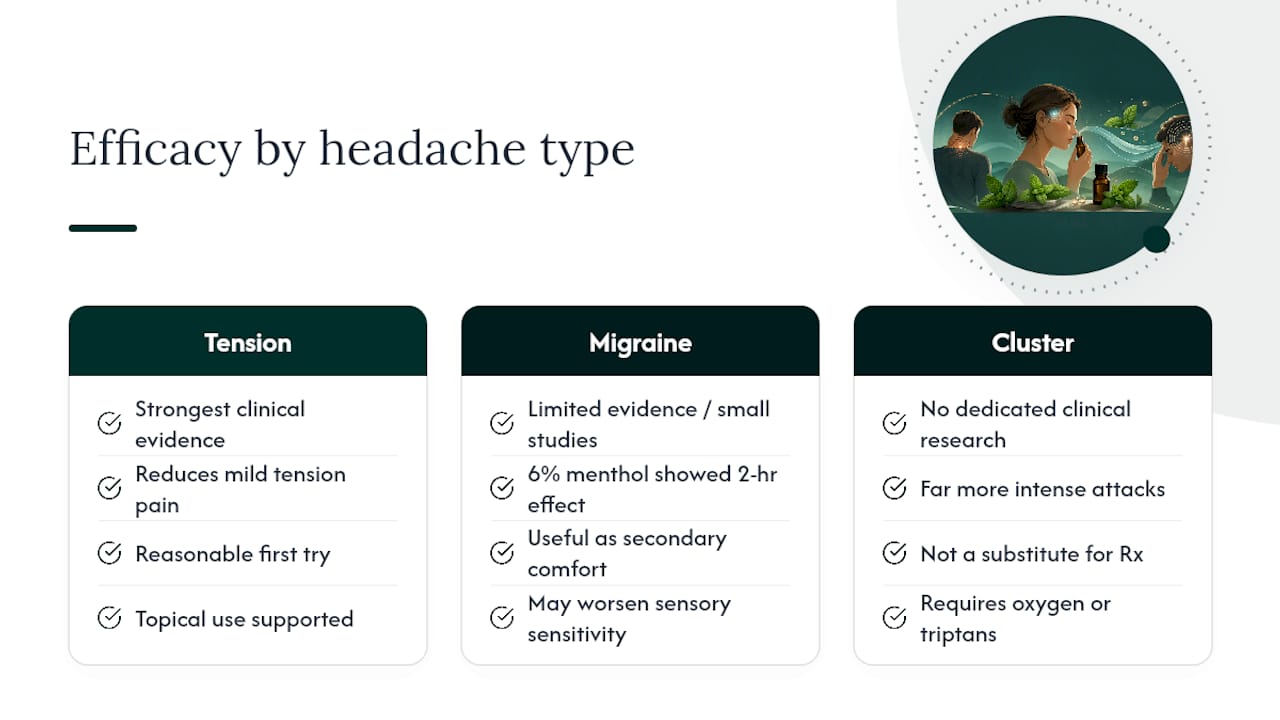
The clinical evidence for peppermint oil is strongest for tension-type headache specifically, and that distinction matters more than marketing copy usually admits.
For migraine, the picture is thinner. Some smaller studies have looked at topical menthol gels, including one that found a 6% menthol topical gel reduced pain intensity after two hours, suggesting menthol’s analgesic effect isn’t exclusive to tension headaches. But migraines involve a different physiological process, often tied to vascular changes and nerve sensitization, and peppermint oil hasn’t been tested with the same rigor in migraine-specific trials as it has for tension-type pain. Some migraine sufferers find the cooling sensation genuinely helpful as a supplementary comfort measure alongside their regular treatment. Others find strong scents make their migraine worse, particularly during the aura or early pain phase when sensory sensitivity spikes.
For cluster headaches, there’s essentially no dedicated clinical research on peppermint oil. Cluster headaches are typically far more intense than tension-type pain and usually require prescription intervention such as oxygen therapy or triptans. Treating a cluster headache with a topical oil alone risks under-treating a condition that needs faster, stronger intervention.
The honest takeaway: peppermint oil is a reasonable first try for mild, everyday tension headaches. For migraine, it’s worth testing cautiously as a secondary comfort measure. For cluster headaches, it’s not a substitute for proper medical treatment.
A Practical Routine Worth Trying
A simple approach that respects the evidence looks like this: apply a diluted peppermint blend to your temples at the first sign of tension, drink water, rest your eyes for ten minutes if you can, and note what triggered the headache in the first place.
Peppermint oil helps a meaningful share of people with mild tension headaches, but it isn’t universal. Track how you respond over a few uses rather than judging it after one try, and don’t let a home remedy substitute for medical evaluation if headaches keep recurring.
— Kratome
Where to Buy Peppermint Oil You Can Actually Trust
Reading about dilution ratios and menthol mechanisms only matters if the oil in your hand actually contains what the label promises.
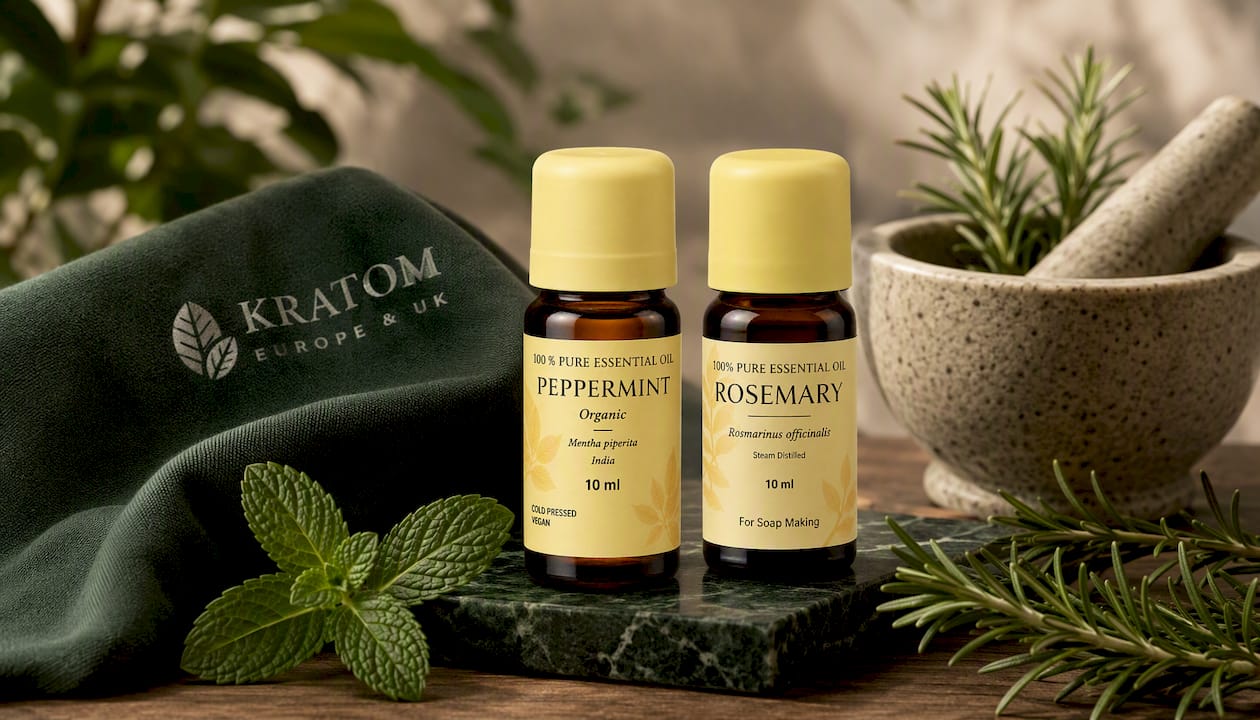
Kratomvia’s Peppermint Essential Oil for Kratom Soap Making ships as a 100% pure oil suited to the carrier-oil dilutions covered throughout this guide, whether you’re mixing a temple rub or a massage blend. The company sources directly from established growers, discloses its testing process rather than burying it in fine print, and ships in discreet, unmarked packaging for buyers across Europe and the UK who’d rather keep their purchases private. If you’re building a broader topical routine, the rosemary essential oil pairs well for scalp and muscle-focused blends alongside your peppermint mix. Check the product page for current stock and place your order when you’re ready to build a dilution you can actually trust.
Sources
Related reading

8 September 2026 · en
Formulation First Kratom Taper for Soapmakers With QC Checkpoints
Read article
7 September 2026 · en
Mitragynine content varies by an order of magnitude: how to read COAs
Read article
6 September 2026 · en