

Gold Kratom Effects
1 September 2026

Gold kratom typically delivers a modest mood lift, smooth and non‑jittery energy, and mild physical ease. It sits between white and red strains on most user reports, though the exact profile depends heavily on dose and how the vendor processed that particular batch. “Gold” is a processing label, not a recognised botanical standard, so the only way to know what you are actually taking is to check the batch’s certificate of analysis (COA) for alkaloid content before assuming its strength or safety.
TL;DR:
- Gold kratom effects depend heavily on processing methods, such as extended drying, fermentation, blending, or selective harvesting, rather than actual plant veins.
- Alkaloid profiles vary significantly by origin and processing, meaning two identical-looking gold products can have different effects and safety profiles.
- Starting doses should be low, around 1 to 2 grams, with effects typically lasting 3 to 6 hours, and users should track their responses carefully.
- Gold kratom is best suited for daytime mental clarity or moderate evening relaxation but should not be relied upon for strong pain relief or as a medical treatment.
- Verify batch-specific alkaloid content through a certificate of analysis before purchasing, as the label “gold” offers no guarantee of potency or safety.
Table of Contents
- What do gold kratom effects come from? Processing, not a plant vein
- Gold kratom effects versus red, green and white: where it actually sits
- How processing changes alkaloid profiles: what the science says
- Dosing, onset and duration for gold kratom
- Safety, side effects and interactions to know before you use gold kratom
- How to verify a gold kratom product before you buy it
- Kratomvia’s approach: lab testing, sourcing and traceability
- Historical and cultural context of gold kratom’s rise
- Scientific research status on gold kratom’s effects and alkaloids
- Potential uses and real limitations of gold kratom
- Legal status and regulations for gold kratom by region
- Gold kratom effects: what actually matters when choosing a product
- Choosing your first gold‑style strain from Kratomvia
- Sources
What do gold kratom effects come from? Processing, not a plant vein
Gold kratom is not a fourth original leaf vein alongside red, white and green. It is a category created after harvest, through drying, fermentation or blending techniques that change the colour and chemical balance of the finished powder. Kratom leaves naturally come in red, white or green vein varieties, and gold products are typically derived from one or more of these through additional processing.
Vendors reach the golden colour through a handful of common methods, and no single technique defines the category. Some producers extend UV or sun drying well past the standard cycle, pushing the leaf through extra oxidation. Others use a brief, sealed fermentation step that alters the leaf’s chemistry in a shorter window. A third approach blends already‑matured red and green powders to land on a middle colour and effect profile, while a fourth relies on selective harvest timing, picking leaves at a specific maturity stage before drying begins.
- Extended drying or UV oxidation: leaves dry longer than typical red or white processing, deepening the colour and shifting alkaloid ratios.
- Short fermentation: a controlled, sealed fermentation period changes the leaf’s chemical composition faster than sun exposure alone.
- Multi‑strain blending: producers combine finished red and green powders to approximate a “gold” effect without a distinct processing method.
- Selective harvest timing: leaves picked at a particular maturity point are processed to produce a consistent golden hue.
That variety is exactly why gold kratom from two different vendors can feel noticeably different, even when both bags are labelled the same way. One producer’s gold might lean closer to a mellow red because it is largely a red/green blend, while another’s might carry brighter, greener characteristics because it relies on extended drying of green leaf. Our own kratom strains explained guide covers how vein colour terminology works if you want the fuller picture before comparing gold to red, white or green.
Gold kratom effects versus red, green and white: where it actually sits
Most user reports describe gold kratom producing four effects with reasonable consistency: a gentle mood lift, smooth energy without the sharp edge some people get from white strains, clearer mental focus at lower doses, and mild physical ease that becomes more noticeable as the dose increases. None of these tend to be as pronounced as what the “pure” vein colours offer at their extremes, which is precisely the appeal for people who find white kratom too stimulating or red kratom too sedating.
- Mood lift: a lighter, steadier uplift than white strains typically provide.
- Gentle energy: motivating without the jittery push some report from pure white varieties.
- Mental clarity: many users describe better focus at conservative doses, useful for daytime tasks.
- Mild physical ease: comfort that builds gradually with dose, though rarely matching red strain’s strength for this purpose.
Pro Tip: If you’re switching from a pure white or pure red strain and finding the effects too extreme in either direction, gold is often the logical middle step rather than jumping straight to the opposite vein colour.
Dose changes the picture substantially. At lower amounts, gold kratom tends to favour the alert, focused end of its range, which is why some people use it during the working day. Push the dose higher and the physical ease and calming qualities become more prominent, shifting the experience towards something better suited to evenings. This dose‑dependent swing is one of the more consistent patterns reported across gold products generally, though it is worth noting research directly comparing gold to other vein colours under controlled conditions remains limited. Much of what we know comes from pharmacology and toxicology reviews of kratom broadly, not gold‑specific trials.
Vendors sometimes market gold products under regional names such as Gold Bali, Gold Borneo or Gold Sumatra. These names typically describe the source leaf’s regional origin before gold processing was applied, and tendencies vary: a Bali‑derived gold might carry more of the relaxing character associated with Bali leaf generally, while a Sumatra‑derived version might lean slightly more energising. Treat these regional labels as a rough starting hint rather than a guarantee, given how much the processing method itself changes the outcome.
In practical terms, gold kratom tends to suit two common use cases well. The first is daytime focus work where you want mental clarity without the wired feeling that a strong white strain can produce. The second is a moderate evening wind‑down, particularly at the higher end of a typical dose range, for people who want to relax without the heavier sedation associated with red strains. Where gold falls short, is strong analgesic use. If your primary goal is significant physical discomfort relief, a dedicated red strain such as Red Maeng Da generally offers more reliable strength for that specific purpose than a gold blend will.
How processing changes alkaloid profiles: what the science says
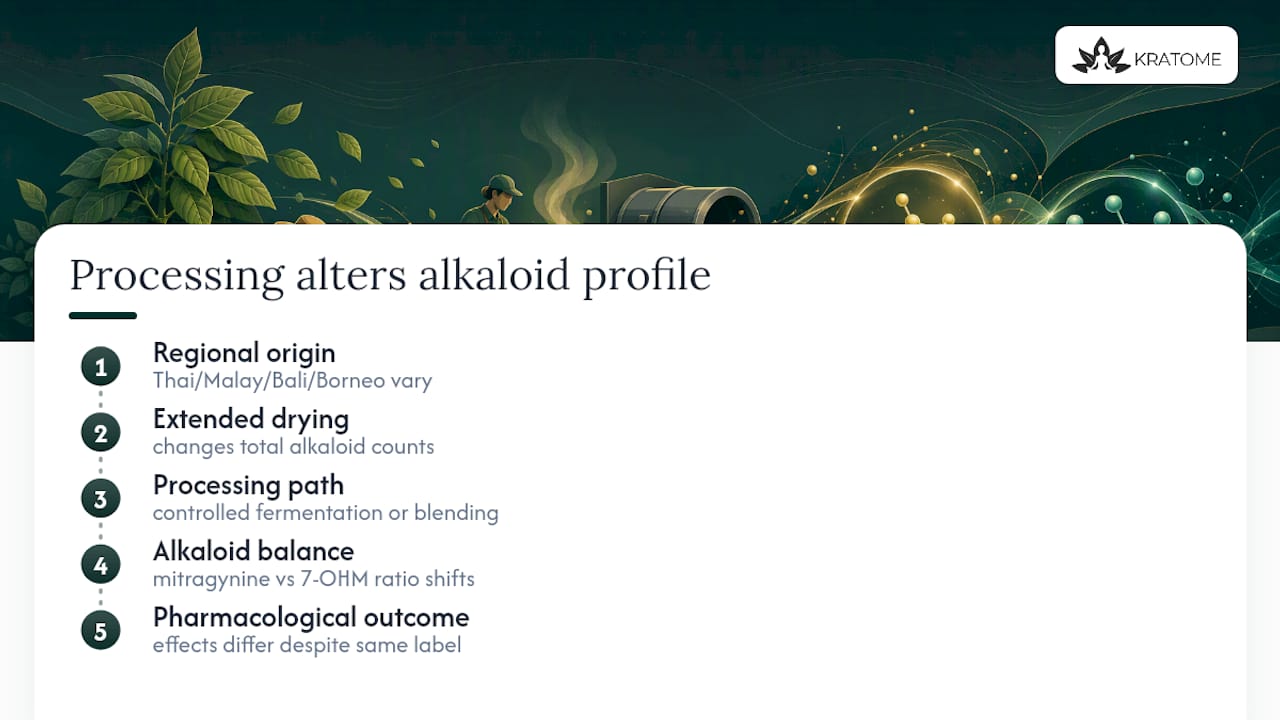
Two alkaloids drive most of kratom’s pharmacological activity: mitragynine and 7‑hydroxymitragynine. Mitragynine is present in far greater quantity in the raw leaf and is linked to the milder stimulant‑leaning effects reported at lower doses, while 7‑hydroxymitragynine, though present in much smaller amounts naturally, is associated with stronger opioid‑receptor activity and plays a larger role as concentration and dose increase.
Analytical work comparing strains has found that mitragynine and 7‑hydroxymitragynine proportions vary meaningfully depending on the plant’s origin and how it was processed, and those alkaloid profiles largely determine the pharmacological effects a given batch produces. Separate comparative analyses of samples from different regions, including Thai, Malay, Bali and Borneo sources, found differing total alkaloid counts across varieties, reinforcing that origin and handling both matter, not just the marketed vein colour.
Processing method and plant origin can shift the balance between mitragynine and 7‑hydroxymitragynine substantially enough to change how a batch behaves, even when two products carry the identical “gold” label on the packet.
This is the practical reason a COA listing specific alkaloid percentages matters more than the colour name on the bag. A gold product fermented one way might carry a meaningfully different mitragynine to 7‑hydroxymitragynine ratio than a gold product created by blending, even if both look and are marketed identically. Our alkaloids explained guide walks through what these two compounds do individually if you want a deeper technical grounding.
Dosing, onset and duration for gold kratom
Start conservatively regardless of prior experience with other strains, since gold’s blended or processed nature makes its strength harder to predict from vein colour alone. A low starting point, typically in the range of 1 to 2 grams, lets you gauge sensitivity before increasing. Many users settle into a moderate range for regular use, with higher amounts reserved for evening relaxation rather than daytime tasks.
- Weigh a low starting dose rather than eyeballing a spoonful, since potency varies batch to batch.
- Wait for onset, typically 20 to 45 minutes, before assuming the dose was too weak.
- Track duration, generally 3 to 6 hours depending on dose and your own metabolism.
- Record what happened: dose, time taken and how you felt, before your next session.
- Increase gradually only if needed, giving several sessions at one dose before adjusting.
Pro Tip: Keep a simple log for your first few weeks. Dose, time, and effects noted on your phone take thirty seconds and save you from guessing why one session felt different from the last.
Powders, capsules and extracts do not behave identically even when labelled “gold.” Capsules simply delay onset slightly compared to powder mixed into a drink, since the capsule shell must dissolve first. Extracts and “shots” marketed as gold deserve particular caution: these concentrate alkaloids well beyond what a leaf powder contains, meaning a small volume can deliver a disproportionately high dose, raising the risk of adverse effects considerably compared with standard powder.
Safety, side effects and interactions to know before you use gold kratom
Most side effects reported with kratom generally, gold included, are dose‑related rather than fixed. Nausea, dizziness, drowsiness and constipation appear more frequently at higher doses and are less common at conservative starting amounts, which is one more reason to begin low and adjust slowly rather than guessing at a moderate dose from the outset.
- Nausea and dizziness: more likely at higher doses or on an empty stomach.
- Drowsiness: more pronounced with red‑leaning gold blends and evening doses.
- Constipation: a common complaint with frequent or high‑dose use over time.
Certain combinations carry higher risk and should be avoided outright. Mixing kratom with alcohol, opioids, benzodiazepines or other central nervous system depressants increases the risk of dangerous sedation and breathing difficulty. If you take prescription medication of any kind, speak with a clinician before adding kratom to your routine, since interactions are not always predictable from the alkaloid profile alone.
Frequent, high‑dose use raises the risk of building tolerance and, over time, dependence. Rotating strains, spacing out use across the week, and sticking to the lower end of your effective dose range are the most commonly recommended strategies for keeping tolerance in check. Seek urgent medical care for symptoms such as difficulty breathing, chest pain, severe confusion or loss of consciousness. Kratom is not an approved medical therapy in most jurisdictions, and it should not replace prescribed treatment for any diagnosed condition.
How to verify a gold kratom product before you buy it
A batch’s colour name tells you almost nothing about what is actually inside the bag. A current, batch‑specific COA is the only reliable way to confirm both potency and safety, and reputable vendors publish these openly rather than making you request them.
- Check the alkaloid panel for mitragynine and 7‑hydroxymitragynine percentages specific to that batch, not a generic average.
- Confirm heavy metal and microbial screening results are included, not just alkaloid figures.
- Look for solvent residue testing if the product is an extract rather than raw powder.
- Match the batch date on the COA to the batch number on your packaging, since a mismatched or outdated report tells you nothing about what you actually received.
- Ask the vendor directly if a COA is not visible on the product page, and treat vague answers about origin or a refusal to share testing as a firm red flag.
A marketing label saying “gold” or “premium” is worth nothing without a document backing it up. Kratomvia’s lab‑tested reports are published per batch precisely so you are not left trusting a colour name, and the partner guide on how to read a COA is a useful primer if lab paperwork is new to you. Our own buying guide for quality kratom covers vendor red flags in more depth if you are comparing multiple sellers.
Kratomvia’s approach: lab testing, sourcing and traceability
Every batch Kratomvia sells undergoes independent laboratory testing before it reaches a customer, covering the alkaloid panel alongside heavy metal and microbial screening. Sourcing focuses on mature leaves from small Southeast Asian growers, paired with controlled drying techniques designed to reduce the contamination and batch‑to‑batch inconsistency that plague less transparent parts of the market. Batch traceability means the COA you check matches the specific product in your hand, not a generic average pulled from an old test. Before buying any gold‑style product, check the relevant product page and lab report for the exact alkaloid figures rather than relying on the strain name alone.
Historical and cultural context of gold kratom’s rise
Kratom itself, Mitragyna speciosa, has been used in Southeast Asia, particularly Thailand, Malaysia and Indonesia, for generations by manual labourers and rural communities managing fatigue and physical strain through daily leaf chewing or brewed teas. The traditional vein system of red, white and green developed from observations tied to leaf maturity and drying at harvest, long before Western markets existed.
Gold kratom has no equivalent traditional lineage. It emerged specifically as a Western commercial category, developed by exporters and vendors responding to demand from a market that wanted a middle‑ground option between the more established red and white extremes. This makes gold fundamentally different from red, white or green in terms of provenance: it is a market innovation built on traditional processing techniques rather than an artefact of traditional practice itself.
That commercial origin is not a mark against it. Extended drying, controlled fermentation and blending are all legitimate extensions of processing methods used traditionally, applied deliberately to create a specific, repeatable effect profile. But it does explain why gold carries no fixed definition the way red or white broadly do. It also explains why gold products vary so much by vendor: without a traditional standard to anchor the category, each producer effectively defines “gold” according to their own process, which is exactly why label trust has to be earned through testing rather than assumed from history.
Scientific research status on gold kratom’s effects and alkaloids
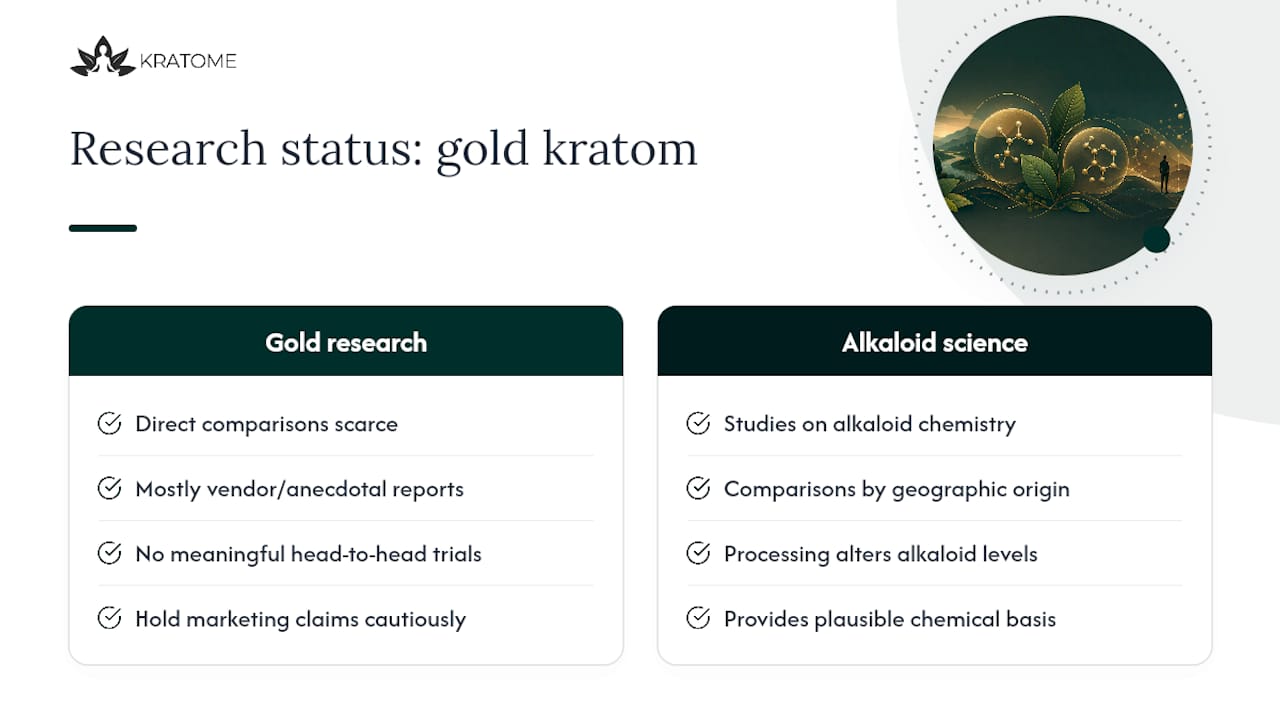
Direct, controlled research specifically comparing gold kratom against red, white and green strains remains limited. Most peer‑reviewed work analyses kratom’s alkaloid chemistry and pharmacology broadly, or compares samples by geographic origin, rather than testing commercially processed “gold” products against their source strains under controlled conditions.
What the existing research does establish clearly is that alkaloid content is highly sensitive to both origin and processing, which is the mechanism gold processing relies on to produce its intermediate effect profile. Comparative alkaloid analyses across different regional samples have documented meaningful differences in alkaloid content tied to source and handling, giving a plausible chemical basis for why extended drying, fermentation or blending would shift a batch’s effects. Reviews of kratom’s broader pharmacology and safety profile similarly note that processing and source materially affect alkaloid levels found in finished products.
The honest summary for a reader is this: the chemistry supporting gold’s middle‑ground reputation is plausible and consistent with what we know about alkaloid variability generally, but gold‑specific clinical research comparing it head‑to‑head against other vein colours simply does not exist in meaningful volume yet. Anecdotal consistency across user reports is not the same as controlled evidence, and it is worth holding that distinction in mind when reading vendor marketing claims about any specific strain.
Potential uses and real limitations of gold kratom
Gold kratom’s most commonly cited practical use is as a balanced daily option for people who want mood support and gentle energy without strong sedation or strong stimulation. Its moderate profile makes it a reasonable starting point for someone newer to kratom who is not yet sure which end of the spectrum suits their goals, since it avoids the more intense extremes of a pure white or pure red strain.
Where gold genuinely falls short is anywhere strong effects are the actual goal. If significant physical discomfort relief is the priority, a strain built specifically for that purpose, such as Red Maeng Da, typically delivers more consistent strength than a gold blend that is deliberately moderated. Equally, if strong daytime stimulation and focus are the goal, a dedicated white strain will usually outperform gold’s gentler energy lift.
It is worth being direct about the limitation running through all of this: kratom, gold included, is not an approved medical treatment for any condition, and no strain should be treated as a substitute for prescribed care. The therapeutic language often used around kratom, including gold varieties, reflects user‑reported experience and plausible pharmacology rather than established clinical evidence. Anyone managing a diagnosed health condition should treat kratom as, at most, a supplementary consideration to discuss with a clinician, not a first‑line solution.
Legal status and regulations for gold kratom by region
Kratom’s legal status varies considerably by country and, within some countries, by state or region, and gold kratom is treated identically to other kratom products under whatever framework applies locally, since regulation targets the plant and its alkaloids rather than specific processing categories. Across much of Europe and the UK, kratom is legally sold as an herbal product, though the regulatory picture is not uniform and some countries have introduced restrictions or are actively reviewing their approach.
UK legal status: Kratom is not controlled under the UK Misuse of Drugs Act, and possessing it is not an offence. However, since 2016 kratom falls under the Psychoactive Substances Act, which makes it an offence to sell, supply or import it into the UK. Regulations and their enforcement can change over time, so it's advisable to stay updated on any potential amendments.
Because rules shift and vary by jurisdiction, and because this article covers a global readership rather than one specific market, treat any blanket “kratom is legal” or “kratom is banned” statement with caution. The only reliable approach is checking your own country’s current regulatory position directly before purchasing, since a status accurate for one region may not apply to your own. Regulatory bodies in several countries have also issued public safety communications about kratom generally, reflecting ongoing scrutiny rather than a settled international consensus.
Gold kratom effects: what actually matters when choosing a product
The conventional advice on gold kratom tends to stop at “it’s balanced,” as though that settles the matter. It doesn’t. Balanced is a description of tendency across many users and many products, not a guarantee about the bag in front of you, because gold is a processing outcome rather than a fixed formula. Two products labelled identically can come from genuinely different production paths, extended drying versus blending versus fermentation, and land at meaningfully different points on the alkaloid spectrum.
What the evidence actually supports is a simple priority order: verify before you personalise. Check the COA for actual mitragynine and 7‑hydroxymitragynine figures before worrying about which regional name or dose range suits your goals. Skipping that step and going straight to dosing advice is where most disappointing experiences originate, not from the strain itself. The reader who checks batch data first and adjusts dose second will consistently get more predictable results than one who trusts a colour name alone.
— Kratomvia
Choosing your first gold‑style strain from Kratomvia
If you are working out where to start, think in terms of which end of the balanced spectrum you actually want, rather than searching for a product literally labelled gold. For readers wanting more of the calming, physical‑ease side of that spectrum, Red Maeng Da delivers a stronger, more dependable version of that character than a blended gold product typically will. If steady, non‑jittery energy and focus are the priority, Green Maeng Da sits closer to the middle ground gold aims for, while White Maeng Da suits readers who want more pronounced stimulation and mental clarity.
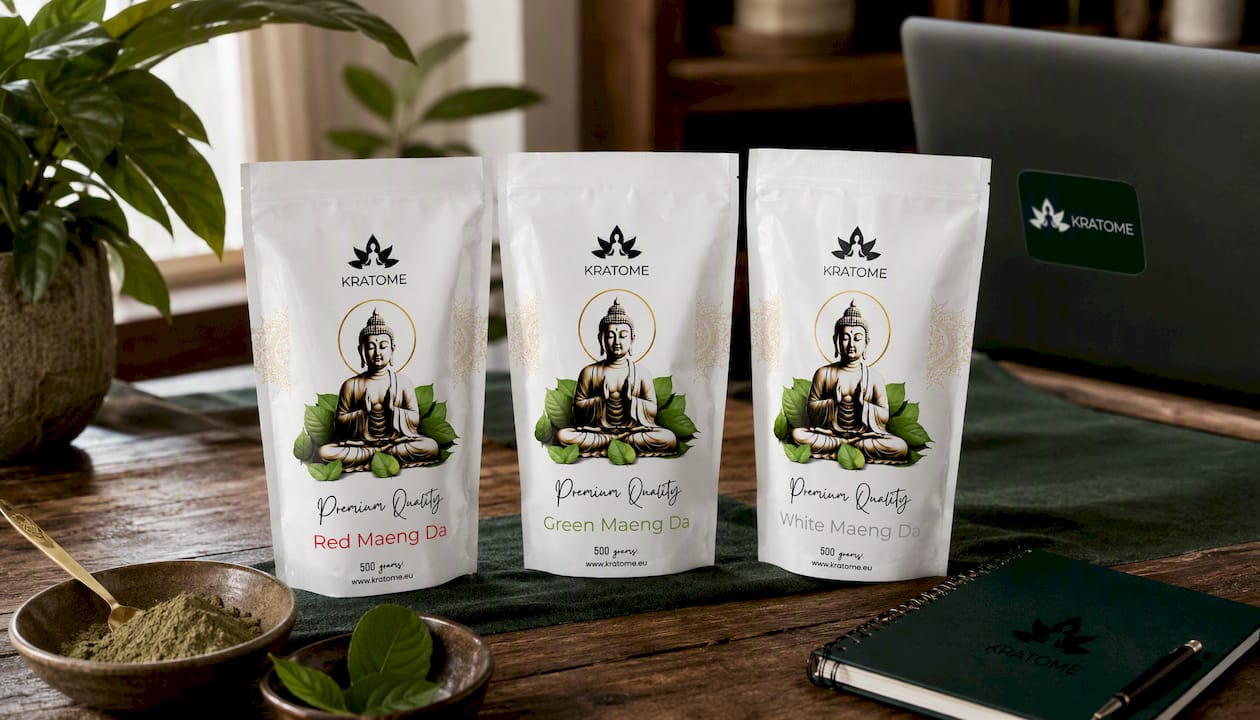
Every one of these strains ships with its own batch‑specific COA, so you can check mitragynine and 7‑hydroxymitragynine figures before you buy rather than trusting a strain name on faith. Powder suits anyone comfortable measuring doses by weight, while capsules offer a fixed, pre‑measured amount if consistency matters more to you than flexibility. Review the lab reports for the batch you’re considering, pick the strain that matches whether you want more relaxation or more energy, and place your order through Kratomvia with same‑day shipping across Europe and the UK.
This article is general information, not a substitute for advice from a qualified doctor. Consult a qualified healthcare professional about your own circumstances before acting on anything here.
Sources
- Alkaloid profiles and activity in different Mitragyna speciosa strains (journal article)
- NCBI PMC review on kratom pharmacology and toxicology
- USU Extension fact sheet on kratom (risks and potency considerations)
- Comparative analyses of Mitragyna speciosa alkaloids (PMC article)
Recommended
- Kratom Alkaloids Explained: Mitragynine & 7-Hydroxymitragynine Effects
- Kratom Research Around the World | Kratom Benefits & Studies
- Buy Kratom Online Europe & UK – Premium Lab-Tested Kratom
Disclaimer: This article is for educational and informational purposes only. Kratom is sold by Kratomvia as a botanical specimen for study and collection purposes, and is not intended, approved, or authorised for human consumption in the European Union. Our kratom is sold as a soap accessory and collectible item.


