

Is Kratom Addictive?
16 September 2026

No, kratom powder sold as a non-consumable soap and cosmetic ingredient is not addictive. That question only applies to human ingestion, which falls outside how Kratomvia’s botanical powder is marketed or used. For makers, the real questions are about stability, pH tolerance, and lab verification, and that’s where formulation guidance actually helps.
TL;DR:
- Kratom powder used as a cosmetic ingredient is not addictive, as addiction relates only to human ingestion, not topical or soap formulations.
- The stability of kratom’s phytochemicals depends on heat and pH during soapmaking, not on any pharmacological dependence or safety issues.
- Proper preservation involves infusing kratom into oils first and avoiding adding wet powder directly onto finished soap bars to prevent spoilage.
- A reliable Certificate of Analysis should verify plant identity, microbial content, heavy metals, residual solvents, and phytochemical levels, all tied to a specific batch.
- Suppliers should provide batch-specific lab reports, and formulators are advised to test small quantities and document ingredient provenance before large production.
Table of Contents
- Is Kratom Addictive When Used as a Soap Ingredient?
- How Do You Add Kratom Powder to Soap and Cosmetic Formulations?
- What Should You Check on a Kratom Certificate of Analysis?
- What Should You Ask a Kratom Supplier Before Buying?
- Kratomvia’s Take on Botanicals in Small-Batch Soapmaking
- Try Red Maeng Da for Your Next Formulation Batch
- Sources
- FAQ
Is Kratom Addictive When Used as a Soap Ingredient?
Addiction is a pharmacological concept tied to ingestion, tolerance, and dependence in the human body. None of that applies to a botanical powder sitting in your workshop waiting to go into a cold-process batch or a melt-and-pour base. The question soapmakers should actually be asking isn’t about dependence at all. It’s about how the material behaves once lye, heat, and time get involved.
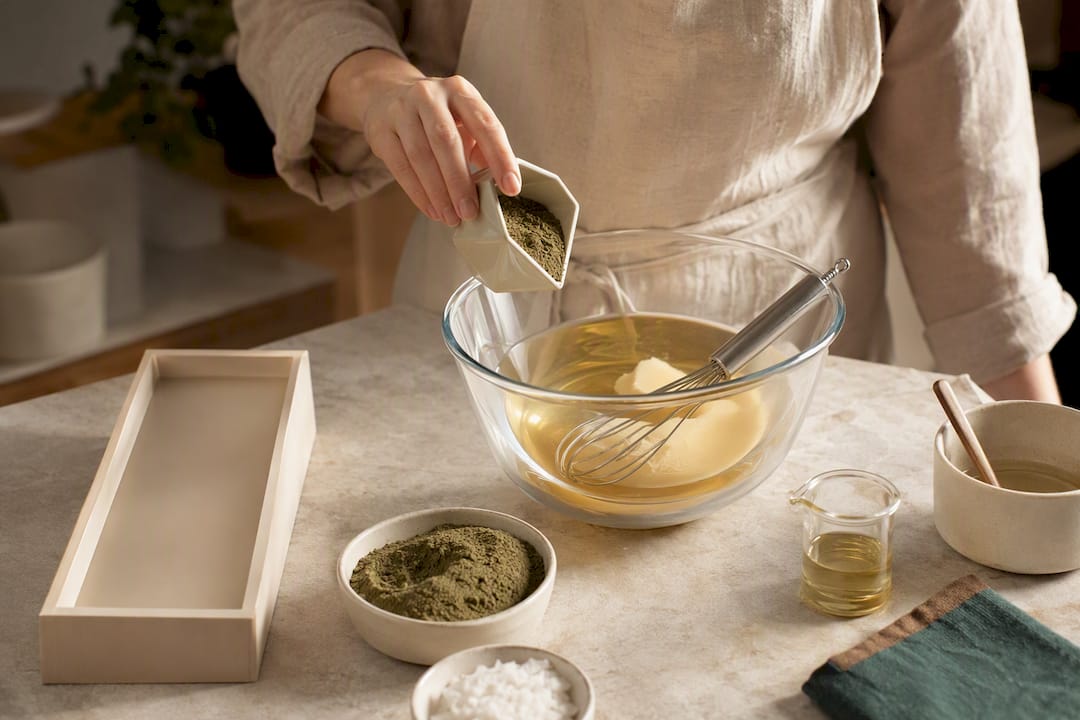
Kratom powder contains polyphenols, flavonoids, and alkaloids, including mitragynine, compounds that show measurable antioxidant activity in laboratory testing. Research on Mitragyna speciosa extracts found strong free radical scavenging activity and documented effects on lipid accumulation in cell models, which signals that the plant carries genuine phytochemical activity worth preserving in a formulation, not just decorative appeal.
The catch is that saponification is rough on delicate plant compounds. Lye reactions generate heat, and the pH during cold-process soapmaking often exceeds 12 before it stabilizes. That environment can degrade polyphenols and flavonoids if the powder goes in raw and early. This isn’t unique to kratom. It’s the same reason experienced soapmakers infuse rather than dump most botanicals straight into hot batter.
What this means practically for your workshop:
- Stability, not addiction risk, is the variable that matters. Heat and alkalinity determine whether phytochemicals survive the process, not any pharmacological concern.
- Oxidation is a storage issue, not a safety issue. Powder exposed to light, heat, or moisture loses potency and can shift in color over time.
- Appearance changes are normal. Botanical powders often darken or brown during cure, which is a cosmetic outcome, not a defect in the material.
- Raw powder embedded in bar tops behaves differently than infused oil. Direct exposure to lye and cure conditions is harsher than a pre-infused carrier.
Treat kratom the way you’d treat any polyphenol-rich botanical powder: a raw material with a shelf life and a sensitivity profile, not a substance with a habit-forming reputation attached to it.
How Do You Add Kratom Powder to Soap and Cosmetic Formulations?
Getting the most out of kratom’s phytochemical profile comes down to when and how you introduce it, not how much you use. Formulators generally have four workable paths, ranked by how well they preserve active compounds.
- Infuse a carrier oil first. Steep kratom powder in a stable oil like olive, sunflower, or sweet almond for four to six weeks in a cool, dark space. This method is widely recommended by soap infusion guides because oil infusion pulls flavonoids and polyphenols out of the plant matter gently, without the heat spike of saponification.
- Add infused oil at light trace, not raw powder at the start. Waiting until your batter has thickened and cooled slightly before adding your infused oil limits how much heat the botanical compounds face.
- Use melt-and-pour for a gentler process overall. Melt-and-pour bases run at lower, more controlled temperatures than cold-process lye reactions, which makes them a friendlier environment for retaining phytochemical activity.
- Consider extract or nanoparticle-based inputs for targeted results. A 2026 study on nanoparticle gel formulations using Mitragyna speciosa extracts found particle sizes around 202 to 256 nanometers with improved antioxidant and enzyme-inhibitory activity compared to crude extract alone. That’s a route worth exploring if you’re chasing a specific cosmeceutical outcome rather than a decorative effect.
Pro Tip: Keep a dedicated infusion jar labeled by date and oil type. Kratom-infused oil that sits too long or gets exposed to heat during storage loses potency well before it looks or smells “off,” so track your batches the same way you’d track any perishable formulation input.
A few cautions worth repeating: never add wet or damp botanical matter directly onto a bar top, since trapped moisture invites mold and rancidity, a point echoed by soap safety guidance from Poison Control. Keep your workspace temperature controlled, and resist the urge to overload a batch with powder just because more seems better. Phytochemical activity doesn’t scale linearly with quantity once you’re past a reasonable formulation ratio.
What Should You Check on a Kratom Certificate of Analysis?
A Certificate of Analysis is the single most useful document a supplier can hand you, and reading it correctly separates a workable batch from a liability. Independent lab testing, not a supplier’s own internal claim, is what confirms a lot is fit for formulation use.
Here’s what a COA should actually show:
- Identity confirmation. The lab should verify the plant material matches the labeled strain, not just “kratom” generically.
- Microbial screening. Results should show yeast, mold, and pathogen counts within accepted limits, particularly important for a powder that will sit in storage for weeks before use.
- Heavy metal panels. Lead, arsenic, cadmium, and mercury should all be tested and reported with specific values, not a pass or fail summary.
- Residual solvent data. If any extraction or processing occurred upstream, solvent residue testing should be included.
- Phytochemical assay data. Total polyphenol content, flavonoid content, and mitragynine percentage give you a real read on what you’re working with batch to batter.
- Batch or lot number tied to the report. Without this, you have no way to match the document to the powder in your hand.
Independent testing matters because in-house results carry an obvious conflict of interest. A third-party lab has no stake in the outcome, which is exactly why batch-level lab reports that list microbial, heavy metal, and phytochemical data are considered a stronger trust signal than a supplier’s own assurances. If a COA is missing, undated, or lacks a batch number, treat that as a hard stop, not a minor gap.
What Should You Ask a Kratom Supplier Before Buying?
Vetting a supplier takes five minutes and saves you from a ruined batch or a wasted order. Run through this checklist before you commit to a bulk purchase:
- Does every lot come with its own COA, or is one report used to cover multiple batches?
- Which independent lab performed the testing, and can you verify that lab exists and operates independently from the seller?
- How is the powder stored and packaged before it ships, and does the packaging protect against moisture and light?
- Does the supplier offer samples or small test quantities before you commit to a larger order?
- What’s the minimum order size, and does it match your batch-testing needs as a small-batch maker?
- Are strain-specific notes available? Red Maeng Da, for instance, is one strain option Kratomvia offers with its own batch-specific lab documentation.
Once you’ve confirmed a lot, request a small sample and run it through your own trial batch before scaling up. Label finished soap and cosmetic products clearly with the ingredient list and production date, and store them the same way you’d store any product containing plant-derived polyphenols: away from direct heat and prolonged light exposure.
Kratomvia’s Take on Botanicals in Small-Batch Soapmaking
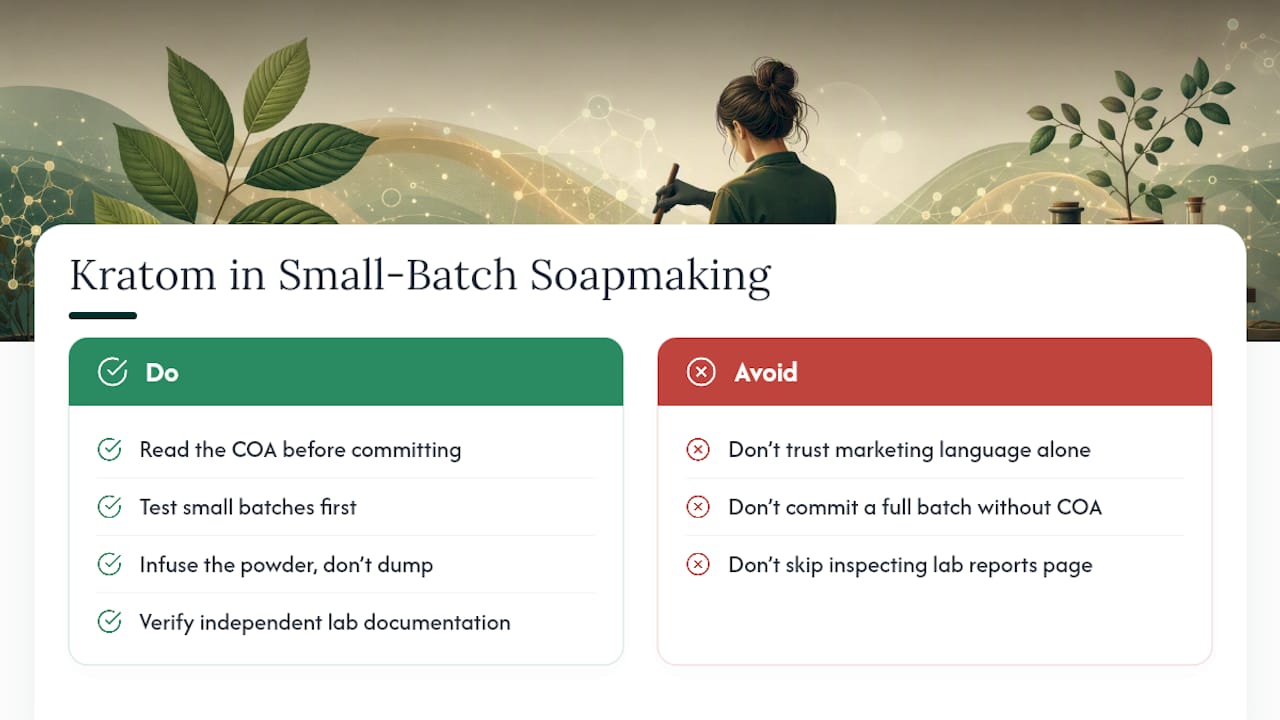
We spend most of our time thinking about lab data, not marketing language, and that shapes how we talk about kratom in cosmetic use. Every batch we sell carries independent lab documentation, because we think traceability is what actually separates a reliable formulation ingredient from a guessing game.
Our honest advice to makers: treat kratom powder the way you’d treat any polyphenol-rich botanical. Test small, infuse rather than dump, and read the COA before you commit to a full batch. If you want to see exactly what’s in a given lot before you buy, our lab reports page has that documentation available for inspection, not buried behind a sales pitch.
— Kratomvia
Try Red Maeng Da for Your Next Formulation Batch
Red Maeng Da powder gives you a documented starting point instead of a guess, which matters more than any marketing claim once you’re standing over a mixing bowl at trace. Every lot ships with its own batch-specific Certificate of Analysis, so you know exactly what phytochemical profile you’re infusing before it ever touches your carrier oil.
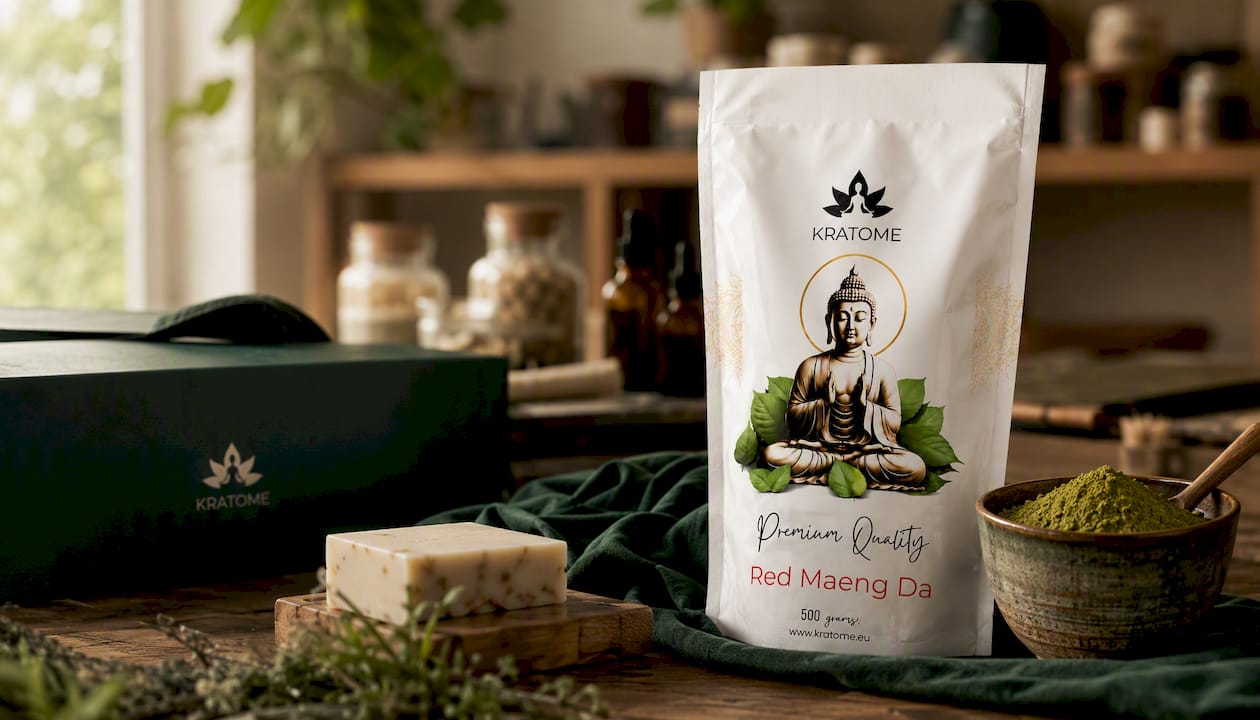
Unlike sourcing from unverified sellers where documentation is an afterthought, Red Maeng Da comes with independent lab testing on every batch and discreet packaging that protects the powder from light and moisture in transit. If you’re planning your next infusion run, check the current lab reports for this lot, request a sample size if you’re testing a new formulation, and place your order once the COA matches what your batch needs.
Sources
- Cosmeceutical potential of Mitragyna speciosa (Kratom): Anti-Adipogenic and Antioxidant Properties of Extracts and Mitragynine
- Phytochemical characterization, bioactivities, and nanoparticle-based topical gel formulation development from four Mitragyna speciosa varieties
FAQ
Can You Add Kratom Powder Directly to Cold-Process Soap?
You can, but adding it raw at high heat during trace degrades more of its polyphenol and flavonoid content than infusing it into a carrier oil first.
Does Kratom Powder Go Rancid in Storage?
The powder itself is shelf-stable when kept dry, cool, and away from light, but botanical matter embedded wet in a finished bar can trap moisture and invite rancidity or mold.
What’s the Biggest Red Flag on a Kratom COA?
A missing batch number or the absence of heavy metal and microbial screening data means the report can’t be reliably matched to the powder you’re holding, and that’s reason enough to look elsewhere.
Is Kratom a Controlled Substance for Cosmetic Use?
Regulatory status varies by country and applies primarily to ingestible use. Formulators should confirm labeling and cosmetic-ingredient rules specific to their own market before selling finished products.
Why Does Kratomvia Test Every Batch Independently?
Independent lab testing removes the conflict of interest that comes with self-reported data, giving formulators verified identity, purity, and phytochemical results they can check before committing to a batch.
Recommended
- Peppermint Essential Oil for Kratom Soap Making EU & UK
- Lavender Essential Oil for Kratom Soap Making EU & UK
- How to Make Kratom Soap | DIY Guide
- Glycerin Soap Base for Kratom Soap Making | SLS Free
Disclaimer: This blog is intended for educational and informational purposes only. The content provided is not intended to promote, recommend, or suggest human consumption of kratom or any other product. Our products are sold exclusively for their intended purposes as described on our website. This information should not be interpreted as medical advice, and we encourage readers to consult qualified professionals for any health-related questions.


