

Kratom and Caffeine
23 September 2026

This guide treats “kratom and caffeine” as kratom powder used as a non-ingestible cosmetic ingredient, added alongside caffeine or other botanical powders strictly for soap-making and topical formulation. Use it conservatively, starting around 1 to 2 teaspoons per 454 g (1 lb) of oils, disperse it as a slurry before it hits your batter, and follow EU and UK cosmetic safety rules, including a Product Information File and a professional safety assessor.
TL;DR:
- Keep kratom powder dosage within 1 to 2 teaspoons per pound of oils to prevent rough texture, cloudiness, and brittleness in the final soap bar.
- Always pre-sieve and create a slurry of kratom powder in water or oil before incorporating it into the soap batter to ensure even dispersion and prevent clumping.
- Use opaque bases to better hide dispersion inconsistencies, while clear bases reveal flecks, requiring lower kratom concentrations and thorough slurry mixing.
- Conduct small batch tests with detailed documentation, including photograph records and formulation notes, to identify stable ratios and avoid formulation failures.
- Sourcing lab-tested kratom from traceable suppliers and maintaining detailed lab reports and batch records is essential for regulatory compliance and product safety.
Table of Contents
- How to Add Kratom Powder to Soap: Dosing and Dispersion
- Melt & Pour vs. Cold Process: Where Kratom Behaves Differently
- Troubleshooting Kratom in Soap and Setting Up Small-Batch Tests
- Regulatory Essentials for Selling Kratom Soap in the EU and UK
- Sourcing, Lab Testing, and What to Keep on Record
- Overview of Kratom and Caffeine Interaction Effects on Soap Formulations
- Formulation Safety Considerations When Combining Kratom and Caffeine Powders
- Common Reasons Soap-Makers Combine Kratom and Caffeine
- What the Formulation Evidence Actually Shows
- Recommended Starting Ratios for Combined Botanical Powders in Soap
- Recognizing Formulation Failures When Two Powders Are Combined
- A Soap-Maker’s Take on Craft and Compliance
- Where to Source Lab-Tested Kratom for Soap-Making
- Sources
- FAQ
How to Add Kratom Powder to Soap: Dosing and Dispersion
Kratom powder behaves like most fine botanical additives: a little goes a long way, and too much wrecks the bar. For color and general aesthetic effect, start with 1 teaspoon per 454 g (1 lb) of oils. If you want a mild scrub texture, 2 teaspoons is a reasonable ceiling before the bar starts fighting you. Push past that and you risk rough spots, cloudy melt and pour, or bars that turn brittle as they cure.
The fix for uneven color and gritty pockets is the same trick colorant suppliers have used for decades: pre-mix the powder into a slurry before it ever touches your batter. Powdered colorants dispersed as a slurry go in smoother and avoid the clumps, streaks, and speckles that plague soap-makers who dump dry powder straight into trace.
Here is a practical sequence for testing kratom in a batch:
- Sieve the powder first. Fine, cosmetic-grade kratom disperses far more evenly than coarse or inconsistently milled material.
- Build a slurry. Mix the powder with a small amount of water or a light carrier oil until it forms a smooth paste with no dry pockets.
- Choose water or oil based on the botanical. Water-soluble components disperse better in a water slurry; if you’re chasing skin feel or a specific extraction into the fat phase, an oil slurry or a short oil infusion works better.
- Add at the right stage. For cold-process, mix the slurry in at light trace. For melt and pour, blend it into the fully melted base just before pouring.
- Blend thoroughly, then stop. Overworking the batter after adding powder reinvites clumping instead of solving it.
Pro Tip: Weigh your slurry water separately from your main lye solution water, and subtract it from your total liquid. Skipping this step is the most common reason cold-process bars turn out soft.
Melt & Pour vs. Cold Process: Where Kratom Behaves Differently
Base type changes almost everything about how kratom powder reads in the finished bar. Clear melt and pour bases show every fleck and shadow of color, which means small dosing errors are far more visible than in an opaque base. Opaque cold-process bars are more forgiving, hiding minor inconsistencies in dispersion that would stand out immediately in a transparent glycerin base.
- Clear or translucent bases: keep kratom concentration low and slurry it thoroughly, or expect visible speckling.
- Opaque bases (tallow, coconut oil heavy recipes, titanium-dioxide-whitened bases): more room to experiment with texture and color depth.
- Exfoliation goals: a coarser grind gives a noticeable scrub; a fine grind at the same concentration reads more as tint than texture.
- Lather preservation: oil infusions preserve lather better than dumping dry powder directly into the batch, since undissolved solids can interfere with how surfactants behave at the bar’s surface.
Pro Tip: If lather quality matters more to your brand than visible fleck, infuse kratom into your base oil at low heat before saponification instead of adding powder at trace.
Bars will often shift color slightly over the first few weeks of cure as botanicals oxidize. That is normal, not a sign of a failed batch, but it means your product photos should wait until the bar has fully stabilized.
Troubleshooting Kratom in Soap and Setting Up Small-Batch Tests
Most kratom soap problems trace back to one of three causes: too much powder, poor dispersion, or the wrong carrier for the botanical. Crystalline or hard-to-dissolve powders can be genuinely stubborn to disperse evenly, and soap-makers who have wrestled with similar fine powders report that pre-wetting and matching the carrier to the powder’s solubility solves most clumping issues.
A repeatable test protocol saves you from guessing twice:
- Run a 100 g test batch rather than a full mold, so a failed experiment costs you almost nothing.
- Photograph the batter at trace, at unmolding, and at one week and two weeks of cure.
- Note lather volume and bar pH at each check point.
- Record your exact slurry ratio, powder supplier, and batch number.
Small test batches paired with photographic records are the fastest route to a repeatable recipe, and that discipline pays off again when you scale toward production runs, since documented test results feed directly into your Product Information File.
Regulatory Essentials for Selling Kratom Soap in the EU and UK
Selling a bar of soap containing kratom powder in the EU or UK means you are selling a regulated cosmetic product, not a craft item exempt from oversight. Two requirements sit at the center of that obligation.
- Appoint a Responsible Person and get a professional safety assessment. Every cosmetic product placed on the market needs both before it ever reaches a customer.
- Keep a Product Information File. Products marketed as cosmetics must have a PIF retained for 10 years after the last batch is placed on the market, covering composition, safety evidence, and manufacturing details.
- Maintain GMP records. Your file should include supplier batch numbers, certificates of analysis, manufacturing dates, and stability notes, along with your preservative rationale if the formulation is water-based.
- Label with correct INCI names. Ingredient listings must use standard International Nomenclature of Cosmetic Ingredients terms, and internal records should track batch IDs even when packaging is too small to print full ingredient lists.
- Check Annex restrictions. Colorants, preservatives, and certain botanical additives carry specific Annex rules under EU cosmetics regulation, so confirm any additive you pair with kratom is permitted at your intended concentration.
None of this is optional paperwork you can skip for a small operation. Guidance from the UK government on making cosmetics available to consumers makes clear that sourcing details, concentrations, and stability data all belong in the same file inspectors will ask to see.
Sourcing, Lab Testing, and What to Keep on Record
Traceable sourcing and independent batch testing are what separate a defensible cosmetic ingredient from a supply chain gamble. When a botanical powder carries a certificate of analysis for heavy metals and microbial contamination, you have documented evidence to point to if a customer or inspector ever asks what is actually in your bar.
Every batch is independently lab-tested for purity and potency, batch reports are publicly available, sourcing is traceable to a known network of growers rather than anonymous bulk suppliers, and orders ship discreetly in plain packaging.
For your own PIF, request and keep these items for every kratom batch you use:
- Certificate of analysis covering heavy metals and microbial screening
- Supplier batch or lot number
- Any extraction or processing notes from the supplier
- Your own internal formulation notes tied to that specific batch
Pro Tip: File your CoA and internal test photos together under the same batch number. If a regulator or a curious customer ever asks about a specific bar, you want to find the answer in under a minute.
Overview of Kratom and Caffeine Interaction Effects on Soap Formulations
When formulators talk about combining kratom and caffeine in a topical product, they are usually asking how the two powders interact physically and chemically inside the bar, not how either one behaves once absorbed by a body. Caffeine is a fine, somewhat crystalline powder that dissolves more readily in warm water than kratom’s coarser plant fiber does, so the two rarely disperse at the same rate if you slurry them together in one step.
Practically, that means treating them as two separate additions rather than one combined powder. Slurry the kratom on its own, using a water or oil ratio matched to its particle size, and prepare a separate caffeine dispersion if your formulation calls for both. Combining them into a single premix often leaves one component undissolved while the other saturates the liquid, which shows up later as gritty pockets or uneven tint in the finished bar.
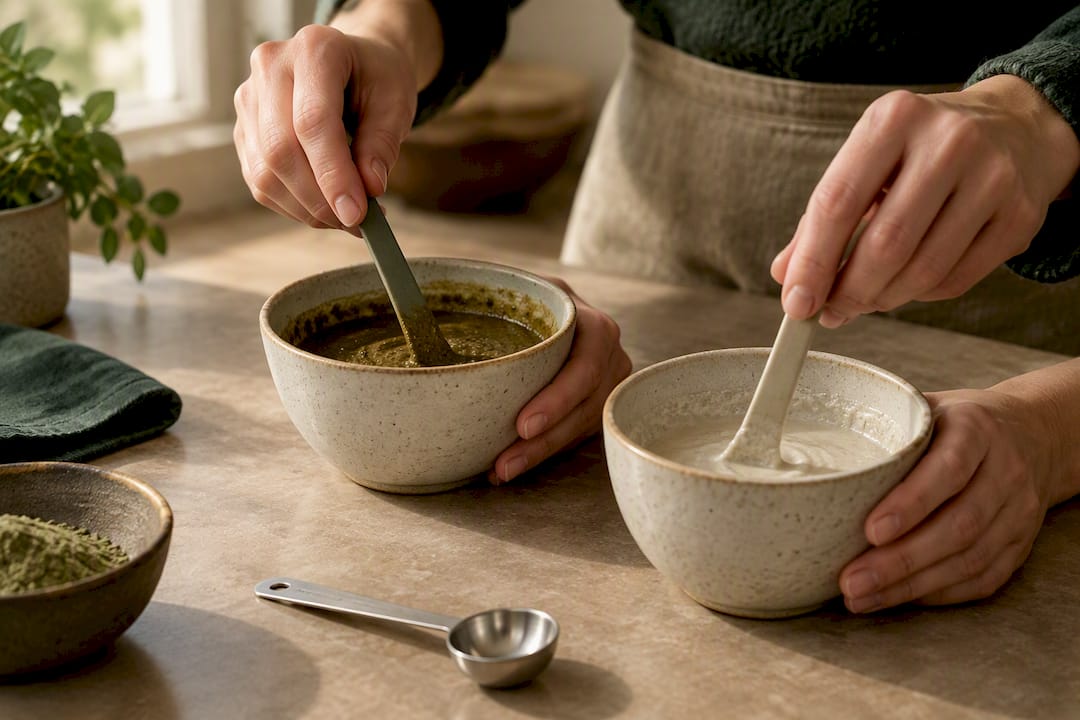
Color behavior also differs between the two. Kratom powder tends to shift the bar toward a warm tan or olive tone depending on strain, while caffeine contributes little visible color at typical concentrations, so any tint variation you see in a combined bar is almost always coming from the kratom fraction. Testing each botanical’s effect in isolation before combining them gives you a clearer picture of what each one contributes to the final texture and appearance, and it makes troubleshooting far faster when something in the batch does not turn out right.
Formulation Safety Considerations When Combining Kratom and Caffeine Powders
Safety in this context means product safety and stability, not a discussion of what happens if either ingredient is consumed, since Kratomvia’s products are sold exclusively as raw material for soap-making and topical crafts. The real formulation risk with combining two fine botanical powders is chemical and physical instability inside the bar over its shelf life, not a bodily reaction.
Caffeine and other crystalline additives can behave unpredictably in a high-pH cold-process environment. Fresh soap batter often sits above pH 10 before it fully cures, and some plant-derived actives degrade or discolor under sustained alkaline exposure. That is one reason experienced soap-makers test small batches and track color and texture over a two-week cure window before committing to a full production run.
Overloading either powder raises the same practical concerns discussed earlier: rough texture, cloudiness in clear bases, and bars that turn brittle as they dry out. When two powders are combined, those effects can compound rather than simply add up, since both are drawing moisture out of the batter as they hydrate. Sticking to conservative concentrations for each botanical, testing them separately first, and keeping your dosing well below the point where texture degrades protects both the bar’s structural integrity and its shelf stability. Document every combination you test, including ratios and cure outcomes, so you are never repeating a failed experiment by accident.
Common Reasons Soap-Makers Combine Kratom and Caffeine
Most crafters reach for this pairing for one of two reasons: visual layering or textural contrast. Kratom’s natural tan-to-olive tones pair well with caffeine’s near-neutral color, which lets formulators create bars with subtle depth. A kratom-tinted base combined with a caffeine-flecked top layer, for instance, gives visual interest without relying on synthetic dyes.
Texture is the other common motivation. Coarsely ground kratom offers a gentle exfoliating quality on its own, and some soap-makers add a small amount of caffeine powder alongside it for a slightly different grain, since caffeine crystals tend to be finer and less abrasive than plant fiber. The combination lets a formulator dial in an exfoliation profile that neither ingredient achieves alone.
Marketing angle matters too. Bars positioned as “botanical” or “plant-powered” often lean on recognizable natural ingredients, and both kratom and caffeine carry consumer familiarity from other personal care categories, like caffeine’s long history in eye creams and scalp treatments. Small indie soap brands frequently use that familiarity to differentiate a product line, provided every label and safety file meets the same regulatory bar as a single-ingredient product. Whatever the motivation, the underlying formulation discipline stays the same: test small, document the ratio, and treat both powders as raw cosmetic material rather than assuming consumer familiarity substitutes for your own stability testing.
What the Formulation Evidence Actually Shows
Published, citable evidence specifically on combining kratom powder and caffeine powder inside a cosmetic base is limited. Most of what soap-makers rely on comes from general botanical powder handling guidance rather than any study designed around this specific pairing, and that gap is worth being upfront about rather than papering over.
What does exist is practical, forum-level experience with difficult-to-disperse powders. Soap-makers working with powdered caffeine and similar crystalline actives report that these ingredients resist dissolving without an appropriate carrier, and that testing stability in the actual formulation matters more than following a generic ratio from another recipe. That is anecdotal rather than peer-reviewed, but it lines up with what any formulator would expect from a fine crystalline solid meeting a high-pH liquid environment.
Broader colorant and botanical powder guidance is more established. The slurry method for dispersing powders, drawn from established soap-making technique rather than any kratom-specific research, applies equally well whether you’re working with a single botanical or two combined. Absent dedicated research on this exact pairing, the responsible approach is to treat each new combination as its own small experiment: test at low concentration, record the outcome, and scale up only once you have a cure cycle’s worth of stable results behind you. That is a formulation caution, not a scientific verdict, and it is the honest state of the evidence right now.
Recommended Starting Ratios for Combined Botanical Powders in Soap
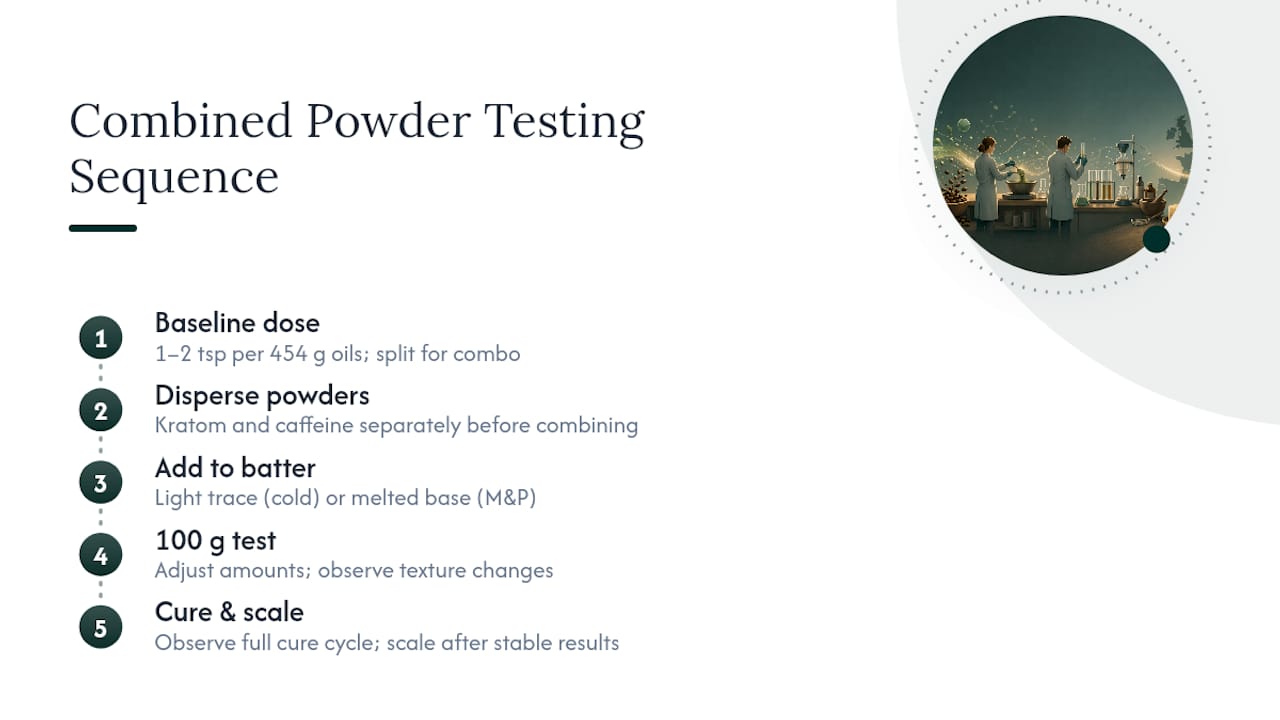
When testing kratom and caffeine together in a single batch, treat the combined load the same way you would treat any dual-additive formulation: keep the total powder weight within the same conservative range you would use for either ingredient alone. If your baseline for kratom is 1 to 2 teaspoons per 454 g (1 lb) of oils, a combined batch should split that allowance rather than stacking two full doses on top of each other.
A workable starting point is roughly half your usual kratom quantity paired with a small, separately-tested amount of caffeine powder, adjusted after your first 100 g test batch shows how the pair behaves together. Because caffeine tends to be more concentrated in color-neutral, fine crystalline form, small quantity changes can shift texture more noticeably than they shift appearance, so increase in small increments and record each change.
Always disperse the two powders separately before combining them into your batter, as covered earlier, since a shared slurry frequently leaves one ingredient under-dissolved. Add the combined slurry at light trace for cold-process work, or into the fully melted base for melt and pour, following the same staging guidance used for kratom alone. There is no universal ratio that works across every base recipe and every supplier’s powder consistency, which is exactly why the small-batch testing protocol matters more here than with a single additive.
Recognizing Formulation Failures When Two Powders Are Combined
A combined kratom and caffeine batch fails in the same basic ways a single-ingredient batch fails, just with a wider range of possible causes to check when something goes wrong. The most common signs are gritty or sandy texture on the cut bar, visible speckling in an otherwise smooth base, a bar that turns unusually soft or greasy, or color that develops dark spots rather than an even tone during cure.
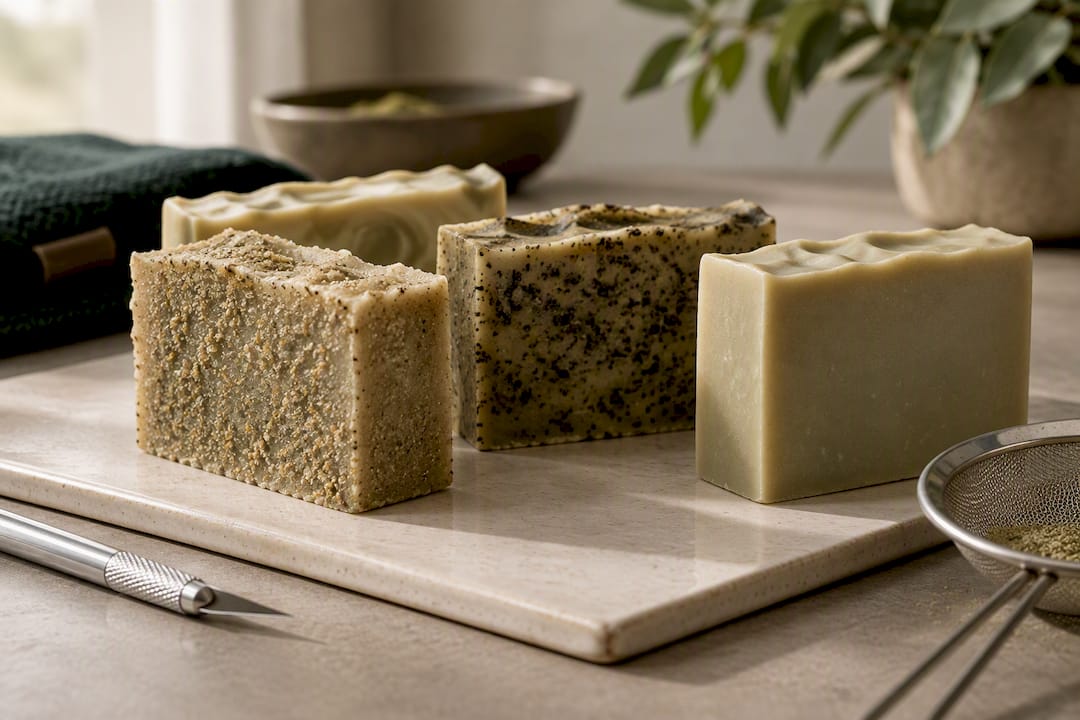
Grittiness almost always points back to inadequate slurry dispersion or a particle size that was too coarse for the intended base. If one botanical was properly slurried and the other was added dry, the dry one is typically the source of the texture problem, which is another reason to test each powder’s dispersion separately before combining them. Dark spotting or discoloration during cure often signals that one ingredient reacted with the batter’s high pH more than expected, and that is a cue to reduce the concentration of that specific powder on your next test round rather than abandoning the pairing altogether.
A bar that turns soft, greasy, or slow to harden usually means the combined powder load pulled too much moisture or interfered with saponification, which is why staying within conservative starting concentrations for both ingredients matters more when two additives share the same batch. If any test batch shows these signs, the fix is the same troubleshooting sequence covered earlier: reduce the load, re-check your slurry ratio, confirm your powder was properly sieved, and rerun a fresh 100 g batch before scaling anything up. Keeping written records of what went wrong on a failed batch is just as valuable as recording what worked, since it stops you from repeating the same combination error twice.
A Soap-Maker’s Take on Craft and Compliance
Working with botanical powders teaches you fast that creativity and paperwork are not opposites. Every interesting bar we have seen started as a 100 g test that someone photographed, weighed, and wrote down. Treat kratom the same way you would treat any new colorant: as a raw cosmetic material that earns its place in a recipe only after it passes your own small-batch scrutiny. This guide has intentionally stuck to non-ingestible, topical use throughout, because that is the only context where the formulation advice above actually applies.
— Kratomvia
Where to Source Lab-Tested Kratom for Soap-Making
Every batch is sourced from a known, traceable network of growers rather than anonymous bulk suppliers with independent lab results posted publicly so purity and potency can be verified before committing a botanical to your recipe book.

If you’re formulating with kratom for color or texture, the White Maeng Da, Red Maeng Da, Green Maeng Da, and Yellow Maeng Da product lines each bring a distinct tone to a finished bar, all starting from a competitive market price. The kratom soap and accessories collection rounds out a formulation kit, and pairing kratom with essential oils or a liquid colorant gives you more control over the final scent and shade. Before you build out your Product Information File, pull the batch documentation straight from the kratom lab reports page so your CoA records are ready the moment your first test batch cures.
Sources
- Cosmetic Products Enforcement Regulations 2013 (regulation 2009/1223)
- Making cosmetic products available to consumers in Great Britain (guidance)
- How to Use Powdered Colorants in Soap: Slurries and Dispersions | Soapy Friends
- Best cold-process soap techniques for embedding botanical powders | SoapMakingTip101
FAQ
Can I Use Kratom Powder for Ingestible Products?
No. Kratomvia markets kratom powder exclusively as a raw material for soap-making and other non-ingestible cosmetic or topical crafts, and this guide covers only that use.
How Much Kratom Should I Start With in a Soap Recipe?
A conservative starting point is 1 teaspoon per 454 g (1 lb) of oils for color, or up to 2 teaspoons for a mild scrub texture, adjusted after a small test batch.
Do I Need a Product Information File to Sell Kratom Soap in the EU or UK?
Yes. Any product marketed as a cosmetic needs a Product Information File retained for 10 years after the last batch reaches the market, along with a professional safety assessment.
What Is the Best Way to Mix Kratom Into Soap Batter?
Disperse the powder as a water or oil slurry before adding it to your batch, since dry powder added directly at trace tends to clump and streak.
Where Can I Check Batch Test Results for Kratomvia’s Kratom?
Kratomvia publishes independent lab reports for every batch on its kratom lab reports page, covering purity and potency testing with full batch traceability.
Recommended
- How to Make Kratom Soap | DIY Guide
- Peppermint Essential Oil for Kratom Soap Making EU & UK
- Tea Tree Essential Oil for Kratom Soap Making EU & UK
- Lavender Essential Oil for Kratom Soap Making EU & UK
Disclaimer: This blog is intended for educational and informational purposes only. The content provided is not intended to promote, recommend, or suggest human consumption of kratom or any other product. Our products are sold exclusively for their intended purposes as described on our website. This information should not be interpreted as medical advice, and we encourage readers to consult qualified professionals for any health-related questions.


