

Kratom Dosage for Energy
4 September 2026

Kratom is commonly reported to produce stimulant, energy-boosting effects at roughly 1 to 5 grams, whilst larger amounts tend to shift the experience towards sedation. No official medical dosage exists for kratom, so the safest approach is always to start low and go slow. Risk climbs noticeably once you push towards or past a moderate upper amount, so treat that as a line worth respecting rather than a target.
TL;DR:
- Doses between 1 and 5 grams are generally stimulant, promoting alertness and focus, while larger amounts increase sedation and risk of toxicity.
- Individual responses vary widely due to body weight, metabolism, tolerance, strain, product form, medications, and health conditions, necessitating careful self-tracking.
- Effects from powder or tea typically last three hours, with a slower onset, whereas extracts act faster and more intensely but are less predictable and not recommended for beginners.
- Start with a micro-dose of 0.5 to 1 gram on an empty stomach, wait at least 60 minutes, and gradually increase only if effects are too mild, avoiding daily escalation.
- Consistent, independently tested batches with controlled drying and clear alkaloid profiles help mitigate dosing variability caused by harvest and processing differences.
Table of Contents
- What does research say about kratom dosage for energy?
- Why does kratom affect everyone differently?
- How long do kratom’s energy effects last?
- How do you find your minimum effective dose for energy?
- What are the risks and warning signs to watch for?
- Why does batch consistency matter for kratom dosing?
- Our take on using kratom responsibly for energy
- Where to find tested strains suited to energy and focus
- Sources
What does research say about kratom dosage for energy?
Kratom’s dose-dependent nature is one of the few points regulators and researchers broadly agree on. At lower amounts, the alkaloids mitragynine and 7-hydroxymitragynine appear to stimulate rather than sedate, which is why so many people reach for a small amount in the morning instead of coffee. The EUDA’s kratom drug profile sets out this pattern clearly:
- Low dose (roughly 1 to 5 grams): typically stimulant, associated with alertness and increased focus.
- Higher dose (roughly 5 to 15 grams): typically sedative and analgesic, with a heavier, more relaxed feel.
- Above approximately 8 grams: toxicity becomes more likely, according to clinical guidance summarised on NCBI Bookshelf.
No safe upper threshold has been formally established. The EFSA’s 2022 risk assessment found insufficient dose-response data to set health-based guidance values, largely because kratom contains more than 40 alkaloids whose combined effects are hard to predict. That is not the same as saying kratom is unpredictable at every dose. It means the margin for error narrows the higher you go, which is exactly why the 1 to 5 gram window gets so much attention from anyone using kratom specifically for energy rather than relaxation.
Why does kratom affect everyone differently?
Two people taking an identical 3 gram dose can have noticeably different mornings, and that is not down to imagination. Bodyweight, metabolism, and prior tolerance all shift how quickly mitragynine reaches peak concentration and how strong that peak feels.
Several other variables matter just as much:
- Tolerance: regular users often need more to feel the same stimulant lift, which is part of why frequent daily use is discouraged.
- Strain and leaf age: vein colour is a rough guide at best, since potency varies by harvest timing, soil, and drying method even within the same strain.
- Product form: extracts concentrate alkaloids well beyond what raw powder delivers, intensifying both the effect and the risk.
- Medications: kratom is metabolised via the CYP3A enzyme pathway, so it can interact with certain prescription drugs that use the same route.
- Underlying health conditions: liver, cardiac, or respiratory issues change how safely a given dose is tolerated.
Pro Tip: Keep your first few sessions to the same time of day, the same meal timing, and the same product. Isolating variables is the only way to learn your personal response curve.
How long do kratom’s energy effects last?
Form changes the entire experience, not just the flavour. Powder taken as a drink, brewed as tea, or packed into capsules tends to behave consistently, with effects generally starting within 30 to 80 minutes and often lasting three hours or more, according to observational dosing research.
Extracts are a different story. Because they concentrate the active alkaloids, they tend to act faster and hit harder, which sounds appealing until you consider how much harder it becomes to judge your dose accurately.
- Powder or tea: slower onset, moderate peak, easier to titrate.
- Capsules: similar profile to powder, with more consistent gram measurement.
- Extracts: faster, stronger, shorter predictability window, generally not recommended for a first attempt at dosing for energy.
For anyone new to using kratom this way, whole-leaf powder or tea offers the most trackable, forgiving starting point.
How do you find your minimum effective dose for energy?
A structured trial beats guesswork every time, particularly in the first few weeks. This protocol draws on the titration approach outlined in clinical guidance and reflects how experienced users typically approach a new batch.
- Start with a micro-dose of 0.5 to 1 gram on an empty-ish stomach, ideally when you have no pressing commitments for the next two hours.
- Wait 60 to 90 minutes before deciding whether to increase anything. Kratom’s onset is not instant.
- If the effect feels too mild, add 0.5 grams and wait again rather than doubling up impatiently.
- Stop increasing once you feel a clear, comfortable lift. That point is your minimum effective dose, and it rarely needs to move upward.
- Cap yourself at 2 to 3 doses per waking day, with real spacing between them to limit tolerance build-up.
- Log everything: the gram amount, the form, the time taken, and how you felt an hour later.
| Step | What to track | Why it matters |
|---|---|---|
| First trial | Exact gram weight, product batch | Establishes your baseline |
| Follow-up doses | Time since last dose, effect strength | Prevents unnecessary escalation |
| Ongoing use | Frequency per week | Flags rising tolerance early |
If you find your “effective” dose creeping upward week by week, that is your cue to stop and reassess rather than push further.
What are the risks and warning signs to watch for?
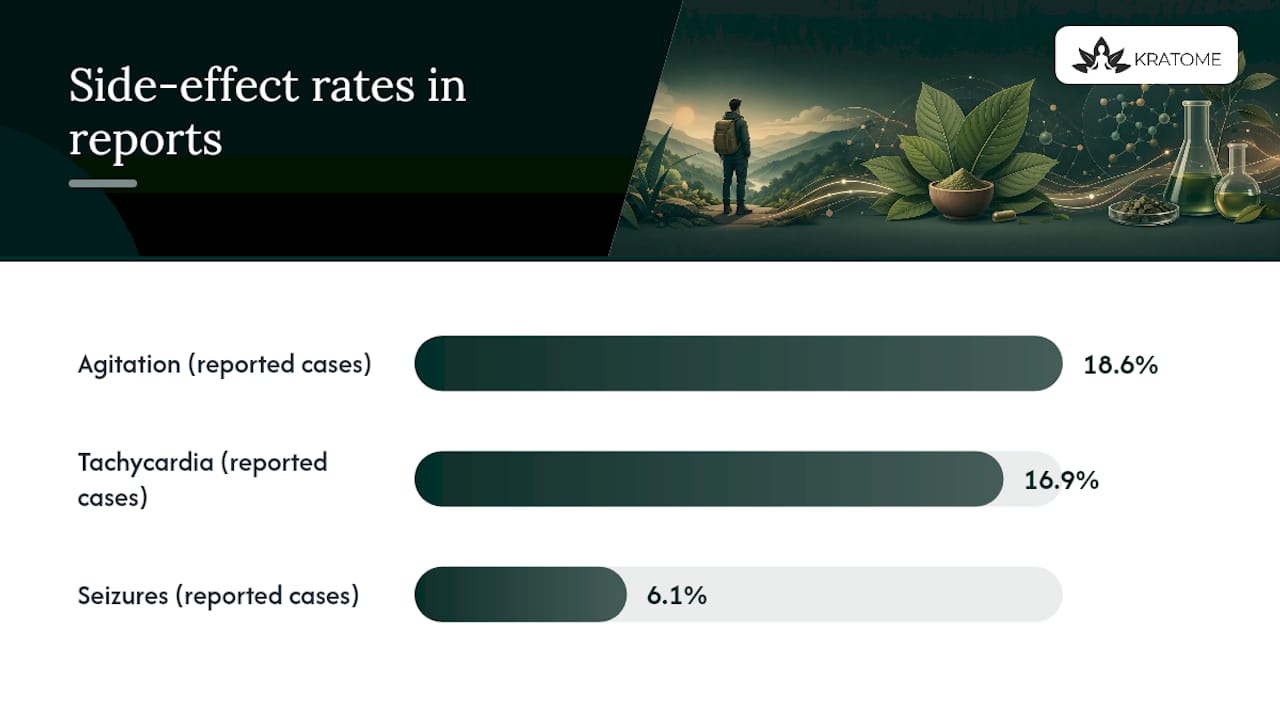
Most side effects at sensible stimulant doses are mild: nausea, dry mouth, or a slightly racing heart. Poison-centre data reviewed in a PMC clinical review found agitation in 18.6% of reported cases and tachycardia in 16.9%, with seizures appearing in 6.1%, figures that climbed alongside higher doses and, notably, alongside polysubstance use.
That last point deserves attention on its own. Combining kratom with opioids, benzodiazepines, or alcohol substantially raises risk, since these substances share overlapping effects on breathing and heart rate.
- Persistent vomiting or an inability to keep fluids down.
- Marked confusion, slowed or laboured breathing.
- Seizure activity of any kind.
- Yellowing of the skin or eyes, which can signal liver strain.
Any of these warrants immediate medical attention rather than waiting it out. None of them are common at low, well-spaced stimulant doses, but they are exactly why the harm-reduction habits above exist.
Why does batch consistency matter for kratom dosing?
A gram of kratom from one harvest is not chemically identical to a gram from another. Alkaloid content fluctuates with soil, harvest timing, and drying technique, which means a dose that worked perfectly last month can feel different from a new batch, even at the same weight.
This is precisely why some vendors test batches independently, source mature leaves, and control drying conditions before products reach customers. When checking any supplier’s lab reports, look for:
- A certificate of analysis matching the specific batch number on your product.
- Alkaloid content clearly stated, not just a pass/fail contamination check.
- Independent, third-party testing rather than in-house verification alone.
Consistency will not eliminate individual variation, but it removes one major unknown from your dosing equation.
Our take on using kratom responsibly for energy
Reaching for kratom every morning the way you might reach for coffee tends to backfire through rising tolerance, not sudden danger. The more useful pattern is occasional, purposeful use, where you actually notice the lift because your body has not adapted to it. Legal status and long-term evidence both remain unsettled in places, so treat this as a personal experiment worth tracking, not a settled science. Anyone with complex medical history should speak to a clinician first.
**
Where to find tested strains suited to energy and focus
Batch inconsistency is a major hidden variable in kratom dosing. Products that are independently lab tested, sourced from mature leaves, and dried under controlled conditions aim to provide consistent dosing experiences.
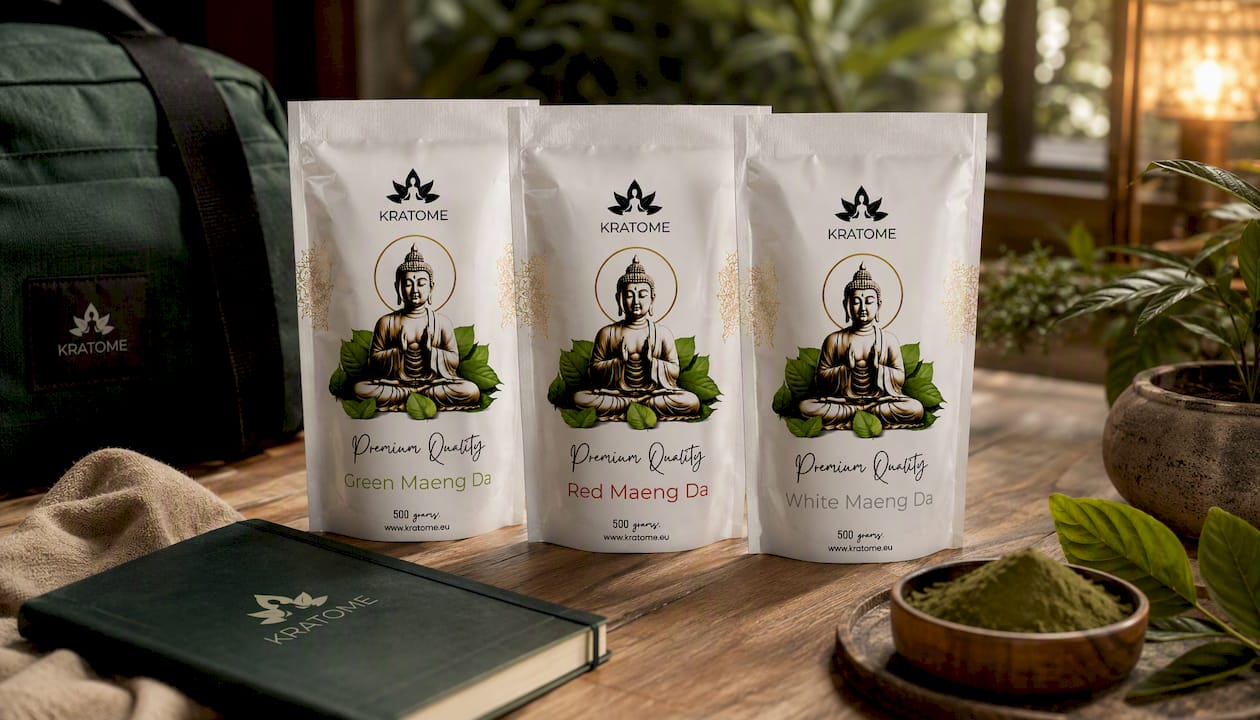
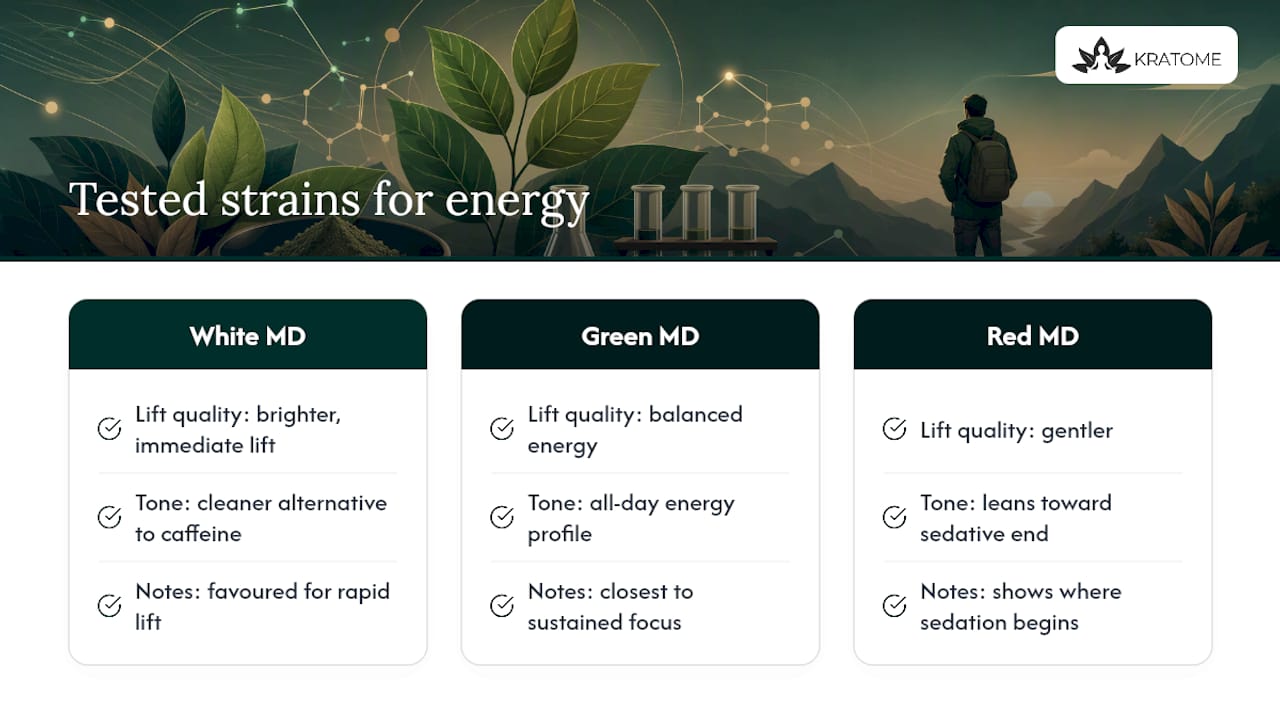
For readers exploring stimulant effects specifically, three strains come up again and again. Green Maeng Da sits closest to a balanced, all-day energy profile. White Maeng Da is often described as a cleaner alternative to caffeine, favoured for its brighter, more immediate lift. Red Maeng Da leans gentler and is worth knowing about even if your focus is energy, since it clarifies where the sedative end of the dose curve begins. None of these are medical treatments, and none replace the titration protocol above.
If you are trying kratom for the first time, buy the smallest quantity available rather than committing to a large order before you know your response. Browse the full range of kratom powders and start with a single strain you can track properly.
This article is general information, not a substitute for advice from a qualified doctor. Consult a qualified healthcare professional about your own circumstances before acting on anything here.
Sources
Recommended
- Green vs White vs Red Maeng Da: Best Kratom Strain, Focus & Relaxation
- Buy Kratom Online Europe & UK – Premium Lab-Tested Kratom
- Buy Green Kratom Online in EU & UK | Premium Green Kratom
- Kratom Strains Explained
Disclaimer: This article is for educational and informational purposes only. Kratom is sold by Kratomvia as a botanical specimen for study and collection purposes, and is not intended, approved, or authorised for human consumption in the European Union. Our kratom is sold as a soap accessory and collectible item.


