

Kratom Dosage Guide: How Much Powder by Strain
21 September 2026

Choose lab-tested powder so you know exactly what’s going into your formulation. From there, the right amount depends on whether you want a light tint, visible speckling, or an exfoliating texture.
TL;DR:
- Using between 1% and 2% of kratom powder by weight is recommended for a subtle tint or light speckle, with higher percentages creating more visible texture.
- Particle fineness and batch consistency significantly affect the dispersion, color stability, and texture of the final soap, making small-batch testing essential.
- Weighing powder on a digital scale is the most accurate method, but a repeatable slurry made with glycerin or oil can provide reliable measurements for hobbyists.
- Color changes are common during curing due to heat-induced pigment shifts, so final color should be evaluated after 30 days rather than immediately after casting.
- Reputable suppliers provide lab reports and traceability, ensuring ingredient purity and consistency for safe, reliable cosmetic formulations.
Table of Contents
- What Is the Best Kratom Dosage for Soap and Cosmetics?
- How Do You Calculate Kratom Dosage by Weight?
- How Do You Measure Kratom Without a Scale?
- How Do You Mix Kratom Powder Into Soap Without Clumping?
- Will Kratom Powder Change Color During Curing?
- What Kratom Powder Attributes Matter for Cosmetic Formulators
- What Are the Different Effects Associated With Kratom Strain Types?
- What Factors Affect How Much Kratom Powder to Use in a Recipe?
- Are There Safety Concerns When Using Kratom Powder in Soap?
- What Should You Watch for When Testing a New Kratom Powder Batch?
- How Often Should You Test New Formulations Before Production?
- Does Kratom Powder Form Affect How You Use It in Soap?
- A Supplier’s Perspective on Getting Kratom Dosing Right
- Order Lab-Tested Kratom Powder for Your Next Batch
- Sources
- FAQ
What Is the Best Kratom Dosage for Soap and Cosmetics?
Soap-making communities have settled on a dependable range for botanical powders, and kratom behaves like most other finely ground plant material in this regard. The consensus guideline calls for keeping botanicals to around 1 to 3 teaspoons per pound of soap base, with professional formulators often staying at 2% or less of total non-water ingredients to keep texture predictable. Push much higher and you risk a gritty bar, uneven color patches, or a batter that traces faster than expected.
Where you land inside that range depends on the effect you’re after:
- Light color or faint speckle: 0.5% to 1% of non-water ingredients, or about half a teaspoon per pound. This works well when kratom is a supporting note alongside other colorants like clays or activated charcoal.
- Noticeable, even color: 1% to 1.5%, closer to a full teaspoon per pound. This is the sweet spot most crafters land on for a consistent olive-to-green tone without added grit.
- Visible speckle or light exfoliant texture: 1.5% to 2%, up to roughly 1 to 2 tablespoons per pound for embedded rather than dissolved use. Some formulators reference a similar tablespoon-per-pound range for embedded botanicals with visible texture.
A 500-gram batch scales the same way, running 5 to 10 grams depending on the effect you want.
Particle size changes both the visual and tactile result. Finely milled kratom disperses more evenly and reads as a soft color wash, while coarser grinds create the speckled, slightly textured look many crafters want in exfoliating bars.
How Do You Calculate Kratom Dosage by Weight?
Percent-based dosing is the only method that scales reliably across batch sizes, and it’s the approach most experienced soapmakers rely on instead of eyeballing scoops. The formula is simple:
(Powder weight ÷ total weight of non-water ingredients) × 100 = percent kratom
Reverse it to find how much powder to weigh out: multiply your non-water ingredient weight by your target percentage (as a decimal).
- 100-gram batch, 1.5% target: 100 g × 0.015 = 1.5 grams of kratom powder.
- 500-gram batch, 1.5% target: 500 g × 0.015 = 7.5 grams of kratom powder.
- 1-pound (454-gram) batch, 2% target: 454 g × 0.02 = 9.08 grams, close to the 1 to 2 tablespoon range cited for embedded botanicals.
Keep a simple log for every test batch: date, total batch weight, powder weight, percent used, particle grade, and cure notes. This turns guesswork into a repeatable recipe instead of a one-time accident.
Pro Tip: A digital kitchen scale accurate to 0.1 grams costs less than a bar of specialty soap and removes almost all the guesswork from measuring without a scale. If you’re currently eyeballing teaspoons, switching to gram measurements is the single biggest accuracy upgrade you can make.
How Do You Measure Kratom Without a Scale?
Not every crafter owns a precision scale, especially when testing a new supplier’s powder for the first time. Volume-based measuring works as a reasonable stand-in, provided you accept some variability from batch to batch.
A level teaspoon of kratom powder typically lands close to the 1 teaspoon per pound guideline used for powdered colorants in soap, while a tablespoon suits the higher end of the range for embedded, textured use. Always level the spoon rather than mounding it, since a rounded scoop can run 20% to 30% heavier than a level one.
The more reliable fix, when accuracy matters, is making a slurry:
- Mix the measured powder with a small amount of glycerin, a light carrier oil, or a similar liquid already in your recipe.
- Stir until you get a smooth, lump-free paste with no dry pockets.
- Use this pre-measured slurry consistently across batches so your visual reference point (a spoonful of paste) stays the same each time.
A scale still beats volume measuring for consistency, but a calibrated teaspoon and a repeatable slurry ratio get hobbyists most of the way there.
How Do You Mix Kratom Powder Into Soap Without Clumping?
Dry kratom powder dropped straight into batter almost always clumps, and those clumps show up later as dark specks or gritty pockets in the finished bar. The fix used across most botanical soap guides is the slurry method: pre-mix the powder with a small amount of liquid before it ever touches your base.
- For melt-and-pour: blend the powder into warmed glycerin or a light oil until smooth, then stir the slurry into your melted base right before pouring.
- For cold-process: mix the powder into a portion of your recipe’s oil or into glycerin, since carrier oils and glycerin both help herbal powders disperse evenly rather than clumping in the lye solution.
- Timing matters: add the slurry at light trace, not before. Adding too early risks the powder settling unevenly; adding too late means it won’t distribute through the batter at all.
For a surface finish, sprinkle a fine-milled powder on top after pouring instead of mixing it through, which avoids the gritty feel some crafters notice when coarser powder is blended fully into the bar.
Will Kratom Powder Change Color During Curing?
Botanical powders can shift color as soap saponifies. The heat generated during that chemical reaction can alter delicate plant pigments, which is why testing small batches before committing to a full production run matters. A shade that looks vivid in the raw powder can mellow, darken, or bleach out entirely by the time the bar finishes curing.
A practical test protocol looks like this:
- Make a small test batch (250 to 500 grams) at your target percentage.
- Check color and texture at 24 hours, 7 days, and 30 days, since pigments can keep shifting through the full cure.
- Note any speckle bleeding into surrounding soap, texture changes, or scent shifts at each checkpoint.
If color fades faster than expected or the texture feels gritty, drop your percentage by half a point or switch to a finer particle grade before your next batch. One consistent finding across botanical soap testing: color stability at the 30-day mark is the real test, rather than how the bar looks fresh out of the mold.
What Kratom Powder Attributes Matter for Cosmetic Formulators
Not all kratom powder performs the same in a mold, and the differences usually trace back to sourcing and processing rather than strain alone. Kratomvia documents batch-level lab testing and traceability for every product it lists, which matters for crafters because inconsistent particle grade or hidden fillers are two of the most common causes of failed test batches.
When you’re comparing powder for cosmetic use, look for:
- Particle fineness listed or confirmed on request, since this drives whether you get a smooth tint or a speckled texture.
- Color consistency batch to batch, so a recipe that worked last month still works this month.
- No fillers or bulking agents, which can throw off your percent-based calculations and introduce unpredictable texture.
- Available lab reports you can check before committing to a full production run, not just a marketing claim.
Green Maeng Da is a reasonable starting point for crafters testing color and texture for the first time, and Kratomvia’s strain guide breaks down how green, red, and white strains differ in tone if you’re trying to match a specific look.
What Are the Different Effects Associated With Kratom Strain Types?
Strain naming in the kratom trade (red, white, green, yellow) refers to differences in leaf vein color and processing method, and crafters often choose between them for the visual and textural qualities those differences produce rather than for any effect on the body. Green-vein powders tend to sit in a mid-range olive tone that blends well into natural soap bases without overwhelming other botanicals. Red-vein powders often run darker and can shift more noticeably during cure, which makes small-batch testing especially useful before a full production run. White-vein powders tend to be lighter in tone and are sometimes chosen when a subtle speckle is the goal rather than a strong color statement.
Because this article is written strictly for non-ingestible, cosmetic, and craft applications, none of these distinctions relate to dosing kratom for personal use, and nothing here should be read as guidance on that front. The practical takeaway for a soap-maker is simpler: strain choice is mostly a matter of matching color and processing characteristics to your recipe, then confirming the result through the same small-batch testing protocol you’d use for any new botanical additive.
What Factors Affect How Much Kratom Powder to Use in a Recipe?
The right percentage for your recipe depends on more variables than a single blanket number can cover. Base type matters first: melt-and-pour bases hold suspended powder differently than cold-process batter, so a percentage that looks perfect in one base can settle unevenly in another.
Particle grade is the second major factor. A fine powder disperses into a smooth tint at a lower percentage than a coarse grind would need to achieve the same visual depth, since fine particles spread pigment across more surface area per gram.
Your intended finish also drives the number. A bath bar meant to feel silky calls for a lower percentage and finer grade than a foot-scrub bar built around visible exfoliating texture. Batch size and mixing method play a role too. Hand-stirred batches tend to distribute powder less evenly than batches blended with a stick mixer, which sometimes means erring toward the lower end of your target range until you’ve confirmed your mixing technique produces consistent results.
Finally, your own experience level with the ingredient matters as much as any formula. First-time users of kratom powder in a formulation should always start at the low end of the recommended range, run a small test batch, and only scale toward the higher end once the color, texture, and cure behavior are confirmed and repeatable.
Are There Safety Concerns When Using Kratom Powder in Soap?
Kratomvia’s products are formulated and sold specifically for soap-making and cosmetic-accessory use, not for ingestion, and the guidance in this article reflects that exclusive purpose. Handling any plant powder in a workshop setting still calls for ordinary craft-safety practices: work in a ventilated space, avoid inhaling fine powder while measuring, and wear gloves if you have sensitive skin, the same precautions you’d take with any finely milled botanical or clay.
Because kratom is a plant-derived powder rather than a synthetic colorant, batch-to-batch variation is normal, which is exactly why lab-tested sourcing and small-batch testing matter so much for cosmetic formulators. Checking a supplier’s lab reports for purity and consistency before you commit to a production run is a straightforward way to avoid surprises in your finished bars. If you’re formulating for retail sale rather than personal craft use, check your local cosmetic-safety and labeling requirements, since these vary by country and by product category.
What Should You Watch for When Testing a New Kratom Powder Batch?
When you’re evaluating an unfamiliar batch of powder for a cosmetic formulation, the things to watch for are visual and textural, not physiological. Look for uneven speckling, where powder clumps instead of dispersing evenly. That usually points to insufficient slurry mixing rather than a problem with the powder itself.
Watch for color bleeding into surrounding soap during cure, which can signal the percentage was too high for that particular batch of base or that the particle grade was too coarse for the effect you wanted. A gritty or scratchy feel on the skin during your test wash is a texture cue, not a safety cue, and it tells you to drop your percentage or switch to a finer grind on the next attempt.
If a test bar develops an unexpected texture change or a musty smell during cure, that’s a sign to check your base recipe’s moisture balance or your storage conditions for the raw powder, not necessarily the kratom itself. Document every irregularity in your batch log alongside the percentage and particle grade you used, since that record is what lets you fix the variable that actually caused the issue instead of guessing at your next attempt.
How Often Should You Test New Formulations Before Production?
Treat every new percentage, particle grade, or supplier batch as its own experiment rather than assuming last month’s recipe still applies. A practical rhythm is to run one small test batch (250 to 500 grams) any time you change one variable, whether that’s a new kratom strain, a different particle grade, or a different base oil blend.
Space your checkpoints across the cure: check color and texture at 24 hours for early clumping or bleeding, again at 7 days for color drift, and a final check at 30 days once the bar has fully cured. This staggered timing catches most of the color and texture shifts that only show up partway through curing, rather than the day the bar comes out of the mold.
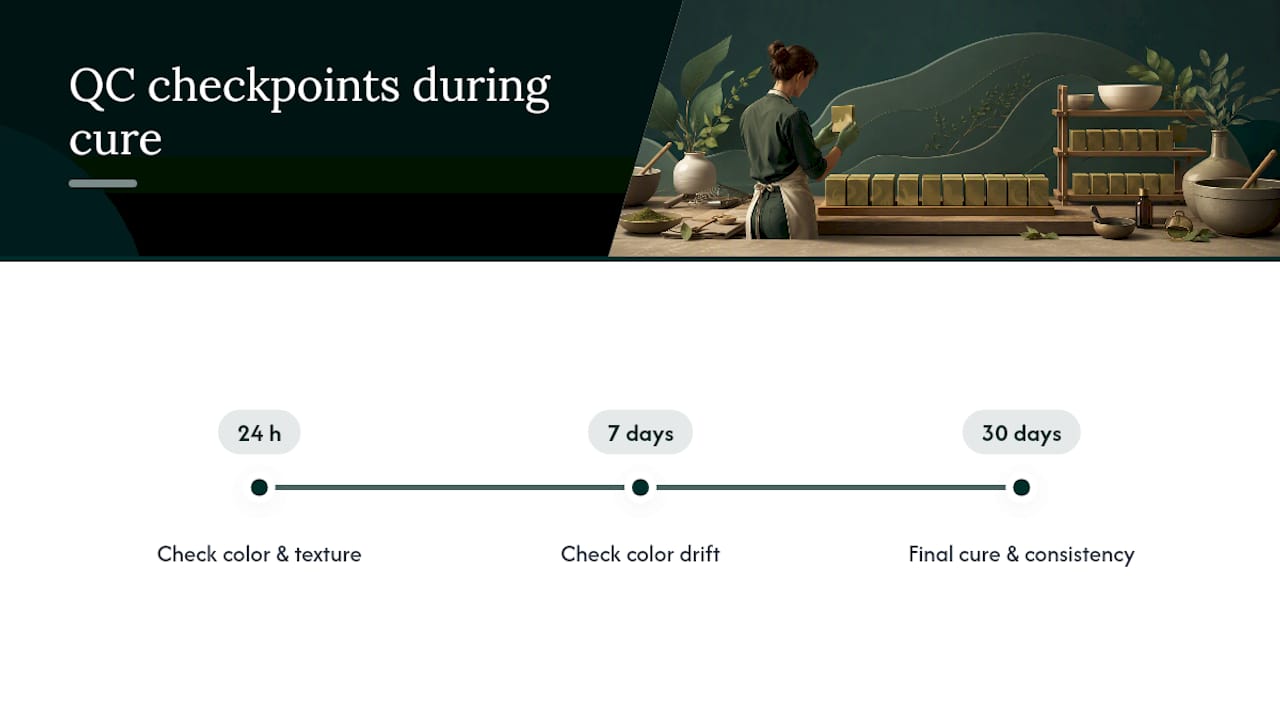
Once a formulation passes all three checkpoints with consistent results, it’s reasonable to scale to a full production batch. If you change suppliers or receive a new lot number from the same supplier, run the small-batch test again before assuming the new stock behaves identically. Batch numbers exist precisely so you can trace which lot produced which result, and cross-referencing that number against a supplier’s published lab reports is good practice any time you switch stock.
Does Kratom Powder Form Affect How You Use It in Soap?
Powder, extract, and capsule-derived material behave very differently in a soap base, and only one of those forms is genuinely suited to cosmetic crafting. Standard dried leaf powder is what nearly all soap-making guidance, including the ranges covered earlier in this guide, is built around. It disperses through a slurry, holds a consistent particle grade, and behaves predictably across melt-and-pour and cold-process bases.
Extracts are concentrated and processed differently, and craft guidance built around raw powder percentages doesn’t transfer to them. Capsules are a delivery format meant for a completely different use case and have no meaningful role in a soap or cosmetic recipe. This is why Kratomvia’s catalog for crafters centers on raw powder rather than extract or capsule products. If a supplier offers only extract or capsule forms, that inventory simply isn’t built for the percent-based, weight-driven formulation approach this guide covers.
A Supplier’s Perspective on Getting Kratom Dosing Right
A reliable supplier builds its business around lab reports and traceable batch numbers so crafters know exactly what they’re weighing into a recipe. Order a small sample first, log your results, and always follow local cosmetic-safety rules before scaling to production.
Order Lab-Tested Kratom Powder for Your Next Batch
Kratom is sometimes sourced directly from a small, known network of growers rather than anonymous bulk suppliers, and batches may carry lab results checkable by batch number before reaching a workshop. That traceability can be a practical advantage for crafters: confirming rather than guessing particle consistency or purity.
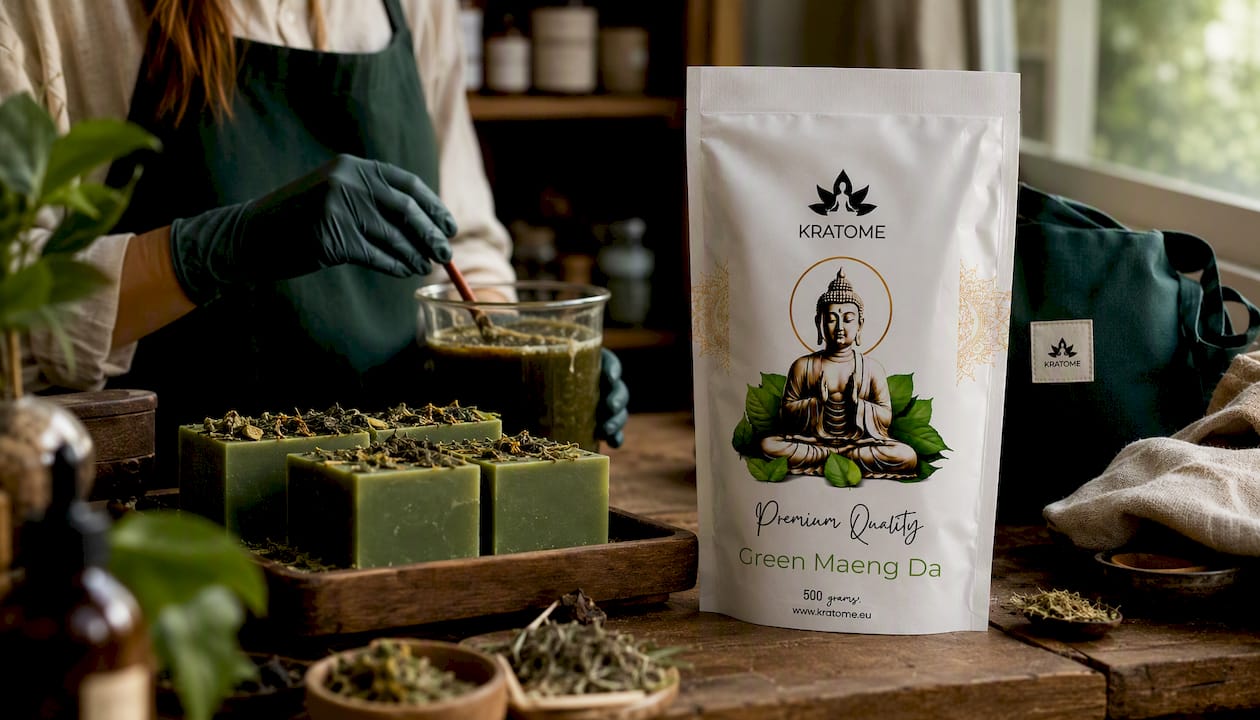
If you’re ready to run your first test batch, Green Maeng Da is a solid starting point for checking color and speckle behavior, priced from €14.90 per order. Browse the full strain catalog to compare green, red, white, and yellow options side by side, and check the lab reports for the batch number on any product before you order. Orders ship discreetly in plain packaging, whether you’re testing a single sample size or placing a wholesale order for production runs. Order a small quantity first, run your test protocol, and scale once your results are consistent.
Sources
- How to Use Herbs and Dried Flowers for Soap Making • Lovely Greens
- Best Cold-Process Soap Techniques for Embedding Botanical Powders | Soap Making Tip 101
- 5 Ways to Add Herbal Powders to Handmade Soap | Soap Making
- Herbs for Soap Making: What Works and What Fails
FAQ
What Percentage of Kratom Powder Should I Use in Soap?
Start at 1% to 2% of your non-water ingredients, which lines up with the general 2% guideline soap-makers use for botanical additions. Adjust toward the lower end for subtle tint and the higher end for visible speckle or texture.
How Do I Convert Kratom Percentage to Teaspoons Per Pound?
A rough guide is 1 teaspoon per pound for a light, colorant-level addition, and up to 2 tablespoons per pound for embedded, textured use, based on common conversion guidance for herbal powders. Weighing on a scale is more accurate than spoons, since powder density varies by particle grade.
How Do I Measure Kratom Powder Without a Scale?
Use a level (not mounded) teaspoon or tablespoon as your reference measure, and mix it into a slurry with glycerin or oil for even dispersion. A scale is still the more reliable option once you’re producing multiple batches.
Why Did My Kratom-Infused Soap Change Color During Cure?
Heat from saponification can alter delicate plant pigments, which is a normal reaction documented across botanical soap testing. Always confirm final color at the 30-day cure mark rather than judging a fresh bar.
Does Kratomvia Sell Kratom Powder Specifically for Crafting?
Yes, Kratomvia sells lab-tested kratom powder, including Green Maeng Da from €14.90, along with strain collections and lab reports crafters can check by batch number before ordering.
Recommended
- Yellow Colorant for Kratom Soap Making
- Red Soap Colorant for Kratom Soap Making
- Green Soap Colorant for Kratom Soap Making
- How to Make Kratom Soap
Disclaimer: This blog is intended for educational and informational purposes only. The content provided is not intended to promote, recommend, or suggest human consumption of kratom or any other product. Our products are sold exclusively for their intended purposes as described on our website. This information should not be interpreted as medical advice, and we encourage readers to consult qualified professionals for any health-related questions.


