

Kratom Lab Testing
15 September 2026

For this article, kratom lab testing means kratom products sold with independent, batch-specific Certificates of Analysis. Before you buy, ask the seller for the lot-linked COA and confirm the issuing lab holds current ISO/IEC 17025 accreditation. If either piece is missing, treat that as a reason to hold the purchase, not a formality to skip.
TL;DR:
- A credible kratom COA must be batch-specific, recent, and issued by an ISO/IEC 17025 accredited lab, with matching lot numbers and test dates.
- Testing results should include numeric data for identity, potency, heavy metals, microbiology, and pesticide residues, not just pass/fail summaries.
- Verification involves confirming accreditation numbers in national registers, ensuring the scope covers botanical matrices, and checking the certification’s validity date.
- Reused or generic lab reports, missing accreditation details, or lack of a COA should trigger suspicion and halting of the purchase process.
- Retailers should enforce strict documentation policies requiring lot-specific COAs, stored alongside shipment records, before selling any batch.
Table of Contents
- What Is a Certificate of Analysis and Why Does It Matter for Kratom Products?
- How Do You Read a Kratom COA Line by Line?
- How Do You Verify a Laboratory’s ISO/IEC 17025 Accreditation?
- Which Test Panels Should Appear on a Kratom COA?
- How Kratomvia Shares Lab Reports With Buyers
- What Do Kratom Alkaloid Profiles Actually Tell You?
- Why Do Kratom Lab Results Vary Between Tests?
- How Do Regional Rules Shape Kratom Lab Testing Expectations?
- How Can You Spot a Fake or Misleading Kratom Lab Report?
- Retailer Policy: Setting a Minimum Documentation Standard
- Where to Find Lab-Tested Kratom and Request a COA
- Sources
- FAQ
What Is a Certificate of Analysis and Why Does It Matter for Kratom Products?
A Certificate of Analysis is a lab document tied to one specific production lot, not a blanket claim about a brand’s entire catalog. It should list the lot number, test date, methods, and numeric results for that batch only, which means a COA from last year’s harvest tells you nothing about the bag on the shelf today.
That distinction separates a factory or internal COA from an independent third-party COA. An internal COA is written by the same company selling the product, using its own equipment and its own staff. A third-party COA comes from a laboratory with no financial stake in whether the batch passes, which is why serious botanical suppliers publish both together or lean on independent testing exclusively.
For a retailer, the COA is the paper trail that protects the business. If a customer or regulator ever questions a batch, the COA plus the shipping records show exactly which lab tested exactly which lot, on what date, using what method. Some industry voices describe a well-documented COA as a kind of quality passport that a batch carries from the lab to the shelf. Without that document, a retailer has nothing to point to if a batch is ever disputed. That gap is exactly what a lot-linked COA closes.
How Do You Read a Kratom COA Line by Line?
Reading a COA quickly and correctly is a skill, and it follows a fairly fixed sequence — learn more in this six-step check for potency and safety. Work through the same checklist every time so nothing gets skipped when you are moving fast at checkout or during a bulk order.
- Match the basics first. The product name, botanical name, and lot or batch number on the COA must match what is printed on the packaging in front of you, word for word and number for number.
- Check the dates. Look for both a test date and a document or issue date. A COA with no date, or a date far removed from the batch’s production window, tells you little about the product you are holding now.
- Confirm the methods. A credible COA names the assay method used, such as HPLC or ICP-MS, rather than simply stating “pass” or “fail.” Numeric results next to a stated specification range let you judge the batch yourself instead of trusting a label.
- Scan the contaminant panels. Heavy metals and microbiology results should appear with actual numbers, not just checkmarks.
- Watch for red flags. A missing lot number, a pass/fail-only format, or vague method names are all signs the document was not built for real verification.
Pro Tip: Keep a simple spreadsheet with columns for lot number, lab name, accreditation number, and test date. Cross-checking a new COA against that log takes thirty seconds and catches duplicated or recycled reports almost instantly.
If a COA is missing entirely, or the numbers do not line up with the packaging, do not accept a verbal explanation in its place. A supplier with a real quality system will produce the correct document or reissue it within a day or two. One botanical sourcing guide puts it plainly: a missing or generic COA is a signal to pause the order, not a paperwork gap to overlook.
How Do You Verify a Laboratory’s ISO/IEC 17025 Accreditation?
ISO/IEC 17025 is the international standard that shows a laboratory has demonstrated competence in specific test methods, not just that it owns the right equipment. It matters enough that EU Implementing Regulation 2019/1793 accepts results only from ISO/IEC 17025-accredited labs for official control testing at border inspection posts, which tells you how seriously regulators treat this credential when the stakes involve consumer safety.
Verifying a lab’s accreditation takes four steps:
- Get the lab’s full name and accreditation number. A legitimate COA prints both directly on the document.
- Search the relevant national accreditation register. Most countries maintain a public database where you can look up the accreditation number and confirm it is active and belongs to that lab.
- Confirm the scope covers your matrix and method. Accreditation is scope-specific: a lab might be accredited for heavy metals in food powders but not for microbiology in botanical matrices, so check that the scope actually lists botanical powder and the method used, such as ICP-MS for metals.
- Check the validity dates. Accreditation lapses and gets renewed on a cycle, so confirm the certificate was active on the test date shown on your COA, not just active today.
For high-value or bulk orders, it is reasonable to request the raw chromatograms or instrument printouts behind the summary numbers, or to commission an independent retest at a separate accredited lab if something about the paperwork feels inconsistent.
Which Test Panels Should Appear on a Kratom COA?
A serious botanical COA covers more than one category of testing, and knowing what belongs on the page helps you spot a thin report immediately.
| Panel | What it checks | Why it matters |
|---|---|---|
| Identity and potency | Confirms the botanical matches its labeled name and reports a numeric alkaloid result against a stated method | Establishes the batch is what it claims to be |
| Heavy metals | Lead, arsenic, cadmium, mercury | Flags contamination from soil or processing |
| Microbiology | Total plate count, Salmonella, E. coli, yeast and mold | Catches contamination from handling or storage |
| Pesticide residues and aflatoxin | Screens for agricultural chemical residues and mold toxins | Required by some destination markets before import |
At minimum, buyers should expect identity, potency, and heavy metals results on any COA worth trusting. A report that skips straight to a marketing summary without these numbers is not offering real quality assurance, no matter how polished the document looks.
How Kratomvia Shares Lab Reports With Buyers
Kratomvia sources its kratom from growers in Southeast Asia and pairs each batch with independent, lab-tested documentation before it reaches a customer. The kratom lab reports page is where those batch-linked reports live, organized so a buyer can find the COA tied to the specific lot they are considering.
Before checkout, a buyer or retailer can request the COA for the exact lot number listed on the product page or packaging. Kratomvia’s own approach mirrors the checklist covered above:
- Match the lot number on the COA to the lot number on the product.
- Confirm the testing lab’s accreditation before treating the results as final.
- Keep a copy of every COA on file, especially for bulk or wholesale orders.
That workflow is what turns a testing claim into something a buyer can actually check.
— Kratomvia
What Do Kratom Alkaloid Profiles Actually Tell You?
An alkaloid profile is the identity and potency section of the COA, and it reports specific alkaloid concentrations rather than a vague strength rating. The numbers are typically expressed as a percentage of the tested material, measured against a stated method such as HPLC.
Two batches of the same strain name can show different alkaloid numbers, because botanical products can vary due to factors like plant maturity, harvest timing, drying method, and regional soil conditions. That variation is exactly why a COA has to be lot-specific. A single “typical profile” listed once on a product page cannot account for the batch actually sitting in a shipment.
For retailers buying in bulk, comparing the alkaloid numbers across several lots from the same supplier over time is a reasonable way to judge consistency. A supplier whose batches show widely different results from one shipment to the next, without a documented reason such as a different growing region, is worth questioning. A supplier whose profiles stay within a tight, explainable range is demonstrating real process control, not just handing over paperwork.
Reading these numbers does not require a chemistry background. It requires comparing the reported result against the specification range printed on the same document, and confirming that both numbers came from a named, verifiable method rather than an unlabeled internal test.
Why Do Kratom Lab Results Vary Between Tests?
Lab testing is precise, but it is not infinitely precise, and buyers benefit from understanding where the natural variation comes from. Different laboratories can report slightly different numbers for the same sample, even when both use accredited methods, because of differences in instrument calibration, sample preparation, and the specific reference standards each lab uses.
Sampling itself introduces variability before any instrument is involved. A single kratom batch might weigh hundreds of kilograms, and the small sample pulled for testing has to represent the whole lot. Uneven mixing, moisture differences across the batch, or an unrepresentative sample pull can all produce results that do not perfectly reflect every unit in that shipment.
Method choice matters too. HPLC and other chromatography-based methods are standard for alkaloid identity and potency work, and ICP-MS is the common method for heavy metals, but even within these methods, labs can set different detection limits or run different numbers of replicate tests. A result reported as “below detection limit” is not the same claim as “zero,” and the difference matters when you are comparing two suppliers’ COAs side by side.
None of this means lab results are unreliable. It means a single COA is a snapshot of one sample from one lot, tested by one method, on one date. Retesting through a second accredited lab is the most direct way to confirm a result that seems unusual, and it is a reasonable step for any buyer moving significant volume.
How Do Regional Rules Shape Kratom Lab Testing Expectations?
Testing expectations are not identical everywhere, because the regulatory frameworks that shape acceptable evidence differ by region. The clearest example is EU Implementing Regulation 2019/1793, which governs official control testing at EU border inspection posts and accepts results only from ISO/IEC 17025-accredited laboratories. That regulation was written for food and feed import controls generally, but it illustrates a broader principle that shows up across most developed markets: official bodies do not accept just any lab report, they require accreditation tied to the specific test method used.
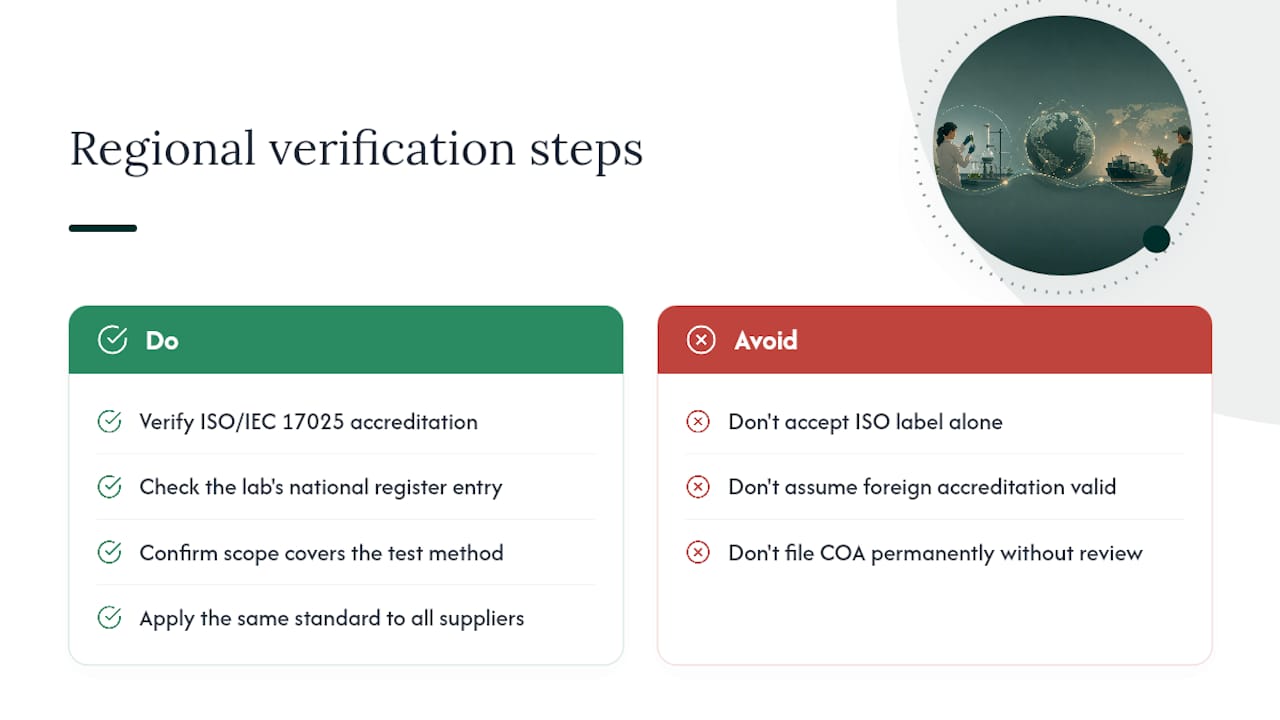
Outside the EU, national accreditation bodies run their own registers, and a lab accredited in one country is not automatically recognized in another unless there is a mutual recognition arrangement between accreditation authorities. That is why the verification steps in the earlier section, checking the specific national register and the specific scope, matter more than simply seeing an “ISO 17025 accredited” label on a document.
For buyers and retailers operating across Europe and the UK, the practical takeaway is consistency: hold every supplier to the same accreditation standard regardless of which country the lab sits in, and verify that standard through the applicable national register rather than taking the claim at face value. Regional rules will keep evolving as regulators pay closer attention to botanical products generally, so a COA that meets today’s expectations is worth rechecking periodically rather than filed away permanently.
How Can You Spot a Fake or Misleading Kratom Lab Report?
Fraudulent lab reports tend to share a handful of tells, and once you know them, they are not hard to spot. A COA with no lab accreditation number, no test date, or a lot number that does not match the product in front of you is the clearest warning sign, and it should be treated as a decisive reason to hold the shipment rather than a detail to overlook.
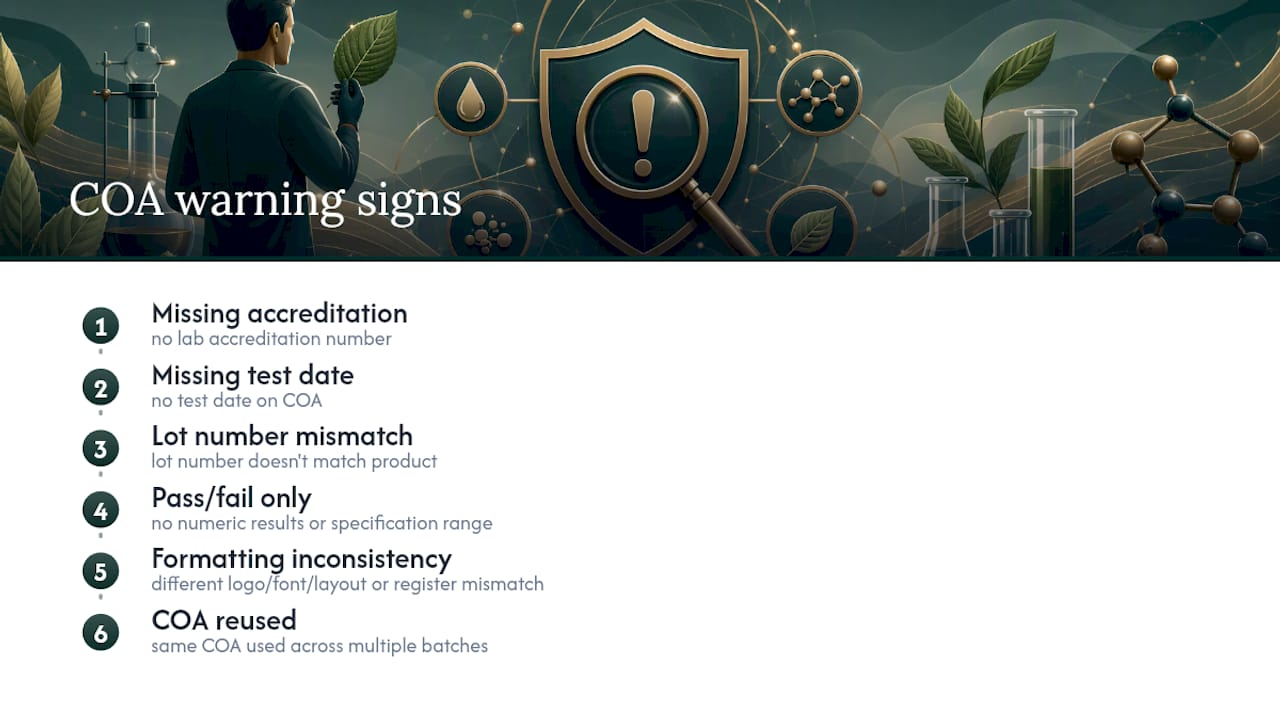
Watch for documents that report only “pass” or “fail” without numeric results next to a specification range. A genuine assay report shows the actual measured value, whether that is an alkaloid percentage or a heavy metal concentration in parts per million, alongside the limit it was tested against. A pass/fail-only format hides the information a buyer actually needs to judge the batch.
Formatting inconsistencies are another clue. A COA that uses a different logo, font, or layout from a lab’s other public sample reports, or one where the accreditation number does not match anything in the national register, suggests the document may have been altered or fabricated. Cross-referencing a supplier’s COA against a lab’s own published sample report, when one is available, is a quick way to catch this.
Finally, be cautious of a COA that gets reused across multiple batches. Each lot should generate its own report with its own test date. If the same COA keeps appearing for shipments months apart, ask the supplier directly for the batch-specific version, and treat a refusal or delay as meaningful information in itself.
Retailer Policy: Setting a Minimum Documentation Standard
Retailers carry the most risk in this chain, so the strongest protection is a written policy rather than an informal habit. Require every supplier contract to specify a lot-linked COA, the name and accreditation number of the issuing lab, and a defined retest window if a batch is ever questioned.
Store COAs and accreditation evidence alongside your batch and shipping records, not in a separate folder that gets forgotten. That pairing is what makes traceability real if a question ever comes up months later.
Set a firm rule: shipments arriving without adequate documentation get held, not sold, until the paperwork is corrected. A supplier that resists this standard is telling you something about how it runs its own quality process.
Where to Find Lab-Tested Kratom and Request a COA
Kratomvia gives buyers and retailers a direct path to lab-tested inventory instead of asking them to take a testing claim on faith. Every batch listed across the red kratom, green kratom, and broader kratom collection pages is paired with documentation you can check before you commit to an order.

Start with the kratom lab reports page, where batch-linked reports are organized by lot so you can pull up the exact document tied to the product you are considering. If you cannot locate the COA for a specific lot number, request it directly before checkout, the same way this guide recommends treating any supplier. Kratomvia also carries essential oils for soap making for buyers building out soap and accessory lines alongside their kratom orders. Review the lab reports for your intended batch, confirm the lot number matches, and place your order once the documentation checks out.
Sources
Confirm accreditation numbers directly through your country’s national accreditation body register rather than trusting the number as printed. For regulatory context on why accredited labs carry legal weight, EU Implementing Regulation 2019/1793 shows how official control testing standards treat ISO/IEC 17025 accreditation as a baseline requirement.
- Implementing Regulation (EU) 2019/1793
- What a Certificate of Analysis Actually Tells You — A Non-Technical Guide
FAQ
What does “lab tested kratom” actually mean?
It means the batch has an independent, lot-specific Certificate of Analysis showing identity, potency, and contaminant results, issued by a laboratory separate from the seller.
How do I verify kratom lab tests are real?
Match the lot number on the COA to the packaging, then look up the lab’s accreditation number in the relevant national register to confirm it is active and covers the right test methods.
What is the difference between in-house and third-party kratom testing?
An in-house COA is written by the same company selling the product, while a third-party COA comes from an independent accredited lab with no stake in the sale, which is why buyers should generally weigh independent results more heavily.
What should a kratom purity testing report include at minimum?
At minimum, expect identity and potency results with numeric values, plus a heavy metals panel covering lead, arsenic, cadmium, and mercury, all tied to a specific lot number and test date.
Does Kratomvia provide batch-specific lab reports?
Yes, Kratomvia publishes batch-linked independent lab reports on its lab reports page, and buyers can request the COA for a specific lot before purchasing.
Recommended
- Salmonella & Kratom: Why a Batch CoA Matters
- How to Choose Quality Kratom
- Kratom Side Effects: What Lab Testing Reveals
Disclaimer: This blog is intended for educational and informational purposes only. The content provided is not intended to promote, recommend, or suggest human consumption of kratom or any other product. Our products are sold exclusively for their intended purposes as described on our website. This information should not be interpreted as medical advice, and we encourage readers to consult qualified professionals for any health-related questions.


