

Kratom Price Guide
12 September 2026

Powder prices vary depending on strain and testing standards, with capsule packs costing notably more due to processing, and extracts priced higher due to concentration, but exact dollar ranges are not provided here. Cost per gram is the metric that cuts through marketing noise: divide the total price by the total grams in the package, and every vendor becomes directly comparable. Lab testing, sourcing origin, and processing method explain most of the spread between a $9 ounce and a $22 ounce.
TL;DR:
- Vendors charging less than $9 per ounce often compromise on testing, sourcing, or processing standards, making verification crucial at lower price points.
- Capsules cost 20 to 40% more per gram than powder due to encapsulation labor and packaging, with fill weight variations significantly impacting actual cost.
- Premium strains like Maeng Da and Bentuangie are priced higher because of limited yield, traceable sourcing, or extra curing and fermentation steps.
- Bulk orders can decrease per-gram costs by over 30%, but only if batch-specific COAs and proper storage conditions are confirmed to ensure product integrity.
- Red flags include pricing far below market average, missing batch-specific Certificates of Analysis, and inconsistent packaging, which indicate potential adulteration or mislabeling.
Table of Contents
- What Is the Average Price Range for Kratom Products?
- How Does Price Vary by Product Form?
- Why Do Some Kratom Strains Cost More Than Others?
- How Do You Calculate Cost Per Gram and Cost Per Serving?
- What Actually Drives Kratom Pricing?
- How Much Can You Save Buying Kratom in Bulk?
- How Do You Spot Value and Avoid Overpaying?
- How Kratomvia’s Testing and Transparency Shape Pricing
- Do Kratom Prices Vary by Region and Legal Status?
- Do Kratom Prices Change With the Seasons?
- How Do You Identify Counterfeit or Adulterated Kratom?
- A Buyer’s Take on What Actually Matters in 2026
- Compare Cost Per Gram, Then Shop With Confidence
- Sources
- FAQ
What Is the Average Price Range for Kratom Products?
Price bands shift with package size, and the per-unit cost usually drops as the pack gets bigger. That pattern holds across nearly every botanical powder market, and kratom is no exception.
Here’s how typical retail pricing breaks down by format and pack size:
Typical retail pricing varies by format and pack size, with larger packages usually costing less per unit. Pricing details are available from vendor sites and guides but vary widely and are not specified here.
Advertised sticker prices can be misleading. A $9 ounce that charges $12 flat-rate shipping costs more per gram than a $14 ounce with free shipping over a modest order threshold. Always add shipping, packaging fees, and any card-processing surcharge before comparing two listings side by side. Vendors that publish Certificates of Analysis alongside pricing tend to sit in the middle-to-premium band, and that positioning is rarely accidental. Testing costs money, and that cost shows up on the price tag.
How Does Price Vary by Product Form?
Powder, capsules, extracts, and specialty formats are not the same product wearing different packaging. Each format carries its own processing overhead, and that overhead is exactly why a bottle of capsules almost never costs the same per gram as loose powder.
Here’s what changes the math for each format:
- Powder is the least processed form. Growers dry and grind the leaf, a lab runs alkaloid and contaminant panels, and the product ships. Processing overhead is low, which is why powder anchors the bottom of the price range.
- Capsules add encapsulation labor, capsule shell material cost, and typically tighter quality control since dosing consistency matters more in a fixed-fill format. Expect a 20 to 40% premium per gram over loose powder.
- Extracts concentrate the plant material, often requiring several times the raw leaf input per finished gram. That input ratio is the single biggest reason extracts cost more than powder on a per-gram basis, independent of any strain premium.
- Liquid formats and shots carry bottling, preservative, and shelf-stability costs on top of concentration, pushing them toward the top of the price spectrum for their actual plant content.
- Specialty and blended formats (flavored, enhanced, or combination products) add formulation and small-batch production costs that rarely scale down the way straight powder does.
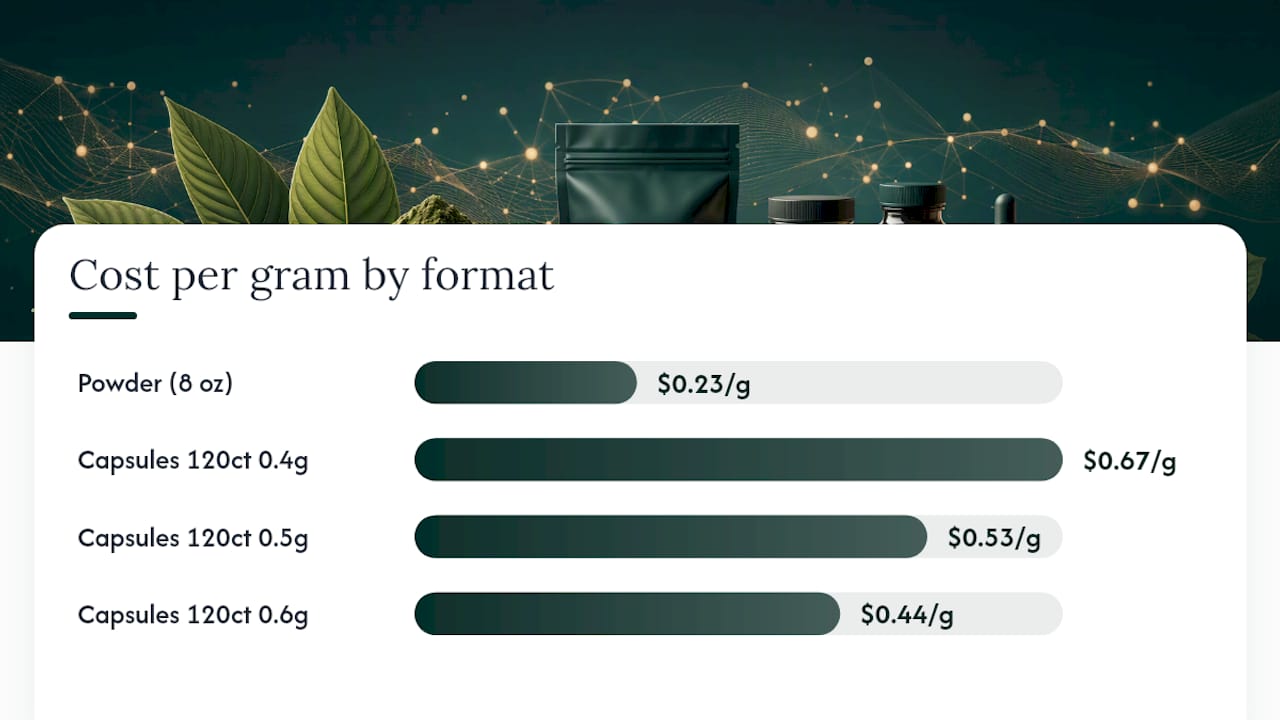
A worked example makes the comparison concrete. An 8 oz powder bag priced at $52 works out to roughly 227 grams for $52, or about $0.23 per gram. A 120-count capsule bottle priced at $32, where each capsule holds roughly 0.5 grams of plant material, contains 60 grams total, which puts the cost at about $0.53 per gram. That’s more than double the powder rate for the same raw material, and the difference is almost entirely encapsulation labor and packaging.
Convenience format premiums are sometimes worth paying. If precise, repeatable measurement matters for your process, a capsule’s consistency has real value that loose powder can’t match without additional equipment.
Pro Tip: Check the vendor’s product specification sheet for capsule fill weight before comparing bottles. A “120 count” bottle at 0.4 grams per capsule contains far less material than one at 0.6 grams, even at an identical price. Multiply capsule count by fill weight to get total grams, then divide price by that number for a true cost-per-gram figure.
Why Do Some Kratom Strains Cost More Than Others?
Strain names signal origin and processing method, and that history is part of what buyers are paying for. Rarity, harvest timing, and blending status move a strain from budget to premium territory faster than almost any other factor.
Typical price bands cluster like this:
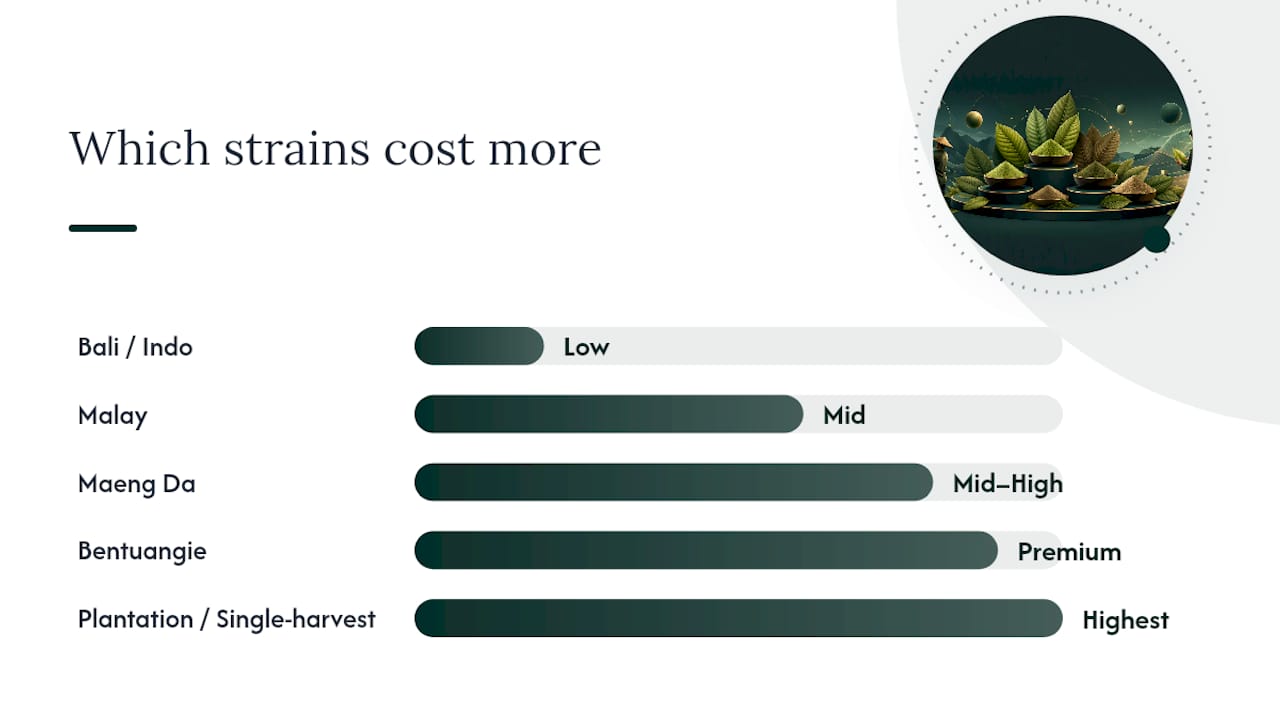
- Bali and Indo: Generally the most widely available and least expensive, often at the low end of the per-ounce range because of high-volume cultivation.
- Malay: Mid-range pricing, reflecting moderate supply and steady demand.
- Maeng Da: Sits in the mid-to-upper range across red, white, and green variations. The name refers to a cultivation and grafting method rather than a single farm, so pricing varies more by vendor than by strain designation alone. A Red Maeng Da listing from a vendor that publishes batch-level testing will typically price higher than an unverified equivalent, and that gap reflects real lab cost, not just marketing.
- Bentuangie: A fermentation-style processing method that requires extra curing time, usually landing in the premium tier.
- Plantation, single-harvest, or small-batch strains: These command the highest premiums because limited yield and traceable sourcing both add cost at the source.
Small-batch and single-harvest products cost more for a defensible reason: limited yield means the grower can’t spread fixed costs, like labor and testing, across as many kilograms. A single-origin batch that gets its own Certificate of Analysis is paying for that documentation on a smaller production run, and the price reflects it.
That premium is defensible when the vendor discloses the blend ratio and provides testing for both components. It’s a red flag when the label uses the word “enhanced” with no explanation of what was added or in what proportion.
The test for whether a strain premium is fair: ask what specifically justifies it. Rarity, documented single-origin sourcing, or third-party testing are legitimate reasons. A fancier name with no verifiable difference in sourcing or testing is not.
How Do You Calculate Cost Per Gram and Cost Per Serving?
The formula is simple: total price ÷ total grams = cost per gram. For capsules, multiply capsule count by fill weight in grams to get total grams before dividing. This single calculation is what separates an actual kratom cost comparison from a guess based on sticker price alone.
Three quick examples show how this plays out:
- Powder: A 4 oz bag (113 grams) priced at $34 comes out to $0.30 per gram.
- Capsules: A 60-count bottle at 0.5 grams per capsule (30 grams total) priced at $19 comes out to $0.63 per gram, more than double the powder example above.
- Extract: A 15-gram concentrated extract priced at $38 comes out to $2.53 per gram, reflecting the multiplied raw-leaf input required to concentrate the product.
Shipping and subscription discounts change the effective number. A $34 bag with $6 flat shipping becomes $40 total, pushing the real cost to $0.35 per gram. When you build a comparison, use five inputs: package price, package weight or count, fill weight per unit (for capsules), shipping cost, and any recurring discount. Run every vendor through the same five inputs and the winner is usually obvious.
What Actually Drives Kratom Pricing?
Four cost centers determine most of the final price tag, and understanding them turns a vague “why is this so expensive” question into a specific, checkable line item.
- Independent lab testing. Alkaloid panels, heavy metal screening, and microbial testing are not free, and batch-to-batch variability in raw plant material is well documented in the pharmacological literature, which is exactly why testing every batch (rather than sampling occasionally) matters. A peer-reviewed review of the clinical and pharmacological literature confirms alkaloid content varies meaningfully between batches, making per-batch testing a real cost rather than a marketing flourish.
- Sourcing and supply chain. Origin, export and import fees, and seasonal harvest timing all move the wholesale price a vendor pays before it ever reaches a warehouse shelf.
- Processing, packaging, and labor. Drying method, grind consistency, encapsulation, and packaging materials add cost that scales with the format complexity discussed earlier.
- Vendor overhead. Customer service, warehousing, discreet shipping logistics, and marketing all sit on top of the product cost itself, and that overhead varies enormously between a small operation and a large one.
Testing cost snapshot: Running a full alkaloid, heavy metal, and microbial panel on a single batch is a meaningful line-item expense for any vendor, and that cost gets distributed across the batch’s total sellable weight. A vendor testing every batch, rather than testing occasionally and hoping consistency holds, is absorbing more cost per kilogram, and that discipline shows up in the price. The NCBI review and NIDA’s research overview both point to composition variability as the underlying reason third-party testing matters at all.
Regulatory context adds another layer of overhead. The DEA’s 2020 informational document outlines the patchwork of state and federal attention kratom has received, and that regulatory uncertainty pushes some vendors toward more conservative (and more expensive) compliance practices, including shipping restrictions and extra documentation. FDA public materials on labeling and supplement regulation reinforce why vendors that invest in documentation and clear labeling tend to charge more. That price difference is buying compliance infrastructure, not just plant material.
How Much Can You Save Buying Kratom in Bulk?
Per-unit cost drops steadily as order size increases, and the discount curve is predictable enough to plan around. A full kilogram order can bring the per-ounce price down by 30% or more compared to buying in 1 oz increments, and wholesale accounts ordering 5 kg or larger often see the steepest discount curve of all.
Per-kilo benchmark ranges span widely by quality tier. Budget-tier bulk kratom can land toward the lower end of the kilogram price range referenced earlier, while premium, fully-tested, single-origin bulk orders sit well above that floor. The gap between those two tiers is almost entirely testing depth and sourcing documentation.
Before committing to a bulk order, confirm the paperwork:
- A batch-specific Certificate of Analysis matching the lot number on the bag, not a generic testing document reused across multiple harvests
- Clear sourcing information tied to that specific batch
- A wholesale agreement or invoice that specifies testing scope, not just price and quantity
Storage matters as much as the paperwork. Larger quantities need airtight, moisture-controlled containers and a cool, dark storage area to preserve product consistency over the life of the order. Buyers without proper storage capacity should stick to smaller pack sizes even if the per-unit math favors bulk, since spoiled inventory erases any bulk discount immediately.
How Do You Spot Value and Avoid Overpaying?
A methodical checklist beats gut instinct every time you’re comparing vendors, and the checklist is short enough to run through in under five minutes per listing.
Total cost comparison should include:
- Base price for the exact package size, not a promotional “starting at” figure
- Shipping cost, factored in even when it’s flat-rate or waived above a threshold
- Return policy terms, since a no-returns policy shifts real risk onto the buyer
- Hidden fees, including payment processing surcharges some vendors add at checkout
- Subscription pricing, which can lower effective cost per gram significantly on repeat orders but sometimes locks in a minimum commitment
Red flags that should make you pause before buying: no Certificate of Analysis available on request, vague or missing sourcing information, a price dramatically below the market range with no explanation, and batch numbers or lab dates that don’t match what’s printed on the packaging. Any one of these alone might be an oversight. Two or more together is a pattern worth walking away from.
Higher prices are defensible when they’re backed by something concrete: documented per-batch testing, traceable single-origin sourcing, or small-batch production that genuinely limits scale. Higher prices are not defensible when the only justification offered is a vague claim about “premium quality” with nothing to verify it.
Pro Tip: Ask any vendor for the specific COA matching the batch or lot number on your intended purchase, not a general testing document from a previous run. A vendor that can produce this instantly is telling you something important about their internal quality process, and a vendor that can’t is telling you something too.
Do check the lab date relative to the harvest date. Don’t assume a professional-looking website is a substitute for actual documentation.
How Kratomvia’s Testing and Transparency Shape Pricing
Kratomvia batch-tests every product line through independent laboratories, and those results are published on a dedicated kratom lab reports page rather than kept behind a customer service request. That transparency is a direct answer to the red flags covered above: a batch number on the bag should match a batch number on a public report, and Kratomvia builds that traceability into its catalog structure.
The testing investment behind those reports is exactly the cost driver discussed earlier. Alkaloid, heavy metal, and microbial panels run on every batch add real expense, and that expense is why fully-tested products sit in the mid-to-premium tier rather than the rock-bottom end of the market. Kratomvia’s guide to evaluating quality walks through the same verification steps this article recommends: check the COA, confirm the batch match, and treat sourcing transparency as a price justification rather than a marketing slogan.
A few catalog specifics worth noting for anyone comparing across vendors:
- Discreet, unmarked packaging on shipments across Europe and the UK, addressing a privacy consideration many buyers weigh alongside price
- Multiple strain lines, including Red, Green, White, and Yellow varieties, each tied to its own batch documentation
- Accessory and manufacturing-support items, including precision scales and soap-making colorants, for buyers working in production or formulation contexts rather than the product line’s kratom powder itself
None of this changes the core math from earlier sections. It simply shows what that math looks like when the testing line item is fully documented instead of taken on faith.
Do Kratom Prices Vary by Region and Legal Status?
Regional pricing differs mainly because legal status shapes supply chains, shipping logistics, and vendor overhead, not because the plant material itself changes value from one country to the next. Where a jurisdiction restricts or closely regulates kratom, vendors serving that market face added compliance costs, from age-verification systems to more conservative shipping practices, and those costs show up in the final price.
Markets with clearer regulatory standing, or with more established distribution networks, tend to see more competitive pricing simply because more vendors can operate without absorbing extra legal risk. That competition compresses margins in a way that thin, legally ambiguous markets don’t allow. A region served by only a handful of willing shippers will almost always show higher average prices than one served by a dozen competing options.
Currency and import duty also factor in for buyers outside a vendor’s home market. A price quoted in one currency may carry additional conversion costs or customs handling fees once it crosses a border, and those fees are separate from the product price itself. Always check whether a listed price already accounts for international shipping and any applicable import handling, since comparing a domestic price to an international one without adjusting for these extras produces a misleading cost-per-gram figure. Regulatory status by country changes over time, so pricing in any given region should be treated as a snapshot rather than a fixed number.
Do Kratom Prices Change With the Seasons?
Harvest timing creates real seasonal pressure on kratom pricing, since the plant follows a growing cycle tied to Southeast Asian weather patterns rather than a year-round, on-demand supply. Peak harvest periods typically bring more raw material to market, which can ease upward pressure on wholesale costs during those windows.
Off-season stretches, or periods disrupted by weather events affecting growing regions, tend to tighten supply and push wholesale costs higher. Vendors that lock in supply contracts ahead of these fluctuations can sometimes hold retail pricing steadier than those buying on the spot market batch by batch, which is one reason established vendors with longer-term grower relationships often show less price volatility than newer entrants.
Demand-side seasonality plays a smaller but real role too. Promotional periods and year-end sales cycles common across e-commerce generally can temporarily lower prices independent of any supply-side change, so a discount doesn’t always signal anything about the underlying harvest or testing quality. The practical takeaway: if a price looks unusually low, check whether it lines up with a known promotional period or an actual seasonal supply increase. If neither applies, treat the discount with more scrutiny, not less.
How Do You Identify Counterfeit or Adulterated Kratom?
Adulteration and mislabeling directly distort price comparisons, since a diluted or counterfeit product can undercut legitimate pricing while delivering far less actual value per gram. The clearest defense is the same one this guide has emphasized throughout: an independent, batch-matched Certificate of Analysis.
A few practical warning signs are worth watching for. Packaging with no lot number, or a lot number that doesn’t correspond to any published testing, is one of the most common indicators of a low-accountability product. Color and texture inconsistency between bags labeled as the same strain and harvest can also signal blending with unrelated fillers, though this is a softer signal than missing documentation and shouldn’t be treated as conclusive on its own.
Pricing itself can be a clue. A listing priced dramatically below the market range covered earlier in this guide, with no explanation such as a closeout sale or an aging batch discount, deserves extra scrutiny rather than automatic excitement about a bargain. NIH’s public health coverage on kratom-related safety concerns reinforces why sourcing verification matters generally, and that verification is exactly what a proper COA and transparent lot-tracking system provide. The single most reliable filter remains the same across every red flag on this list: if a vendor can’t produce a specific, batch-matched lab report on request, treat the listing’s price as unverifiable regardless of how attractive the number looks.
A Buyer’s Take on What Actually Matters in 2026
Most price guides treat cost-per-gram as the whole story. It isn’t. The number only means something once you know what’s behind it, and in 2026 the gap between a documented product and an undocumented one is wider than most buyers assume.
Prioritize verifiable Certificates of Analysis over strain names or marketing language. A batch-matched COA tells you more about fair pricing than any strain designation ever will. Always run the cost-per-gram math with shipping included, since a cheap listing with expensive shipping is often the more costly option once you do the arithmetic honestly.
Bulk buying only makes sense when you can verify batch consistency and you actually have the storage capacity to protect that investment. Buying five kilograms to chase a discount, then storing it poorly, erases the savings and adds risk on top. The buyers who consistently get good value aren’t the ones finding the lowest sticker price. They’re the ones who can explain exactly what they’re paying for.
— Kratome
Compare Cost Per Gram, Then Shop With Confidence
Every calculation in this guide points to the same conclusion: price only means something when you know what’s behind it. Kratomvia publishes batch-specific lab reports for every strain in its catalog and ships discreetly across Europe and the UK, so the cost-per-gram math you just learned to run has something solid to check itself against.
UK legal status: Kratom is not controlled under the UK Misuse of Drugs Act, and possessing it is not an offence. However, since 2016 kratom falls under the Psychoactive Substances Act, which makes it an offence to sell, supply or import it into the UK. Regulations and their enforcement can change over time, so it's advisable to stay updated on any potential amendments.
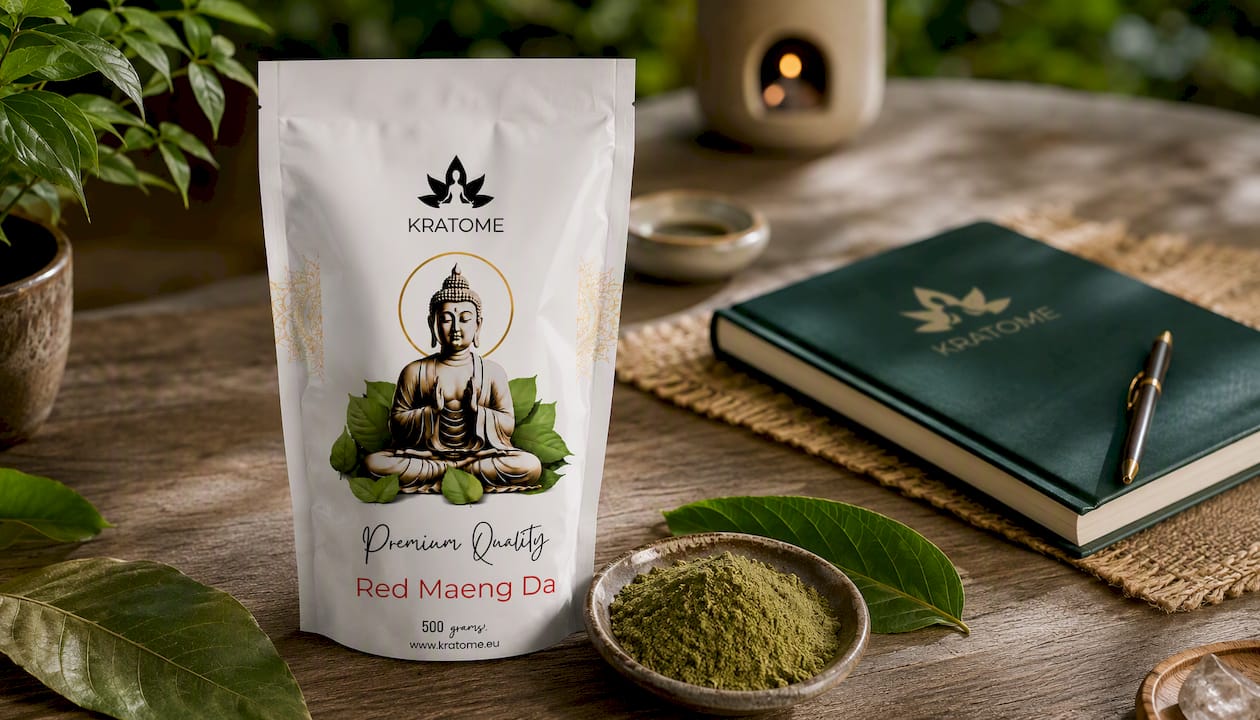
The catalog includes strain-specific products like Red Maeng Da, alongside manufacturing and formulation accessories intended for soap making and production contexts, including a digital precision scale built for accurate batch measurement and a red colorant for soap making for production-scale formulation work. Before you buy anywhere, pull up the batch’s Certificate of Analysis and run the cost-per-gram formula from this guide. If the numbers and the documentation both hold up, you’ve found a fair price. Start by browsing the current lab reports to see exactly what testing standard you’re paying for.
This article is general information, not a substitute for advice from a qualified doctor. Consult a qualified healthcare professional about your own circumstances before acting on anything here.
Sources
- NIDA — Research topics: Kratom
- NCBI PMC review on kratom
- DEA — Kratom informational PDF (2020)
- FDA — FDA and kratom
FAQ
How much does kratom cost per ounce?
Powder typically ranges from $7 to $18 per ounce depending on strain and testing standards, with lab-tested batches usually priced toward the upper end of that range.
What is the best way to compare kratom prices across vendors?
Calculate cost per gram by dividing the total price by the total grams in the package, including shipping in the total price for an accurate comparison.
What’s the biggest red flag when shopping for affordable kratom options?
A price far below the typical market range with no batch-matched Certificate of Analysis available on request is the clearest warning sign of an unverifiable or low-quality product.
Recommended
- Salmonella & Kratom: Why a Batch CoA Matters
- Kratom Information Guide
- Start Safely: 0.5–1 g Kratom Dose for Beginners, Check Lab Reports
Disclaimer: This blog is intended for educational and informational purposes only. The content provided is not intended to promote, recommend, or suggest human consumption of kratom or any other product. Our products are sold exclusively for their intended purposes as described on our website. This information should not be interpreted as medical advice, and we encourage readers to consult qualified professionals for any health-related questions.


