

Super Green Malay Kratom
22 September 2026

Super Green Malay refers to a green-vein Malaysian kratom variant selected from larger, more mature leaves and marketed by vendors as higher in potency than standard Green Malay. Before sourcing it for soap-making or accessory production, check two things first: an independent laboratory Certificate of Analysis (COA) and batch traceability back to a specific harvest lot. Kratomvia lists lab-tested green catalog items that meet both criteria. This guide covers product selection and quality evaluation only, not personal use.
TL;DR:
- “Super Green Malay” typically comes from larger, more mature leaves, but vendor claims of higher potency require verification through a lab-based Certificate of Analysis.
- The term “Super” is a marketing label indicating leaf size and maturity, not a standardized measure of alkaloid density or quality.
- Independent lab testing should include identity confirmation, alkaloid content, microbial safety, and heavy metal screening to ensure product quality and safety.
- Batch traceability, with clear batch numbers linked to specific, dated lab reports, is essential for verifying sourcing and testing results.
- Pricing for lab-tested Super Green Malay starts around €14.90 for small orders, with bulk costs decreasing based on volume and verification quality.
Table of Contents
- What Is Super Green Malay Kratom?
- Super Green Malay Vs Maeng Da: What Actually Differs?
- What Forms Does Super Green Malay Come In?
- How Do You Verify Lab Testing and Sourcing Transparency?
- Where Should You Buy Super Green Malay Material?
- What Do Dosage Guidelines Typically Cover?
- What Effects Do Vendors Associate With Super Green Malay?
- What Safety Considerations Apply to Raw Botanical Material?
- What Is the Legal Status of Kratom Products?
- What Does Super Green Malay Typically Cost?
- What Do Buyers Say About Their Experience?
- A Publisher’s Note on Sourcing and Testing Standards
- Ready to Source Lab-Tested Super Green Malay?
- Sources
- FAQ
What Is Super Green Malay Kratom?
Malay kratom traces its name to Malaysia, where green-vein leaf has long been a staple of the regional botanical trade. The “green-vein” classification refers to the leaf’s vein color at harvest, a marker that vendors use to separate their catalogs into green, red, white, and yellow product lines.
The word “Super” is not a scientific classification. It is a trade term vendors apply when a batch comes from larger, more mature leaves, sometimes called elephant-ear leaves because of their size. Vendors commonly claim this leaf selection correlates with a denser alkaloid profile than standard-grade Green Malay, though that claim rests on vendor description rather than a fixed industry standard.
Here’s where things get useful for a buyer rather than a casual browser. Scientific literature on Mitragyna speciosa identifies mitragynine as the plant’s dominant alkaloid and describes a genuinely complex secondary alkaloid profile that shifts with leaf maturity, growing region, and harvest timing, according to peer-reviewed pharmacological analysis. That complexity is exactly why “Super” as a marketing label and “Super” as a verified potency claim are two different things.
What the consensus actually looks like when you strip out the sales copy:
- Regional origin: Grown and harvested in Malaysia, distinct from Indonesian-grown strains sold under similar green-vein labels.
- Leaf selection: “Super” typically signals larger, later-harvest leaf material rather than a separate botanical variety.
- Vendor claims vary: Some sellers use “Super” loosely as an upsell term; others tie it to genuinely distinct harvest batches.
- Verification gap: Industry specialists generally agree that the label alone tells you nothing reliable. A COA tells you something concrete.
That last point is the one worth remembering. A bag labeled “Super” without a linked lab report is a marketing claim, not a quality claim.
Super Green Malay Vs Maeng Da: What Actually Differs?
Buyers frequently ask how Super Green Malay stacks up against Green Maeng Da, and the honest answer is that the two labels describe different things entirely. Malay is a regional designation tied to Malaysian growing regions. Maeng Da is a lineage or quality-grade designation, applied across multiple regions, that vendors use to signal a more selectively cultivated or grafted plant stock.
Trade descriptions commonly present Green Maeng Da as carrying a denser, more concentrated alkaloid profile due to selective breeding, while Malay strains, including the Super variant, are often described by vendors as having a longer-lasting character profile. Neither claim is independently standardized. Both rest on the same trade-description tradition that applies to the “Super” label itself.
For a buyer sourcing raw material rather than shopping for personal use, here’s what actually matters:
- Leaf selection philosophy: Maeng Da emphasizes cultivar selection; Super Malay emphasizes leaf maturity and size within a regional strain.
- Vendor consistency claims: Maeng Da lines are frequently marketed as more batch-consistent due to controlled cultivation; regional Malay lines vary more with harvest conditions.
- Formulation relevance: For soap-making and topical accessory work, the practical differences that matter are grind consistency, color, and moisture content, not the marketing distinction between lineage and region.
- Cost implications: Maeng Da grades often carry a price premium tied to the cultivation story, which matters if you are sourcing at bulk volume.
If you want a side-by-side breakdown of how green, white, and red strains diverge in vendor descriptions more broadly, Kratomvia’s strain guide covers that ground in more detail. The short version for procurement purposes: treat both “Super” and “Maeng Da” as trade vocabulary, and let the COA settle any potency question a label can’t answer on its own.
What Forms Does Super Green Malay Come In?
Vendors typically stock Super Green Malay in a handful of standard formats, and the format you choose should follow directly from what you’re building. Fine powder is the most common form, and grind consistency affects how evenly a botanical ingredient disperses through a soap base or accessory filler. Extract concentrates exist too, generally marketed for smaller-batch formulation work where a manufacturer wants a more concentrated ingredient without scaling up raw leaf volume.
Packaging follows a similar logic. Small retail packs, typically in the 1 to 4 ounce range, suit hobbyist soap-makers testing a new formulation. Bulk kilo packs suit manufacturers running production batches where consistent supply matters more than trying a new botanical for the first time.
Three practical steps before you commit to a format:
- Match grind size to your process. A coarser grind disperses differently in a cold-process soap base than a fine powder does, and testing a small batch first avoids wasting a bulk order.
- Check moisture content claims. Residual moisture affects shelf stability and can cause clumping in storage, particularly for buyers holding stock across seasons.
- Confirm packaging integrity. Moisture-barrier bags and plain, discreet shipping matter for both product preservation and buyer privacy, whether you’re ordering a trial pack or a bulk order.
Pro Tip: Order a small trial pack before committing to bulk kilo quantities, especially if you’re testing a new grind size in a soap base for the first time. Particle uniformity affects dispersion more than most first-time formulators expect.
Manufacturers working at scale should also ask about industrial packaging options, since a vendor that only offers small retail bags may not have the supply chain to support consistent production runs.
How Do You Verify Lab Testing and Sourcing Transparency?
A Certificate of Analysis is the single most useful document a vendor can hand you, and it should cover more ground than a simple potency number. A thorough COA typically includes identity testing to confirm the botanical is what the label claims, an alkaloid content readout, microbial screening for contaminants like salmonella or yeast, and heavy metal analysis for lead, arsenic, and cadmium.
For manufacturers working in non-consumptive applications, the microbial and heavy metal panels carry the most practical weight, since those results affect handling, storage, and workplace safety regardless of end use. Systematic reviews of commercial kratom products have flagged real variability across vendors in both alkaloid content and contamination risk, which is exactly why independent testing functions as the verification step that a vendor’s own marketing copy cannot replace.
One figure worth sitting with: batch-level COAs covering microbial screening and heavy metal analysis represent what researchers describe as the minimal quality floor manufacturers should demand from any botanical supplier, according to systematic review findings on commercial kratom variability. Alkaloid profiling adds useful verification of potency claims, but the contamination screens are the non-negotiable baseline.
Batch traceability is the second pillar, and it works alongside the COA rather than replacing it. A batch number printed on a product page, linked to a specific lab report for that exact lot, lets you confirm you’re getting the material that was actually tested rather than a general “representative sample” pulled from a different harvest. Vendors that publish harvest region alongside batch numbers add another layer of accountability, since regional sourcing details are harder to fabricate convincingly than a generic potency claim.
Here’s what a careful buyer checks before placing an order:
- Is there a COA linked directly from the product page, or does the vendor only reference testing in general marketing language?
- Does the batch number on the bag match a specific, dated lab report, rather than a rotating or reused document?
- Does the vendor name a harvest region or grower relationship, or is sourcing described only in vague terms like “premium Southeast Asian farms”?
- Are contaminant screens included, not just an alkaloid percentage?
- Is the COA from an independent third-party lab, rather than an in-house test the vendor conducted itself?
Red flags cluster around the opposite of all five points: no linked COA, ambiguous sourcing language, batch numbers that don’t correspond to a dated report, or alkaloid claims presented without any contaminant data alongside them. A vendor unwilling to publish that information, or one that makes you request it repeatedly before providing anything concrete, is telling you something about how seriously they take quality control.
Kratomvia publishes its lab report hub with results tied to specific batches, and the same transparency extends to individual product pages where COAs sit alongside the listing rather than in a separate, hard-to-find archive. That structure, batch number on the product, COA one click away, is the standard worth measuring other vendors against. For a closer look at why microbial screening specifically matters for raw botanical supply, the salmonella and batch testing breakdown walks through what contamination risk actually looks like in practice.
Where Should You Buy Super Green Malay Material?
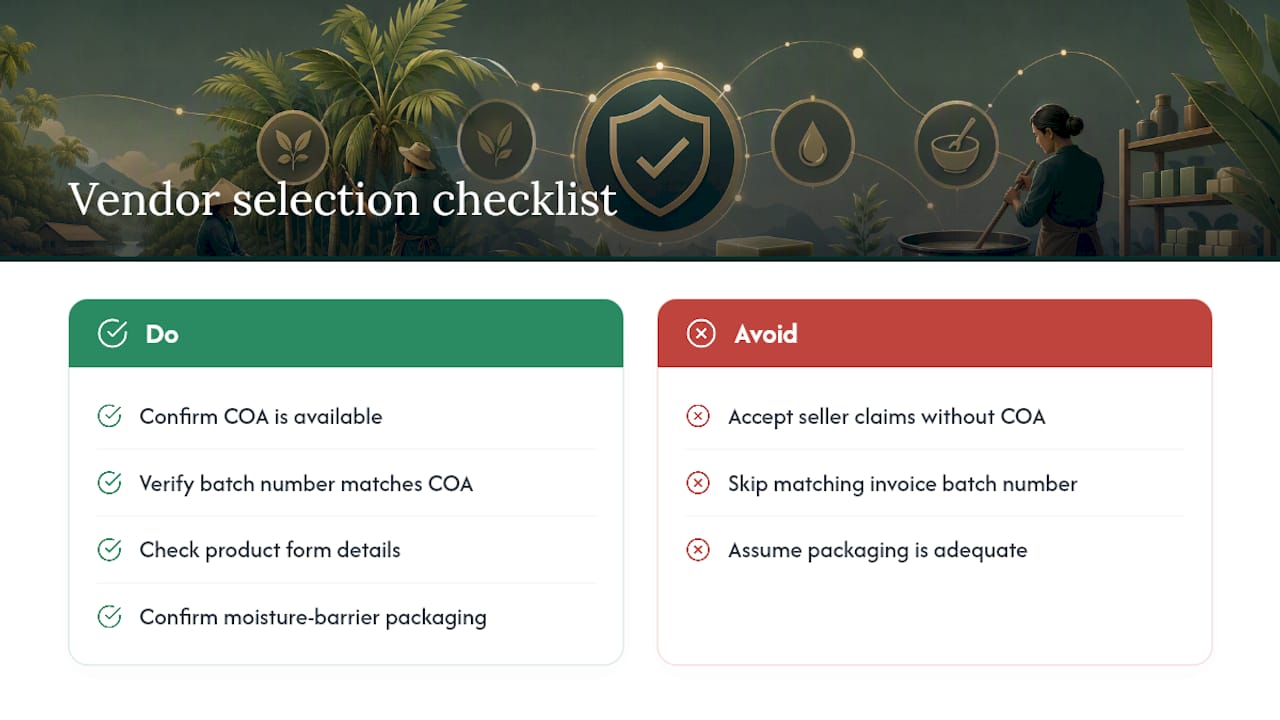
Vendor selection comes down to five checkable facts, and none of them require taking a seller’s word for it. Confirm COA availability first, since a vendor without published lab results is asking you to trust a claim rather than verify one. Confirm batch numbering next, and make sure the number on your specific order matches a dated report rather than a generic “current testing” page.
Product form descriptions should be unambiguous. A listing that says simply “kratom powder” without specifying grind size, moisture handling, or pack weight options leaves too much to guess at, especially for a manufacturer trying to standardize a formulation across repeat orders. Shipping and packaging details matter too: moisture-barrier packaging protects the product in transit and storage, and plain, discreet shipping matters to buyers who prefer privacy in their purchasing, a preference that applies as much to commercial buyers as individual ones.
Customer service responsiveness rounds out the checklist. A vendor that answers bulk-order questions, clarifies COA details on request, and provides straightforward return terms is signaling operational maturity that a slick product page alone can’t fake.
Kratomvia’s catalog is built around those same five points. Green-vein products sit in a dedicated green kratom collection with batch-linked COAs on individual product pages, and the sourcing model draws from a defined network of growers rather than anonymous bulk suppliers, which keeps traceability intact from harvest to shipment. Buyers who want to compare vein colors side by side before deciding what fits a formulation project can also review the red kratom, white kratom, and yellow kratom collections, since sourcing transparency standards apply across the full catalog, not just the green line.
Before placing an order, three steps protect you from a bad batch: request the COA directly if it isn’t already linked, confirm bulk availability and packaging options match your production volume, and verify the batch number on your invoice corresponds to the report you reviewed. Skipping that last step is the most common mistake bulk buyers make, since a vendor’s general marketing claims can outpace what any single batch actually tested at.
What Do Dosage Guidelines Typically Cover?
Dosage guidance in the kratom trade generally applies to personal wellness use rather than the soap-making and accessory applications this guide focuses on, and vendor-published dosing charts are not something Kratomvia positions as guidance for its own catalog. What’s more relevant to manufacturers is measurement precision for formulation consistency: weighing raw material accurately by weight rather than by volume prevents batch-to-batch drift in a soap recipe, since powder density can vary slightly between harvests even within the same strain.
Formulators working with botanical powders generally standardize by gram weight against a fixed base recipe, then adjust based on how the finished product performs, texture, color uptake, scent retention, rather than adjusting the botanical quantity itself for any personal effect. That distinction matters because it keeps the conversation focused on product engineering rather than personal consumption.
If your interest in dosage information stems from general curiosity about how the broader kratom trade discusses measurement, Kratomvia’s beginner dosage overview covers that ground with an emphasis on checking lab reports before anything else. For manufacturers, the practical takeaway is simpler: precise gram measurements protect formulation consistency, and a reliable COA protects the integrity of what you’re measuring in the first place.
What Effects Do Vendors Associate With Super Green Malay?
Vendor descriptions of Super Green Malay commonly emphasize a balanced character profile, often described in trade language as sitting between the more stimulating claims made about white-vein products and the more mellow claims associated with red-vein strains. Those descriptions come from vendor marketing and long-standing trade convention rather than standardized clinical measurement, and they should be read with that context in mind.
For manufacturers, the relevant “effect” isn’t a personal one at all. It’s how the raw material performs in formulation: color consistency in a soap batch, scent character when blended with essential oils, and how the powder behaves when incorporated into a cold-process versus melt-and-pour base. Green-vein material generally imparts a subtler earthy tone compared to some red-vein powders, which soap-makers often account for when balancing a fragrance profile.
The alkaloid complexity that scientific literature associates with Mitragyna speciosa is also the reason vendor potency claims for any green-vein product, Super Malay included, deserve COA verification rather than acceptance at face value. A batch’s actual alkaloid profile can vary with harvest timing and regional growing conditions, which is precisely the kind of variability an independent lab report is designed to catch.
What Safety Considerations Apply to Raw Botanical Material?
Handling raw botanical powder for manufacturing carries the same general considerations that apply to any plant-based raw material used in soap-making or accessory production. Contamination risk sits at the top of that list, which is why microbial screening on a COA matters as much as any potency figure. Systematic review literature has documented real variability in contamination levels across commercial kratom products, underscoring why independent lab verification matters before material enters a production workflow.
Storage conditions affect safety over time as much as the initial lab result does. Moisture exposure during storage can encourage microbial growth in botanical powders generally, which is why moisture-barrier packaging and dry, temperature-stable storage areas matter for any manufacturer holding stock across multiple production runs. Cross-contamination between raw botanical ingredients and other production materials is a standard workplace consideration too, handled the same way a soap-maker would handle any other unprocessed plant ingredient in a shared workspace.
Sourcing from a vendor with consistent batch-level testing reduces the guesswork involved in managing these considerations, since you’re working from documented results rather than assumptions about a given lot’s condition.
What Is the Legal Status of Kratom Products?
Kratom’s legal status varies significantly by country and, within some countries, by region or state, and no single answer applies universally. Some jurisdictions permit the sale of kratom as a botanical product without restriction, others regulate it under controlled substance or novel food frameworks, and a smaller number restrict or prohibit import and sale outright.
Buyers and manufacturers should verify current regulations in their specific country and region before ordering, since laws in this space have shifted in various jurisdictions over recent years and continue to evolve. Kratomvia ships across Europe and the UK, but regulatory frameworks differ even within that broader region, and confirming local rules before placing a bulk order remains the buyer’s responsibility rather than something a vendor’s shipping policy can substitute for. When in doubt, checking directly with a country’s relevant regulatory or customs authority is the reliable path, rather than relying on general trade discussion or vendor marketing claims about legality.
UK legal status: Kratom is not controlled under the UK Misuse of Drugs Act, and possessing it is not an offence. However, since 2016 kratom falls under the Psychoactive Substances Act, which makes it an offence to sell, supply or import it into the UK. Regulations and their enforcement can change over time, so it's advisable to stay updated on any potential amendments.
What Does Super Green Malay Typically Cost?
Pricing across the kratom trade varies by pack size, vendor sourcing model, and whether a product carries a “Super” or lineage-specific label like Maeng Da. Small retail packs generally carry a higher per-gram cost than bulk kilo purchases, which is standard across most botanical raw material markets, not unique to kratom specifically.
Vendors that invest in independent lab testing and batch traceability sometimes price slightly above suppliers that skip third-party verification, since testing carries a real cost that gets reflected somewhere in the product price. That price difference is worth treating as a quality signal rather than a drawback: a slightly higher cost tied to a published COA is generally a better value proposition than a cheaper product with no verification behind its potency or purity claims.
Kratomvia’s Green Maeng Da product line starts from €14.90 for a one-off order, giving buyers a concrete reference point for entry-level pricing on a lab-tested green-vein product. Bulk pricing for manufacturers typically scales down per unit at higher volumes, and confirming current bulk rates directly with a vendor before committing to a large order is standard procurement practice, since published retail pricing doesn’t always reflect wholesale terms.
What Do Buyers Say About Their Experience?
Buyer feedback across the kratom trade tends to cluster around a consistent set of priorities: whether the COA matched expectations, whether packaging arrived intact and discreet, and whether customer service responded clearly to questions about batch numbers or bulk order terms. Manufacturers sourcing for soap-making or accessory production specifically tend to focus their feedback on formulation performance, grind consistency, color behavior, and how well a powder incorporated into a finished product, rather than commenting on personal effects.
Recurring positive signals across vendor reviews generally point to transparent sourcing information, responsive support for bulk inquiries, and consistent batch-to-batch quality that lets a manufacturer standardize a recipe without repeated reformulation. Recurring complaints, when they appear, tend to center on vendors that were slow to provide COA documentation on request or whose batch numbers didn’t clearly correspond to the lab report on file, reinforcing why traceability checks matter before committing to a large order rather than after a shipment arrives.
A Publisher’s Note on Sourcing and Testing Standards
Some vendors source directly from a defined network of growers rather than anonymous bulk suppliers, and every batch that enters their catalog goes through independent laboratory testing before it’s listed for sale. That structure exists because batch traceability only means something if the number on a product page actually maps to a specific, verifiable lab report, not a general claim about testing somewhere upstream in the supply chain.
Experience in the industry shapes how some companies approach transparency, and customer testimonials reflect what that commitment means to manufacturers sourcing material for formulation work. Discreet shipping across Europe and the UK rounds out some models, giving buyers and commercial customers privacy without compromising on documentation. Readers ready to source lab-tested green-vein material can review current batch reports directly on the product pages before placing an order.
— Kratomvia
Ready to Source Lab-Tested Super Green Malay?
Kratomvia gives manufacturers a direct line to lab-tested green-vein material without the guesswork that comes from anonymous bulk suppliers hiding behind vague sourcing language. Every batch across the catalog, including Green Maeng Da, Red Maeng Da, and White Maeng Da, ships with an independent COA and a batch number you can check against the published lab report before you commit to an order.
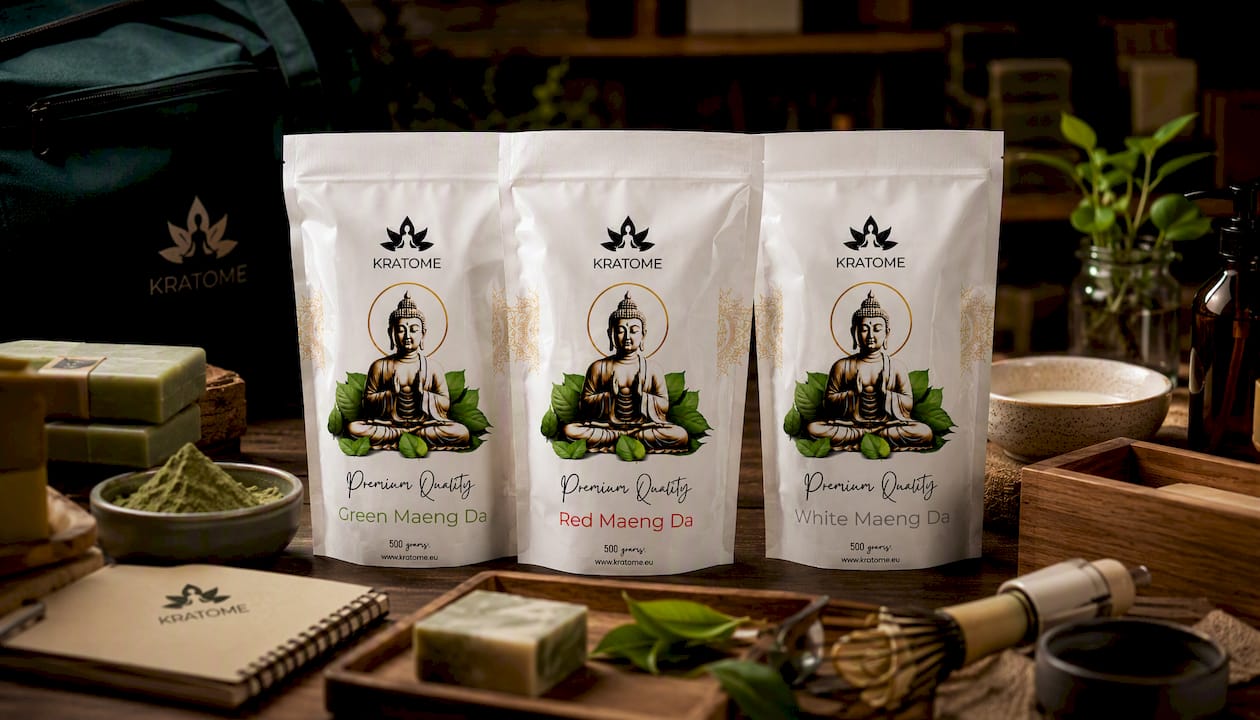
Green Maeng Da starts from €14.90 for a one-off order, and the same batch-linked transparency applies across the full green kratom collection for buyers comparing pack sizes before scaling up to bulk quantities. If you’re formulating at production volume, contact support directly to confirm bulk availability and packaging options, and always cross-check the batch number on your shipment against the COA on file before that material goes into a production run. Browse the current catalog and pull up the lab reports for any batch you’re considering, right from the product page, before you place your order.
Sources
- Mitragyna speciosa: pharmacology and analysis (NCBI PMC)
- Kratom (Mitragyna speciosa): a systematic review (NCBI PMC)
FAQ
What Does “Super” Mean in Super Green Malay Kratom?
“Super” is a trade term vendors use to describe batches selected from larger, more mature leaves, sometimes called elephant-ear leaves, rather than a distinct botanical species. It’s typically paired with a vendor claim of higher alkaloid density, which is worth verifying against an independent COA rather than accepting on the label alone.
How Does Super Green Malay Differ From Green Maeng Da?
Malay is a regional designation tied to Malaysian growing areas, while Maeng Da refers to a selected lineage or quality-grade applied across multiple growing regions. Vendors commonly describe Maeng Da as more alkaloid-dense due to selective cultivation, while Malay strains are often marketed around a longer-lasting character profile.
What Should a Certificate of Analysis Include?
A thorough COA covers identity testing, alkaloid content, microbial screening for contaminants, and heavy metal analysis for elements like lead and arsenic. Systematic reviews point to microbial and heavy metal screening as the minimal testing floor manufacturers should require from any botanical supplier.
Why Does Batch Traceability Matter for Manufacturers?
A batch number links your specific order to the exact lab report for that harvest lot, rather than a general testing claim covering the vendor’s broader inventory. Without that link, there’s no way to confirm the material you received matches the results a vendor advertises on their site.
How Much Does Lab-Tested Super Green Malay Cost?
Pricing varies by vendor, pack size, and whether independent testing is included, and Kratomvia’s Green Maeng Da starts from €14.90 for a one-off order as a reference point for entry-level, lab-tested green-vein pricing. Bulk rates for manufacturers typically scale down per unit and are available on request through current product pages.
Recommended
- Green Soap Colorant for Kratom Soap Making
- Transparent Glycerin Soap Base for Kratom Soap Making
- Orange Essential Oil for Kratom Soap Making EU & UK
- Glycerin Soap Base for Kratom Soap Making | SLS Free
Disclaimer: This blog is intended for educational and informational purposes only. The content provided is not intended to promote, recommend, or suggest human consumption of kratom or any other product. Our products are sold exclusively for their intended purposes as described on our website. This information should not be interpreted as medical advice, and we encourage readers to consult qualified professionals for any health-related questions.


