

Yellow Kratom Effects
10 September 2026

Yellow kratom is a post-harvest processing category, not a naturally yellow-veined leaf. Producers reach that color through extended drying, fermentation, or blending different leaf batches, and the exact method shifts from farm to farm. Mitragynine content and other measurable markers can vary as a result, which is why a batch-specific certificate of analysis matters more here than with red, green, or white labels. Kratomvia treats that lab documentation as a baseline for every product it lists, yellow included.
TL;DR:
- Yellow kratom is a processed outcome rather than a natural vein category, created through extended drying, fermentation, or blending, with no industry standardization.
- The alkaloid profile, especially mitragynine and 7-hydroxymitragynine levels, can change due to processing, but these shifts do not predict safety or efficacy.
- Variability in yellow kratom batch quality is high because it depends on unstandardized processes and sourcing methods, making lab testing crucial.
- Buyers should prioritize batch-specific certificates of analysis, origin disclosure, and detailed processing descriptions over label color alone.
- Community feedback suggests yellow products often vary more in quality and effects, with transparency from sellers being the key indicator of reliability.
Table of Contents
- What Does “Yellow Kratom” Actually Mean?
- How Producers Actually Create Yellow Kratom
- The Chemistry Behind the Yellow Label
- Yellow Versus Red, Green, and White: A Relative Comparison
- A Quality Checklist for Yellow Kratom Listings
- How Kratomvia Approaches Sourcing and Testing
- Reading Product Specs and Batch Documentation Correctly
- Legal Status and Regulatory Considerations
- What the Research Actually Says About Risk and Variability
- What Buyers and Enthusiasts Report About Yellow Batches
- The Bottom Line on Buying Yellow Kratom
- Shop Yellow Kratom Batches With Full Lab Documentation
- Sources
What Does “Yellow Kratom” Actually Mean?
Every kratom leaf, regardless of what a label says, comes from the same tree: Mitragyna speciosa. The tree itself only produces three vein colors as it grows, visible in the stem running through each leaf.
- White vein — harvested earlier in the leaf’s maturity cycle
- Green vein — harvested at a middle stage
- Red vein — harvested from fully mature leaves
Yellow does not appear on that list because it is not a stage of growth. It is a description of what happens to the leaf after harvest. Some vendors call it “yellow,” others call an almost identical process “gold,” and there is no industry-wide standard dictating which term applies to which method. That naming inconsistency is one of the more confusing parts of shopping for kratom online, and readers who want a fuller primer on how vein categories work in the first place can review how red, white, and green strains differ before comparing yellow against them.
The starting leaf still matters, even once processing takes over. A yellow product made from a white-vein base will carry different underlying characteristics than one made from a red-vein base, simply because the raw material going into the drying or fermentation process was already distinct. Two products can both say “yellow” on the label and still come from noticeably different starting points.
How Producers Actually Create Yellow Kratom
Three production routes dominate the market, and vendor and community guides consistently point to the same trio.
- Extended or staged drying. Leaves move through multiple drying environments, often starting in shade and finishing under direct sunlight (or the reverse), rather than following one continuous drying cycle.
- Fermentation or curing. Leaves are held in controlled humidity and temperature for a defined period before final drying, a slower process than straight sun-drying.
- Blending. Some producers skip specialized drying entirely and mix finished white-vein and red-vein (or white and green) powders to approximate a yellow appearance and profile.
None of these three methods is standardized across the industry. A farm in one region may define “extended drying” as a two-day process, while another stretches it over a week, and blending ratios vary just as widely between operations.
Pro Tip: When a product listing doesn’t specify which of these three methods was used, treat “yellow” as a marketing description rather than a technical one, and lean on the certificate of analysis instead of the label copy.
The Chemistry Behind the Yellow Label
Kratom leaves contain a range of naturally occurring alkaloids, and two get the most attention in scientific literature: mitragynine and 7-hydroxymitragynine. Processing does not create these compounds from nothing, but it can shift their relative concentrations in a finished batch. Learn more about how mitragynine and 7-hydroxymitragynine function within the plant’s broader alkaloid profile.
Extended drying and fermentation both introduce oxidation. Peer-reviewed work on kratom pharmacology notes that processing steps like drying and fermentation can alter alkaloid ratios, including the balance between mitragynine and its oxidized counterpart, 7-hydroxymitragynine.
That is the chemical logic vendors point to when explaining why a yellow batch reads differently on a lab panel than a red or white batch from the same farm. It is worth being direct about the limits of that evidence, though. The FDA has not approved kratom for any medical use and specifically flags the shortage of rigorous safety and efficacy data. For shoppers, the practical takeaway is narrower than it might sound: chemistry explains why a COA’s alkaloid panel might look different across colors. It does not tell you anything about outcomes, and no responsible seller should imply that it does.
Yellow Versus Red, Green, and White: A Relative Comparison
Because yellow is a processing outcome layered on top of an existing vein type, it sits in an odd spot compared to the three primary categories — a complexity explored in detail in the THCA Flower Blog & Strain Reviews | Luxurious Habbits, which compares botanical product categories and processing methods. Community discussion threads, including a long-running Reddit conversation on the topic, consistently describe it as landing somewhere between white and red in general character, though descriptions vary widely from one poster to the next.
- Processing method: White, green, and red rely on harvest timing alone. Yellow adds a secondary step (extended drying, fermentation, or blending) on top of one of those base leaves.
- Typical character: White is generally described as brighter and more energetic in tone, red as more mellow, green as a middle point. Yellow is frequently described as a blended middle ground, though this depends entirely on which base leaf and method were used.
- Relative duration: Fermentation and extended drying are marketed as producing a smoother, longer curve in vendor descriptions, but this is a qualitative claim, not a measured one.
- Consistency: Primary vein types show batch-to-batch variation too, but yellow shows more, precisely because there is no fixed recipe for how it is made.
That last point is the one worth remembering above the others. Variability is the defining feature of yellow, not a side note.
A Quality Checklist for Yellow Kratom Listings
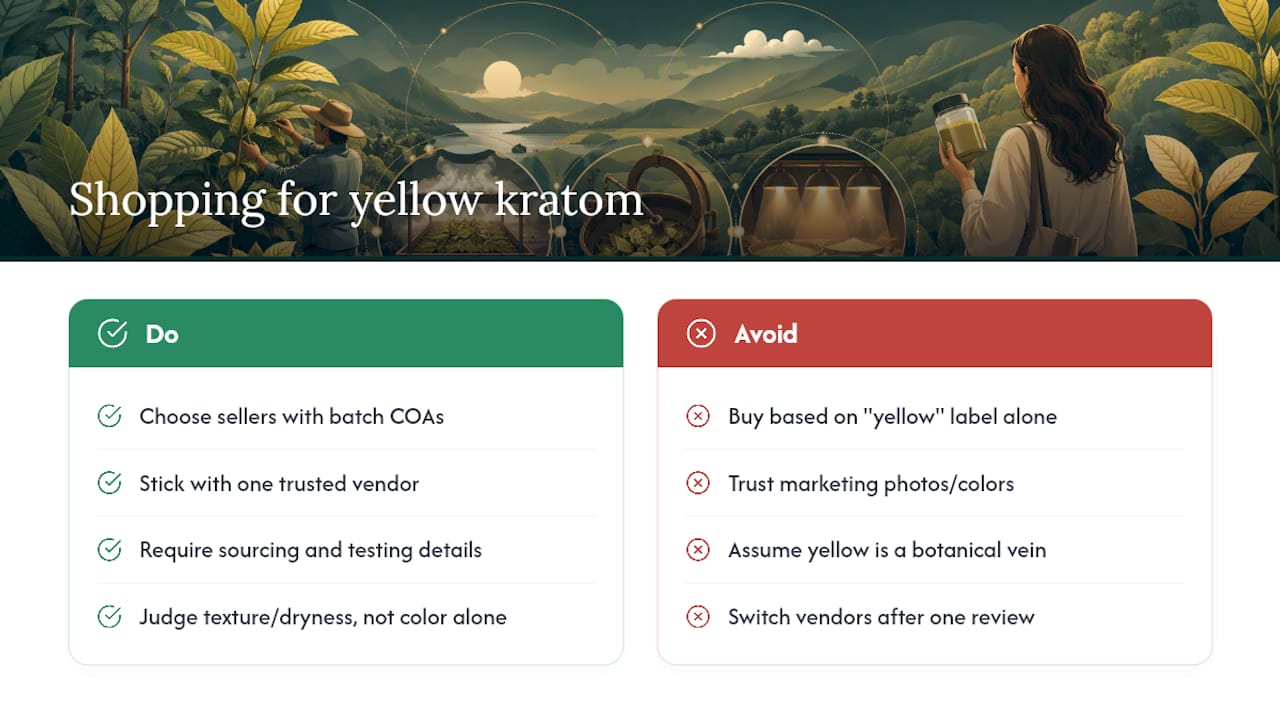
Because “yellow” carries no fixed definition, the label alone tells you almost nothing reliable. The certificate of analysis and the seller’s disclosure habits tell you everything else.
- Confirm the COA is batch-specific. A generic PDF that never changes across restocks is a warning sign; a legitimate COA references a lot of number tied to the exact product you’re viewing.
- Check what the panel actually screens for. Look for an alkaloid profile where available, plus heavy metal and contaminant screening. Independent testing that covers all three is the standard worth expecting from any serious vendor.
- Look for harvest and origin disclosure. A trustworthy listing states the harvest date, the base leaf vein, and the growing region rather than just the finished color.
- Read the processing description, not just the color name. A seller who explains whether a batch was fermented, extended-dried, or blended is giving you something you can actually verify against the COA.
One detail deserves particular weight: because yellow depends entirely on post-harvest technique rather than a fixed leaf variety, batch-to-batch testing matters more for yellow-labeled products than for red, green, or white. Skipping that check on a yellow purchase carries more uncertainty than skipping it on a primary vein type.
Buyers in certain jurisdictions should also note that some regions apply general botanical product labeling rules, including advisory language required under frameworks like California’s Proposition 65, so it’s worth checking what disclosure standards apply where you live before buying any plant-based product.
How Kratomvia Approaches Sourcing and Testing
The company sources botanical material directly from growers in Southeast Asia and puts every batch through independent laboratory testing before it reaches a product page. That testing pairs with clear batch disclosure, so a shopper comparing a yellow listing against the checklist above has something concrete to check it against, not just a color name.
Shipping goes out discreetly across Europe and the UK, which matters for buyers who value privacy regardless of what they’re sourcing the material for. The combination of direct sourcing, batch-level lab reports, and transparent disclosure supports product consistency and accurate labeling. You can review Kratomvia’s general sourcing and testing practices on its kratom information guide.
UK legal status: Kratom is not controlled under the UK Misuse of Drugs Act, and possessing it is not an offence. However, since 2016 kratom falls under the Psychoactive Substances Act, which makes it an offence to sell, supply or import it into the UK. Regulations and their enforcement can change over time, so it's advisable to stay updated on any potential amendments.
Reading Product Specs and Batch Documentation Correctly
The products are formulated and sold strictly for soap-making and botanical accessory purposes, and understanding a product spec sheet means knowing what to look for rather than how much to use. A batch report will typically list a lot number, harvest and processing notes, and the results of contaminant and heavy metal screening. That lot number is the single most important detail on the page, since it ties the physical product in hand to the specific COA the vendor published.
Weight and concentration figures on a botanical or colorant product listing describe the material itself, not a usage protocol. A soap-making colorant, for instance, will specify concentration relative to the total batch volume of soap base, which is a manufacturing spec, not a personal-use guideline. When a listing is unclear about which basis a figure uses, that ambiguity is itself worth treating as a flag, since a reliable seller states its measurement basis plainly.
Safety precautions in this context center on handling and storage rather than any other kind of guidance: keeping botanical material away from children, storing it in a cool, dry place, and following any jurisdiction-specific labeling advisories, such as those under frameworks like Proposition 65, that apply to botanical or colorant products in your region.
Legal Status and Regulatory Considerations
Kratom’s legal status varies by country and, within some countries, by state or region, and that variability applies to yellow-labeled products exactly as it does to red, green, or white. There is no single global rule, which means a product legal to purchase and ship in one market may face restrictions in another.
Because the FDA has not approved kratom for any medical use, federal guidance in the United States centers on that lack of approval rather than a blanket prohibition, and individual states have taken different regulatory paths from there. European and UK regulations similarly differ by country, and botanical or colorant products may fall under separate labeling frameworks than food or supplement products do. Buyers should check their own jurisdiction’s current rules before ordering, since regulatory positions shift and a rule accurate at the time of writing may not remain accurate indefinitely.
For sellers and buyers focused on non-ingestive applications like soap manufacturing or botanical display use, general product safety and labeling regulations, rather than substance-specific consumption laws, tend to be the more relevant framework. Reviewing a jurisdiction’s general botanical product or cosmetic ingredient labeling requirements is a more useful starting point than searching for kratom-specific statutes, which are still unevenly written from one region to the next.
What the Research Actually Says About Risk and Variability
Most of what’s publicly known about kratom’s broader risk profile comes from surveys, limited clinical research, and product-variability reports rather than large-scale controlled trials. Examine notes that the research base remains thin and that user-reported experiences vary considerably, a pattern consistent with what this article has already covered about processing inconsistency.
That variability is precisely why sourcing discipline matters more than any single processing method. A yellow-labeled batch from an inconsistent supplier carries more unknowns than a red or white batch from the same supplier, simply because yellow’s defining traits depend on a process nobody has standardized. Contaminant risk, meanwhile, is not unique to any vein color. It’s a function of growing conditions, harvest handling, and storage, which is exactly why independent lab screening for heavy metals and contaminants matters regardless of what color a bag is labeled. Readers interested in what a rigorous testing regimen actually screens for can review what independent lab testing typically covers across kratom product categories generally.
The practical response to that thin evidence base isn’t avoidance. It’s documentation. A COA that specifies contaminant and heavy metal results, tied to a batch number you can match to the product in hand, is the closest thing to a risk-reduction tool that currently exists for botanical kratom products.
What Buyers and Enthusiasts Report About Yellow Batches
Online kratom communities have discussed yellow-labeled products for years, and the tone of that discussion is notably more skeptical than it is enthusiastic. Forum threads, including the Reddit discussion referenced earlier in this guide, tend to focus less on describing a distinct “yellow effect” and more on questioning whether a given vendor’s yellow product was fermented, blended, or simply dyed differently in marketing photos.
That skepticism is a useful signal for anyone shopping today. Enthusiasts who’ve compared yellow listings across multiple vendors consistently report that the biggest variable isn’t the color category itself. It’s whether the seller discloses enough about sourcing and testing to make the label meaningful in the first place. Some community members describe yellow products they’ve encountered as visually and texturally distinct from red or white powders, a difference attributable to the drying or fermentation step rather than to any inherent property of a “yellow vein,” since no such vein exists on the plant.
The overarching theme across community discussion, vendor documentation, and the available pharmacological literature points in the same direction: yellow’s identity is manufactured, not grown, and every claim about its character should be read as a description of one producer’s process rather than a universal trait. Buyers who’ve had the most consistent experience across purchases tend to be the ones who stuck with sellers offering batch-specific lab documentation rather than switching between vendors based on marketing copy alone. That pattern, more than any specific product review, is the clearest practical lesson available to someone comparing yellow listings today.
The Bottom Line on Buying Yellow Kratom
The conventional framing of yellow kratom, treating it as a fourth vein type sitting alongside red, green, and white, gets the category wrong from the start, and that mistake shapes a lot of bad purchasing decisions. Once you accept that yellow describes a process rather than a plant characteristic, the entire evaluation shifts. You stop asking “what does yellow do” and start asking “what did this specific producer do to this specific batch.”
That’s the gap most buying guides miss. They treat color consistency as a proxy for quality consistency, when the two have nothing to do with each other. A yellow product’s reliability depends entirely on whether the seller can show you a batch-specific COA, disclose the base leaf vein, and describe the actual processing method used, not on how convincingly yellow the powder looks in a product photo.
If there’s one priority worth putting ahead of everything else, it’s this: stop evaluating yellow kratom by label and start evaluating it by documentation. Vendor transparency, not marketing terminology, is what separates a well-made batch from a mislabeled one.
— Kratome
Shop Yellow Kratom Batches With Full Lab Documentation
Kratomvia’s advantage over browsing unverified marketplace listings is straightforward: every batch ships with independent lab testing behind it, so you’re never guessing whether a “yellow” label reflects an actual process or just a marketing choice.
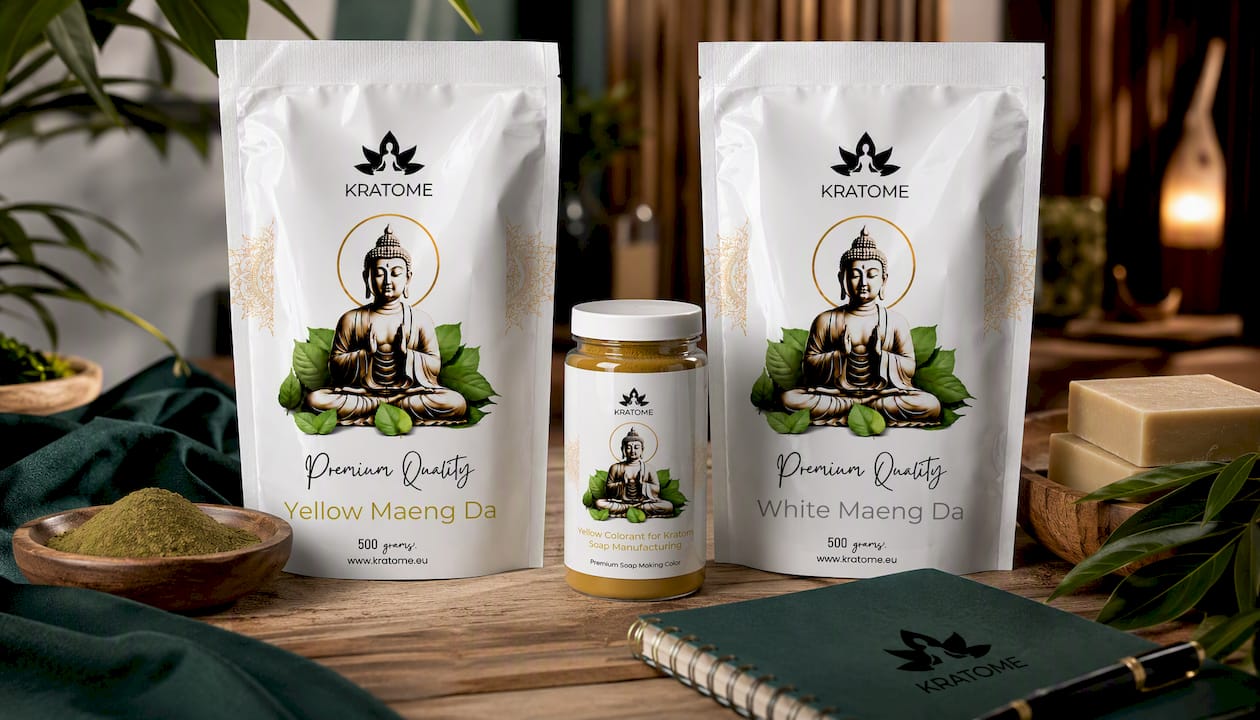
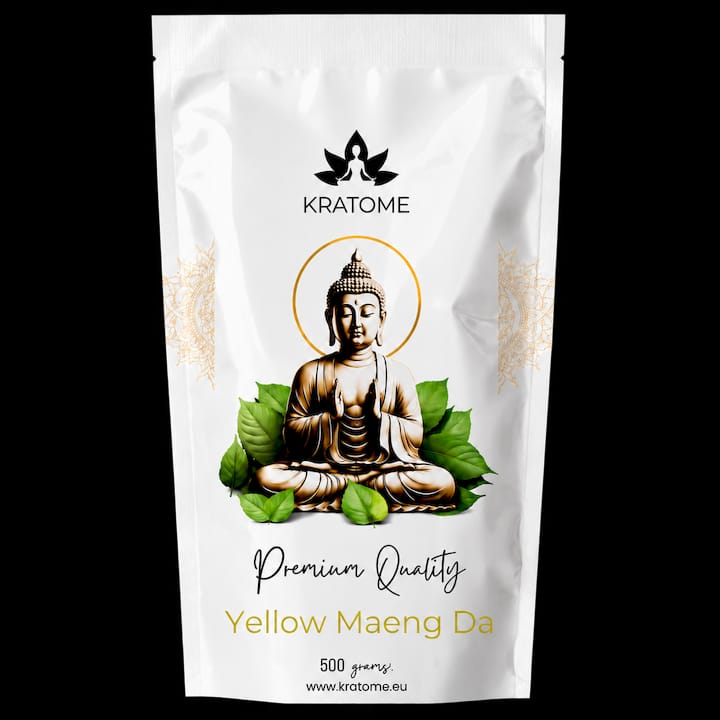
The Yellow Maeng Da listing discloses its base leaf, batch number, and COA availability, giving buyers a concrete document to check rather than a color claim to take on faith. For readers working specifically in soap production, the yellow liquid colorant for kratom soap making is formulated and sold exclusively for that non-ingestive manufacturing application, with its own batch documentation attached. And for anyone comparing base leaf types before choosing a finished product, the White Maeng Da page shows how Kratomvia discloses starting vein material across its catalog.
Browse the full yellow kratom collection to compare batch reports side by side, or check current listings and shipping details before placing an order.
This article is general information, not a substitute for advice from a qualified doctor. Consult a qualified healthcare professional about your own circumstances before acting on anything here.
Sources
- FDA and kratom
- Frontiers in Pharmacology review on kratom pharmacology (2022)
- Examine
- Yellow kratom explained: strains, types & how it differs
Recommended
- Kratom Lab Reports Europe | Lab-Tested Kratom
- Salmonella & Kratom: Why a Batch CoA Matters
- Buy Yellow Kratom Online in the EU & UK
- How to Choose Quality Kratom
Disclaimer: This blog is intended for educational and informational purposes only. The content provided is not intended to promote, recommend, or suggest human consumption of kratom or any other product. Our products are sold exclusively for their intended purposes as described on our website. This information should not be interpreted as medical advice, and we encourage readers to consult qualified professionals for any health-related questions.
Disclaimer: This article is for educational and informational purposes only. Kratom is sold by Kratomvia as a botanical specimen for study and collection purposes, and is not intended, approved, or authorised for human consumption in the European Union. Our kratom is sold as a soap accessory and collectible item.


